1. Motivation: A (Midlife) Crisis is a Terrible Thing to Waste
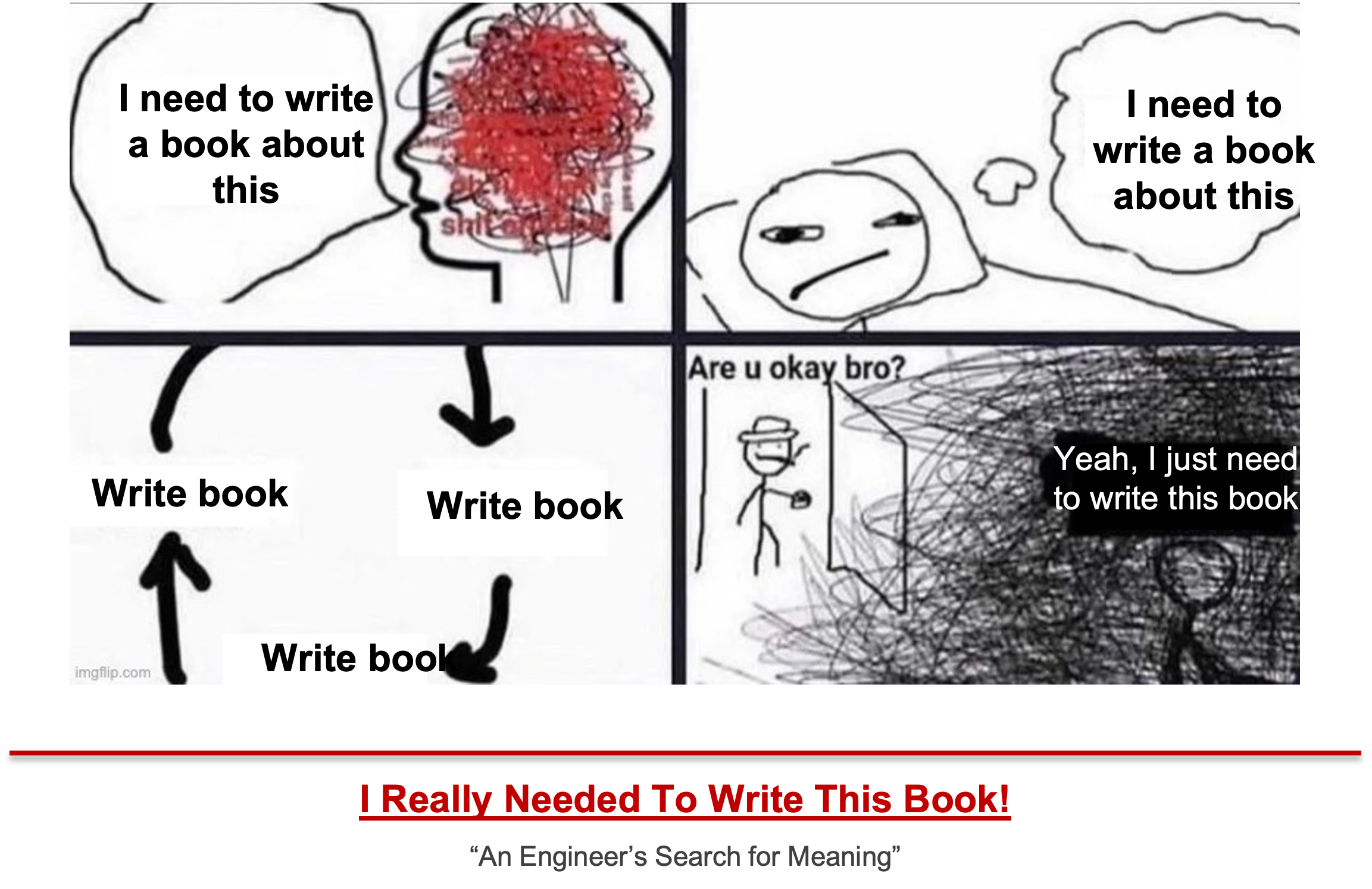
I just had to write this book!
“Here comes 40. I’m feeling my age and I’ve ordered the Ferrari. I’m going to get the whole mid-life crisis package.”
― Keanu Reeves, Canadian actor
“Look, if you had one shot or one opportunity
To seize everything you ever wanted in one moment
Would you capture it or just let it slip?”
― Eminem, American rapper, in “Lose Yourself”
What Would I Do if I Had Only 5 Years to Live?
A few years ago, I asked myself the above question.
No, I wasn’t suffering from some terminal disease. Luckily what I had was something far more mundane and commonplace: a midlife crisis.
Lots of people go through it, of course. It’s almost a rite of passage.
Some people might suffer for a while, but most manage to make a complete recovery and move on as if nothing happened.
Except, in my case, things happened. Big things. Evidently so big that I ended up writing a book about deep things like meaning, purpose and hope in life, no less!
The kind of book that philosophers, poets and those who have actually gone through serious suffering in life are supposed to write—not some guy who sits in a chair and writes code all day!
How does something like this happen?
Well, I’m going to tell you about it. That’s what this chapter is all about.
But let me start with some general observations about this supposedly innocuous little condition known as “midlife crisis”.
It is commonly believed that you have one big bad crisis sometime in your 40s, which makes you question everything you have done until then and whether that’s all there is to life.
And then, depending on your circumstances, you either get a new car or a new career or a new carefree attitude towards life. Or maybe just a car-free lifestyle in an unfamiliar country. Some people go totally crazy and buy a whole vineyard or something. And others just get seriously drunk.
These activities typically result in your big bad crisis getting replaced by a smaller one.
Depending on which remedy you followed, you either end up with buyer’s remorse or a new boss that’s no better than your old boss or a “the grass looked greener there” type of disappointment. Or maybe just high Uber bills. Or bad wine. Or just a plain old hangover.
Luckily, most of us are far more familiar with handling these types of minor crises, having experienced them multiple times in our lives by then. In a short period of time, everything comes back under control.
Crisis solved, and life gets back to normal.
Unfortunately (or fortunately) for me, things didn’t quite work out like that.
In my case, instead of one big bad crisis, I had more like a series of bouts over a few years.
This had the unexpected benefit that none of them were too severe and I was able to apply my learning from previous bouts to the subsequent ones. What doesn’t kill you makes you stronger, right?
For example, I had already learned in previous bouts that buying a speedier car doesn’t quite work because cops take special delight in giving speeding tickets to recovering midlife crisis sufferers.
I have always been a math / science nerd who also liked to tinker with real stuff, so I had never really had any doubts about my career as an engineer. Moreover, spending a few nights in karaoke bars had already taught me the hard way that becoming an entertainer was just not in the cards for me. And I had spent enough time driving through wine country to know that owning a vineyard was back (and bank) breaking work. Winemaking didn’t look like it would be my cup of tea.
I had also flipped through enough self-help books in bookstores (remember those?) to learn that the rational way of dealing with things like midlife crises was to clarify one’s priorities in life by asking the hard question: “What would I do if I had only 6 months to live?” Whatever bubbled to the top of that list would be the thing(s) to focus on for your second innings.
6 Months to Live?
Once you get over the dread and anxiety of having to ponder your own mortality, you quickly realize that six months is such a short time that the answer to the existential question usually turns out to be rather easy and, frankly, even banal.
For most people, their 6-month bucket list would consist of things like getting their affairs (I mean financial of course!) in order, spending quality time with family and friends, smelling some roses, drinking some champagne, and generally taking things as they come, without too much complaint.
I had already tried all of those answers out.
Unfortunately, this had had the undesirable effect that my financial planner had raised his fees, my family and friends had started getting annoyed at me for calling them at odd times, my neighbors (whose roses I was smelling) had started looking at me funny and my doctor had told me to cut down on the champagne.
(Ok, I know this book is supposed to be all about facts and logic, but please allow me a little creative liberty to fail at being humorous in the first chapter, just so I can scratch that itch and get over it. I promise, after this chapter is over, it is all going to be facts and logic until you start screaming for more drama!)
Clearly, the “6 months to live” question wasn’t working for me, though it made so much sense at first.
Still, I felt like there was definitely some truth to it. It did force me to seriously think about my life and prioritize things, but maybe it needed some changes before it became truly interesting and useful.
That’s when it occurred to me - I needed to extend the time frame! Instead of 6 months, I needed to ask: “What would I do if I had 5 years to live?”
Now that’s a far more interesting and useful question.
The longer timeframe makes the question a lot harder to answer because it means you’d have enough time to get something substantial done. A lot can be accomplished in 5 years.
Plus, the timeframe is also far more realistic: unless someone is already suffering from something serious, they can probably count on having at least 5 more years to live, right?
The “5 years to live” question forces you to dig deep and see what it is that you really want to do in life or would regret not doing. With 5 years at your disposal, maybe you can still do it!
Is Panicking a Good Way to Start?
In my case, the answer came to me one day in the shower. Just popped right out of thin (well, more like thick and humid, to be frank, given I was in the shower) air, stood there in front of me and almost made me panic.
The scenario that materialized in my mind was so scary, I had to gasp for breath!
Let me put it this way.
Imagine you binge on a great TV show all weekend. Hour after hour, episode after episode.
Then, when you see your coworkers on Monday, you start raving about it.
You tell them about all the wonderful characters and events and scenes in the show, but you soon realize that they have no clue what you’re talking about.
Then one of them interrupts you and asks “Hey, back up! We have never heard of this show. What is it about? What genre, what theme?”
And imagine that you are unable to come up with anything. You suddenly realize that you remember a ton of details, but are struggling to articulate anything like a central theme for the show. You’re as confused as your coworkers.
You tell them, “Sorry guys, I was so wrapped up in the details that I didn’t think about the underlying story or theme.”
If that happened to you, you would feel like an idiot. You’d feel like maybe you wasted the whole weekend, right?
Well, now imagine if this show was your whole life. It was the epic long-running drama of your life, with hundreds of episodes, dozens of characters, many twists and turns. Many of them highly memorable and poignant. Some even life-changing. And you were the main character.
And yet, you were so busy simply going through it all that you never took the time to wonder if there was a theme or coherent narrative underneath it all. If someone asked you what it was all about, you’d be at a loss to say anything.
That wouldn’t just make you feel awkward, it would be downright scary. It’s almost like a zombie who is going through the motions, but has no clue what’s really going on.
And, if you’re like me, you’d want to go further. You don’t just want to tell a coherent story, but you want to tell the story behind the story. Not just the scenes, the events and the characters, but describe how those scenes might have come about, why those events might have occurred, why those characters might have behaved the way they did, and so on. Not just the “what” of your life story, but the “how” and even the “why”.
Now, I agree that many people may say that they don’t care about such things. They would rather focus on the people, the feelings, the poetry and drama of their life. Why bother going deeper?
But even such people, when pressed, will say that living a meaningful life is important to them.
In fact, finding meaning in one’s life is and has always been important for the vast majority of people throughout history. That is exactly why we have come up with religions and philosophies and even poetry and drama.
And now, given the great strides we have made in science and engineering which have transformed everything else in our lives, I felt that we should be able to look at life through that lens as well. It should now be possible to be not just a great storyteller, but also a historian, an anthropologist, a biologist and maybe even a physicist of one’s own life, describing it all the way from the surface events down to the bedrock underneath.
And again, if you’re like me, you’d want to do that not just for your own life, but for “big L” Life, the Universe and Everything, since that’s what provides the rich context within which the stories of our own lives unfold.
At a minimum, this looked like a very worthwhile exercise, at least to a science and engineering nerd like me.
In short, being able to tell the story of my life, as well as Life in general, thoroughly and from first principles, became an obsession for me.
This sort of thing becomes even more urgent when you realize that this may be your only chance! YOLO, right?
I had been given this one shot, one opportunity, to seize everything I ever wanted. How was I ever going to let it slip?
(Those are Eminem’s words by the way, not mine.)
Meaning and Purpose
I felt I was really privileged to have been given this opportunity. To me, it almost looked like it was my duty to seize it. It had to be done.
So, it was time for me to get to work.
How do I make sense of my life all the way from the ground up? What are the underlying principles, forces and rules behind Life, the Universe and Everything? How do they ultimately lead up to my own life? Does my life have a purpose? Does what I do in my life matter in the larger scheme of things? What is this larger scheme, if there is one? And where is it all going?
In other words, what does this all mean and why does it mean that?
Of course, questions of this sort have been asked millions of times by millions of humans over millennia. And over the same period of time, many people have come up with some pretty interesting answers. Some of them have even withstood the test of time and gone on to become extremely popular, even to the point of turning into religions and philosophies.
(Interestingly, over time, the meanings of the words “meaning” and “purpose” themselves have changed. The words have taken on more theological or philosophical or even poetic connotations. And sometimes that is used as justification for why the methods of reason cannot be used to reach them! But rest assured that there is a way to define these concepts scientifically as we shall soon see. And doing so not only makes them amenable to scientific analysis, but also more practical and, dare I say, more meaningful.)
It would certainly have been easier for me to just go with some highly popular ideas from ancient books, or sing moving verses from some great poems, or throw out some popular memes floating around in the zeitgeist that sounded cool. But I didn’t want to do that.
Most of the religious or philosophical or poetic ideas rely on some pretty big assumptions. And very often there isn’t any sort of a rigorous process to get to their conclusions. As a consequence, there is often a lot of inconsistency in them. Not only that, but many of those ideas have been proven incorrect over time.
As a scientist and engineer, I prefer to approach problems systematically. My training and daily practice have made me a highly analytical truth-seeker. As a result, I needed something far more solid.
I wanted to find honest, defensible answers to these questions, based on well-established evidence and rigorous, stepwise analysis, all the way from the ground up. No shortcuts, leaps of faith, hand waving, or dogma.
And if such a thing wasn’t possible, I wanted to know the reasons for that. Was it because we just hadn’t tried? Or was there a more fundamental problem? Are there limitations to what we can know about reality? If so, I wanted to understand them, and understand where the boundaries lay and why they lay there.
I saw no point in just feeling warm and fuzzy by telling myself some made-up stories or glossing over the details. They might help in the short run, but they keep nagging at the bottom of my being.
I wanted to learn the most reasonable, well-grounded answers available today, and if they were incomplete, then why that was the case. In my book, it’s ok to not know things as long as we are honest about that and either have ways to move forward or know why that wasn’t possible. Anything less seems like selling ourselves short, not to mention that if there really is a way, it’s sure to be discovered in the future. Burying your head in the sand is a terrible long term strategy.
And let’s be honest. What I was asking for was a tall order, for sure. Scary even. But once it popped into my head, it wouldn’t let go.
Answers, Entropy and Growth
It took quite a while to find and compile answers to these questions that could meet my, admittedly stringent, criteria.
What surprised me was that much of what I sought already existed. Some concepts were widely known, while others were obscure or emerging. Many of the ideas turned out to have been developed only in the last couple of decades. I needed to add only a few missing pieces and apply what I call the “engineering sensibility” to organize everything systematically, making it all fit together into a comprehensive and coherent framework.
As I got deeper into it, I kept discovering even deeper insights. Things that previously looked fuzzy started to become clearer. New avenues kept opening up, which led to further clarity as well as further richness of understanding. I even discovered that I knew things I didn’t know I knew!
Towards the end of this exercise, I found myself becoming more and more peaceful. Like a storm inside my head had started subsiding, the sun had started to peek out of the clouds, and the birds had started chirping again.
Not only that, but there was an unexpected bonus.
This exercise didn’t just give me answers to my questions, but pointed towards a better, more authentic, well-grounded way of life. Some of the religious or philosophical or popular ideas that I had previously taken for granted suddenly lost their power over me, while some others started making a lot of sense.
Being an engineer, maybe I could describe the feeling as the entropy in my head subsiding and a new life-like growth taking its place. (Keep that image in your mind. We will be talking about entropy and life a lot in this book.)
The feeling was so nice that I felt I had to write it down and share it. What was merely a personal quest turned into a much larger and more formal project.
Long story short, the end result is this book, “An Engineer’s Search for Meaning”.
As the meme at the beginning of the chapter says, I just had to write this book. I would have written it even if only for my own satisfaction. But by putting it out there, I am hoping it will appeal to others who think like me.