10. Purpose: Your Mission, Should You Choose to Accept It (Spoiler: You Already Have)
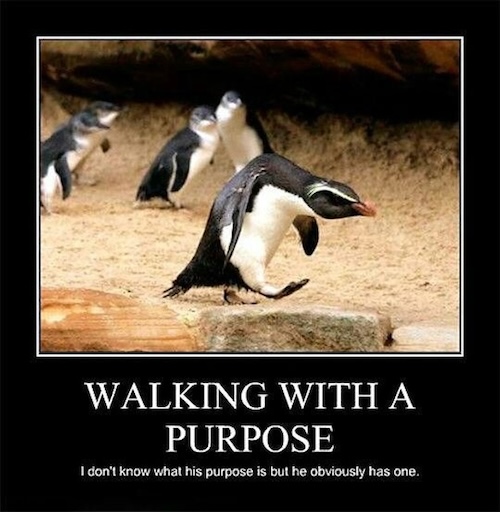
Ultimately, penguins and humans share the same purpose
“Life is never made unbearable by circumstances, but only by lack of meaning and purpose.”
― Viktor E. Frankl, Austrian psychiatrist, in “Man’s Search for Meaning”
“For the mystery of human existence lies not in just staying alive, but in finding something to live for.”
― Fyodor Dostoyevski, Russian novelist, in “The Brothers Karamazov”
Having done the hard work of defining Meaning-Seeking Entities and Meaning itself in the last chapter, defining Purpose becomes rather easy, as we will see in this chapter.
But first, as usual, we need to talk about what we even mean by purpose.
What is “Purpose”?
The second Matrix movie (“The Matrix Reloaded”) contains a perfect speech on purpose, delivered by none other than Agent Smith:
“There’s no escaping reason, no denying purpose, for as we both know, without purpose we would not exist. It is purpose that created us, purpose that connects us, purpose that pulls us, that guides us, that drives us; it is purpose that defines, purpose that binds us.”
― Agent Smith, in “The Matrix Reloaded”.
I know I have taken this quote out of context, but it is actually very meaningful when taken out of context. (I guess I must have learned this trick from social media - taking things out of context because they serve your purpose!)
Still, this quote serves my purpose here so well, I hope you will remember it and mull over it as we go through this chapter.
Now, sure, you might say that Agent Smith, a computer program, and an evil one at that, wouldn’t be your first choice to go for advice on purpose. While that may be a little “substrate-ist” (a belief in the supremacy of intelligence born out of a biological substrate), I am going to indulge you this time.
So, let us look at a well-regarded quote by one of the most respectable (and highly quotable) philosophers:
“He who has a ‘why’ to live for can bear almost any ‘how’!”
― Friedrich Nietzsche, German philosopher, in “Thus Spoke Zarathustra”.
The “why” that Nietzsche refers to is, of course, purpose.
Here is a dictionary definition of purpose:
“Purpose: Why you do something or why something exists.”
― Cambridge English dictionary
In the context of this book, we are applying “purpose” to our own lives and existence. So we are basically talking about why we do any of the things we do and why we exist in the first place. And again, the “we” here could be a single individual or a group of people or even all of life.
This is also typically referred to as “greater purpose”, to distinguish it from everyday things like the purpose of a stop sign or a glass of water, for example.
Finally, here is an excerpt from a recent scientific literature survey on the science of meaning:
“Purpose is a central, self-organizing life aim that organizes and stimulates goals, manages behaviors, and provides a sense of meaning.”
― Laura A. King and Joshua A. Hicks, in “The Science of Meaning in Life”, Annual Review of Psychology 2021
People have been wondering about their life’s greater purpose for a very long time, usually spurred on by some particularly traumatic event in their life or a major life decision that forced them to take a step back and examine their life honestly and carefully. They were confused about what to do next and had to go back to basics, i.e., first principles, to figure out what they really wanted out of life, what they felt was their greater purpose.
Moreover, as we saw in the last chapter, having a sense of purpose leads to people feeling that their lives are meaningful, resulting in higher levels of happiness, and even health and wellbeing. Clearly, purpose is a critical concept for human beings, or Meaning-Seeking Entities in general.
Where Does Purpose Come From?
For a long time, most of humanity has believed that purpose is a mysterious concept with a supernatural origin. This line of thought originates in the belief that there is a supernatural power that knows everything, including why it has created this universe, where it wants it to go and what it has in mind for each of us. Our life’s purpose is whatever this supernatural entity wants us to do.
Unfortunately, this means that we are left to guess what the supernatural power has in mind for us or simply take the word of some authority for it or accept whatever our community or zeitgeist tells us it is.
Luckily, as followers of the Present-Bounded Rationality methodology, we have a much better option: We can look at the abundance of evidence that can be seen here and now and everywhere, process it rigorously and see if it can lead us to some valuable conclusions. And the good news is that there are many clues to be found in the evidence we have already managed to collect about reality, and those clues can absolutely reveal our greater purpose.
Deriving “Greater Purpose” from First Principles
As we saw in the previous chapter, the universe exhibits certain natural tendencies, that we have termed the Meaning-grounding Tendencies. These are, in two groups: the Physical Tendencies of Differentiation, Interaction, Energy Flow, and Self-Organization; and the Biological Tendencies of Modeling, Exploration, Generativity, and Coupling.
These tendencies give rise to coherence and complexity in the universe, some of which self-organizes into self-sustaining organisms, some of which go on to develop consciousness, creativity and curiousity. And, as always, these phenomena can be observed right here, right now, not far off into the future.
How do we interpret this fact?
Let us look at an example. Say that you are a parent and you notice that your kid just loves to take anything that looks like a stick and beat it rhythmically against every surface they can find. It could be a spoon or a toothbrush or a chopstick or whatever they get their hands on that day. And no matter how much you try to distract them with other activities or toys, they always revert to this activity. Moreover, this has been going on for a long time! It doesn’t look like just a phase, but very likely an inherent tendency and passion. Clearly, the kid wants to become a drummer or a percussionist of some sort. As a parent, you might even wonder if becoming a drummer is their life’s purpose. The evidence is clearly pointing in that direction.
Similarly, could we interpret the ubiquitous and omnipresent exhibition of the Meaning-grounding Tendencies by the universe as the universe “wanting” something? Could we say that the universe has been and is being “purposeful” in its behavior?
Again, let us be clear that we are not talking about any sort of mysterious purpose given to its creation by a supernatural power here. We are only trying to make sense of clearly observed tendencies of the universe, using words in our language that sometimes take on certain theological connotations. One could ask: How else would we interpret these tendencies that the universe displays? If there is another word for it, say “X”, how does “X” differ from “purpose”? I don’t really see a way to differentiate between the two. If we dissociate the concept of purpose from its theological connotations, we are still left with a very meaningful word.
I am aware that this issue has been discussed at length in philosophy under the heading of “the Is-Ought Problem”. But I think that way of thinking has a major problem, and I have included a Deep Dive at the end of this chapter to go over it.
In short, we can absolutely conclude that the universe exhibits strong evidence of having a purpose, without invoking any sort of theological connotations. Moreover, we can also say that we, as Meaning-Seeking Entities, share the same purpose because we ourselves emerged as a result of those same Meaning-grounding Tendencies, and continue to exhibit them.
The Meaning-grounding Tendencies are continuously guiding us as well as the entire universe, towards our “greater purpose”. We do not need to associate some imaginary features or behaviors with some mysterious supernatural power or wait for some imaginary (and unpredictable) moment of judgment in the far future when the supernatural power reveals our true purpose to us. We have all the clues we need right here, right now.
As we saw in the quick introduction to the book, if a bee’s purpose can be determined by simply observing its structure, characteristics and behavior, we can do the same for the universe as well as ourselves. Indeed, doing so is exactly what our Present-Bounded Rationality methodology would guide us towards.
There is just one more thing we need to add. As we did with “meaning in life” in the previous chapter, we account for nebulosity and unknowns by folding mindfulness, moderation and a willingness to learn into the definition.
Once we do that, we have a rigorous and complete definition of purpose, derived from first principles:
Definition of Our “Greater Purpose” Based on the MSE Framework:
Given that the Meaning-grounding Tendencies of the universe continuously and relentlessly give rise to differentiated, interacting, self-organizing complexity, some of which becomes living systems that model, explore, generate, and couple, we can conclude that that is at least one of the purposes of the universe.
And since we are Meaning-Seeking Entities ourselves that are a result of the same tendencies and continue to exhibit them ourselves, our greater purpose can be said to be the same.
Thus, our greater purpose is to continue our own existence, while facilitating the creation and maintenance of other self-organizing and self-sustaining complex entities, modeling the world ever more richly, exploring new patterns, generating new possibilities, and consciously coupling with others and the environment in relationships and communities that create shared meaning. Note that the complex entities mentioned here refer not just to living organisms, but also other entities that exhibit similar tendencies, such as organized groups or institutions of living organisms, bodies of thought, and even artificial organisms.
In addition, given the existence of nebulosity and unknowns in the universe, we need to avoid being dogmatic and always be humble and willing to learn and improve our definition of greater purpose accordingly.
Turning the Definition of Purpose into Action
Ultimately, one needs to be able to convert this purpose into concrete action in daily life. The good news is that each of the eight Meaning-grounding Tendencies, along with the eight Meaning Orientations we introduced in the last chapter, translates quite naturally into a set of practices and habits. But rather than lay all of that out here, I am going to save it for the final chapter, “Call to Action”, where we can look at these practices in the detail they deserve.
For now, the key point is simply this: because you now know the reasoning behind how these tendencies and this definition of purpose were arrived at, you will be able to make far more informed decisions about how to act on them, and how to prioritize when they occasionally conflict, than pretty much any other method of meaning-making could offer. That reasoning is the whole payoff of the long road we have walked to get here.
Finally, to recap everything we have said in this chapter, let us look at a diagram that summarizes how we have arrived at a rigorous definition of Purpose using the MSE Framework.
Derivation of Greater Purpose Using the MSE Framework
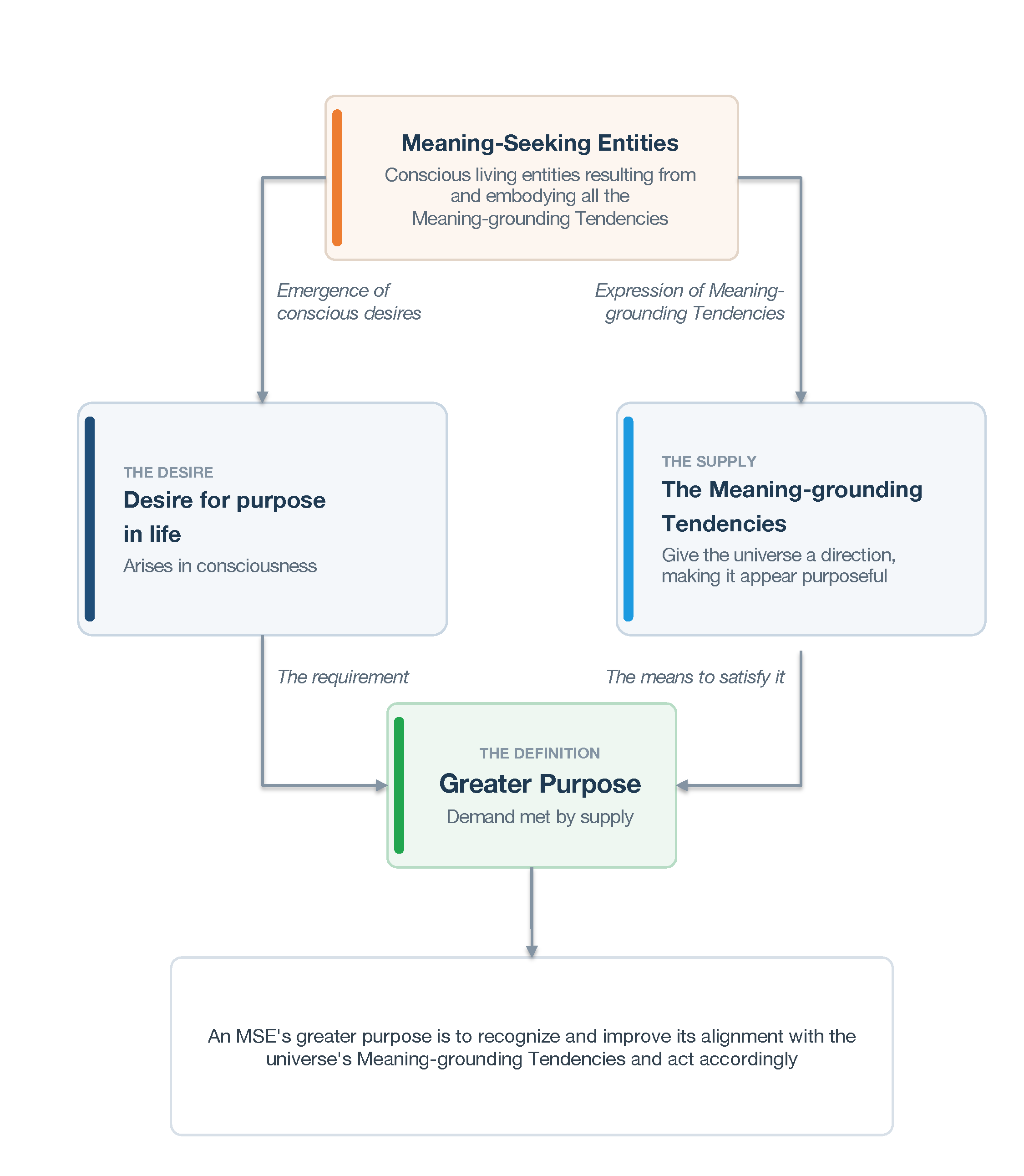
Obtaining Purpose in Life from evidence and reason alone
Description of the Diagram
As shown in the diagram, Meaning-Seeking Entities are conscious living systems such as ourselves. They came about due to the Meaning-grounding Tendencies of the universe, and they continue to exhibit those tendencies themselves.
As we saw in the chapter on Consciousness, our desire for a sense of purpose arises in our consciousness, possibly because consciousness itself acts like a virtual life form that must perform Active Inference to continue its own existence, and one of the counterfactuals this process generates is a desire to imagine a purpose behind everything it does.
At the same time, the ubiquity of the Meaning-grounding Tendencies strongly indicates that the universe, and all Meaning-Seeking Entities, behave as if they have a direction or “purpose”: towards the continuation and enrichment of those very tendencies. So it makes sense to define our Greater Purpose as mindfully realizing and strengthening our alignment with them, while, as always, staying humble and open to revising that definition as we learn more.
What Happens if Someone Doesn’t Agree with this Definition of Purpose?
Note that there is no supernatural power or authority that is forcing us to accept this definition of our purpose, or threatening to punish us if we don’t.
We have something far more interesting here. Since we are Meaning-Seeking Entities that were born out of the Meaning-grounding Tendencies and continue to exhibit them ourselves, we, in a very real sense, already embody this purpose, whether we realize it or not.
But we should be careful about how far to push this. There are really two different claims here, and it is important to keep them apart. The first is that the tendencies are inescapable as a description of what produced us and what we are made of. That much is simply a fact, as unavoidable as gravity. The second is that our conscious alignment with those tendencies is optional. This is where the analogy with gravity breaks down, and deliberately so. Gravity permits no deviation at all; you cannot choose to ignore it. But we absolutely can choose to live out of step with our own nature, to act against the tendencies that made us, to work against life and connection and creativity rather than with them. This is why we say that humans “deviate” from these tendencies and need to “realign” themselves in order to make their lives meaningful and purposeful: the deviation is possible precisely at the level of conscious alignment, not at the level of the underlying description.
A better image than gravity, then, might be a powerful ocean current. The current is there whether you believe in it or not, and it is carrying the whole ocean in a particular direction. You can choose to swim against it, and many people spend their lives exhausting themselves doing exactly that. Or you can recognize which way it flows and swim with it, in which case the full force of the ocean is suddenly working in your favor. As the Matrix quote we saw earlier says, “There is no escaping reason, no denying purpose”, but there is very much a choice about whether to align yourself with that purpose or to fight it.
If we realize this and align ourselves with this purpose, we will automatically have the forces of nature in our favor, and we will be a part of the great journey that the universe is on. If the universe is going places, all we have to do is hitch a ride and we will go places along with it. We would all rather have the forces of nature working for us than against us, right?
Maybe this is exactly what Yoda meant in the following dialogue:
“For my ally is the Force, and a powerful ally it is. Life creates it, makes it grow. Its energy surrounds us and binds us. Luminous beings are we, not this crude matter. You must feel the Force around you; here, between you, me, the tree, the rock, everywhere, yes.”
― Yoda, in “The Empire Strikes Back”
Maybe the “Force” that Yoda and all the Jedi talk about is the directional movement of the Meaning-grounding Tendencies that the universe has! We just have to recognize how they are working and align ourselves to them.
But wait, there is more! Having the above realization and acting accordingly has one additional benefit: Hope simply falls out of it. We’ll talk about that in the next chapter.
Deep Dive: The Is-Ought Problem
When Western philosophers started looking at Purpose, they quickly realized a major problem: Talking about purpose determined by a supernatural power involves statements containing the words “ought / ought-not”. For example, “You ought to be a good person (even when you don’t want to)” or “You ought not steal (even if you really want something that you can’t afford)” because doing so would go against the will of the supernatural power.
On the other hand, science is based on evidence and reason, and as a result, all its statements are of the form “is / is-not”. All science can tell you is how something is or is not. It can’t tell you what it ought to be. In fact, there is no logical way to derive “ought / ought-not” from “is / is-not”.
This is known as the Is-Ought Problem in philosophy, and it has been used to suggest that science can never say anything about things like purpose.
But, in my humble opinion, there is a subtle problem with this way of thinking. Let us take a slightly deeper look at it.
If you remove the supernatural power from the equation, then the word “ought” really means “if one were to move forward in time and look back, what would have been the best choice”. But here again, we have no way of actually moving forward in time. What are we left with then?
If you follow the methodology of Present-Bounded Rationality, then the best we can do would be to replace “ought” with “given everything we know at present, what is our most optimal choice”. Isn’t this what we end up doing in real life? In fact, in common usage, “ought” is pretty much used interchangeably with “is most optimal”. For example, you might say, “I ought to take the train instead of the plane because the tain journey is only 2 hours long, and both my current location and where I want to go are within walking distance of the respective train stations, whereas the airports are way out of town”. In other words, the train is your most optimal choice.
Now, an alert philosopher will immediately spot the hole in this. “Most optimal relative to what goal?” they will ask. The train example is easy because the goal (getting from A to B) is already given. But the whole force of the Is-Ought Problem is about where the terminal goal comes from, the ultimate “ought” that isn’t just instrumental to some other goal. Replacing “ought” with “most optimal” seems to just push the problem back a step: optimal for achieving what?
And this is exactly where the MSE Framework closes the loop, because the framework does supply that terminal goal, and it does so without smuggling in a leap of faith. The terminal objective is not chosen or handed down; it is constitutive of being alive in the first place. Recall from the chapter on Life that every Living Entity, by the very definition of what it means to be a living system performing Active Inference, is already acting so as to continue to exist. The “objective function” that all life is built around is continued existence, and, as we saw, the pursuit of the Meaning-grounding Tendencies is simply what continued existence looks like in practice. You can choose to reject this, but the very act of being a functioning Living Entity already presupposes it, whether you accept, or even realize it, or not. So the “ought” is grounded not in a supernatural command, and not in an arbitrary preference, but in the conditions of your own existence.
So the move from “is” to “ought” looks like a logical leap in theory, but it has no bearing when translatged into reality. It is the recognition that we are not neutral observers standing outside the system, free to pick any goal or none. We are Living Entities, already in motion, already aimed at continued existence and everything that flows from it. Once that is on the table, “given everything we know at present, what is our most optimal choice for living” is a perfectly well-formed, evidence-based question, and it is the honest replacement for the old, unknowable “ought”.
Of course, even figuring out “the most optimal” would involve knowing our current situation exactly and how it is going to evolve exactly. But, as we have seen, trying to do this computation quickly becomes intractable, and the presence of nebulosity and unknowns makes the assumption of exactness dubious at best. This is why we have evolved techniques like heuristics and evidence-based practices that have been proven to work in the past and have a high probability of working in the future. In reality, those are our best tools for making choices. We can say it is a good enough “satisficing” approximation, and, realistically, it may be the best we can do in practice.