12. Call to Action: From Knowing the Path to Walking the Path
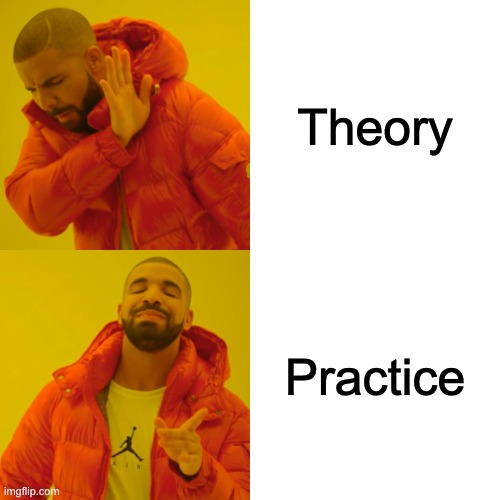
Engineers shouldn’t just come up with theories. They should produce tools and practices.
“There is a difference between knowing the path and walking the path.”
― Morpheus, in “The Matrix”
“It doesn’t matter how beautiful your theory is, it doesn’t matter how smart you are. If it doesn’t agree with experiment, it’s wrong.”
― Richard P. Feynman, in one of his lectures
Whenever you come across any new philosophy of life, no matter how convincing and appealing it is, the most important question you must ask is: What can I do with it? What can I do daily, weekly, or on a regular basis? How can I put this philosophy into practice and see real improvements in my life as a result? If no such prescription is available, then what is the whole point of the exercise?
There is a big difference between theory and practice. In fact, in our discussion on Present-Bounded Rationality, we identified this as one of the biggest limitations of rationalism, or any other philosophy that limits itself to abstract ideas.
Moreover, since this book is entitled “An Engineer’s Search for Meaning”, I feel like it is absolutely my duty to come up with tools that can be used to put all of this theory into practice. This is what engineers are supposed to do.
Rubber, Meet Road
What we have done so far is that we have settled on the Present-Bounded Rationality (PBR) Methodology, developed the MSE Framework based on it, used the framework to identify 8 Meaning-grounding Tendencies the universe appears to exhibit, and shown how they can be used to find meaning, purpose and hope in life. In addition, we have identied 8 Meaning Orientations as stances that we can adopt in our daily lives to help align ourselves with the Tendencies.
What we need to do next is to develop some practices based on these concepts. These practices need to be simple for most people to follow on a regular basis, so they can actually see the benefits of the ideas presented in the book for themselves, wihtout having to even understand the theory.
Here are the eight Meaning Orientations again, this time framed as everyday stances you can actually check yourself against, along with the tendency (or tendencies) that justify each:
- Authenticity: Act from your own shape rather than a borrowed template, and let your distinct self show up in what you actually do. (Grounded in Differentiation.)
- Sense-making: Pay attention to what is really happening around you and inside you, and work toward consistency between what you believe, what you value, how you act, and the universe itself. (Grounded in Modeling.)
- Curiosity: Stay open and interested, willing to experience new phenomena, new places, new people, and new tasks, and keep learning. (Grounded in Exploration.)
- Equanimity: Engage fully with the flow and change of life without grasping or clinging. Accept that things must move on. (Grounded in Energy Flow, also known as Dissipation, which we experience as impermanence.)
- Stewardship: Sustain, protect and grow the systems your life depends on: your body, your habits, your relationships, your work, and the larger living systems you belong to. (Grounded in Self-Organization.)
- Connection: Consciously recognize that other beings matter, and build and tend relationships and communities that hold meaning over time. (Grounded in Interaction and Coupling.)
- Creativity: Bring something new into being in your work or thinking or life itself, in varius forms, especially things that express the other orientations. (Grounded in Generativity.)
- Humility: Hold your models and conclusions loosely, accepting the limits of your knowledge and agency, and always willing to learn and adapt. (Grounded in Modeling and Exploration turned back on themselves, and reinforced by Present-Bounded Rationality’s honesty about nebulosity and the unknown.)
Of course, as we have already said, there is some overlap and synergy in all of these, so some of the activities that you might engage in might express more than one orientation at once. The more the merrier.
With all of this in mind, let us see how we can go about developing some practices.
The Rudder Practices
It is well known that any practice works best when we identify concrete situations where and when it can be acted upon. That way, whenever you find yourself in that situation, it reminds you to follow that practice. Over time, it becomes a habit and then the benefits really start to compound.
So let me start by asking some questions about some regular situations that we all face:
- What’s the first thing you do when you get up in the morning?
- How about just before you hit the pillow at night?
- What is the most common activity you do whenever you have a free moment during your day?
Unfortunately, for many people, most days, the answer is: “Check my social media feed!”
Is it any wonder, then, that we think that life has become crazy, sad, angry and generally miserable? This is because most of our social media feeds are full of such negative content. When you feed your mind junk, it’s no wonder it gets sick over time!
It has been well acknowledged that we need better alternatives to these bad habits. What would be a better alternative? How about something simple that can be done anywhere, anytime, in small chunks, just like checking a social media feed?
Fortunately for you, that’s very much possible. It is possible to define practices that can each be performed in a few minutes in any of the above situations, and that can help make your life more meaningful, purposeful and hopeful over time.
Together, I call these four the Rudder Practices. A rudder is a small and simple thing, but it is what keeps a ship on course: a gentle, constant correction is all it takes to steer something far larger than itself. That is exactly the role these practices play. As we have noted, human beings can drift out of step with the Meaning-grounding Tendencies, so we need to periodically check and realign ourselves to them. The Rudder Practices are those small, regular corrections. Also, as we shall soon see, Rudder is the name of the web app that accompanies this book that can act as your helper when learning these practices.
Let me first name them along with the most likely time that one might do them, and then we will look at each of them in more detail:
- “Mindful Moments”: Whenever you have a free moment at any point in your day,
- “Purposeful Mornings”: Before you start your day in the morning,
- “Hopeful Evenings”: The last thing you do at night, and
- “Meaningful Life”: Whenever you are in the mood for taking a deeper perspective, such as on weekends or birthdays or while making New Year’s resolutions or some other significant event in your life.
Let us now go over each of these practices in detail. Each one takes only a few minutes to complete. Moreover, each of them can be useful immediately and can impact your life positively over the long run.
The “Mindful Moments” Practice
Mindfulness help us with multiple Meaning Orientations. Its attentional half feeds Sense-making, since you cannot make sense of anything you have not actually noticed. Turned inward on your own reactions, that same attention is how Authenticity gets discovered, since you cannot reason your way to your own nature from the outside. And its nonjudgmental half is Equanimity in practice, observing what arises without grasping at it or pushing it away. That is why mindfulness earns a practice of its own.
Moreover, as we have already seen in the chapter on Life, Mindfulness can be seen as a way for complex Living Entities to align themselves completely with Active Inference. So it should not surprise us that our ancestors, who thought hard about their lives and minds and experimented with them, discovered the practice of Mindfulness long before we knew anything about Active Inference. That’s the wonderful thing about truth. It can be arrived at from many different angles.
The ancient practice basically involves focusing your full attention on the present moment, simply observing and labeling things happening around you, as well as inside your body and your mind, clearly and calmly, without making any judgment about them.
Practicing mindfulness in everyday activities has been proven to improve focus, productivity and peace of mind. Simply observing and labeling things occurring in the present moment, instead of trying to judge them as being desirable or “good” or not, is like removing cobwebs that cloud your perception. Also, the present moment is where you have the highest level of “agency” or effectiveness on your actions as compared to any moment in the future or indeed, the past.
Thus, being mindful allows you to perceive everything more clearly, think more clearly about it, and act more effectively on it. All of this makes your life more attuned to reality, which is first step to being more aligned with it. And that, as we have already shown, leads to more meaning, purpose and hope over time. (In the language of the Orientations, this practice is how you cultivate Sense-making, Authenticity and Equanimity together.)
With that quick introduction, now it is time for us to look at the specific steps involved in the Mindful Moments practice:
A) Mindfully focusing on your surroundings:
- Start by settling down comfortably wherever you are, taking a deep breath and exhaling slowly.
- Gently allow your mind to pay attention to what is happening around you, right here, right now.
- Take a look around yourself and make a note of something that catches your attention. It could be anything you see or hear or smell or touch (e.g. “pen”, “chair”, “carpet” etc.).
- Pay careful attention to that object. Notice some of its properties, such as its color, shape, or texture, or the way it is changing etc. Trying to do so helps to focus your mind on the object.
- If your mind wanders, that’s ok. Gently and playfully bring your focus back to the object. Allow it to fill your attention as much as you can, at least for a few seconds.
- Avoid making any judgments about the object, such as whether it is desirable or not. Whatever it is, let it be, and try to simply experience it the best way you can.
B) Next, it is time to focus on your body:
- Gently close your eyes and turn your focus inwards, towards your own body.
- You will start to notice various physical sensations occurring in your body, such as your breath coming in and going out, maybe an itch somewhere on your skin, or tension in your muscles.
- Once again, choose whatever catches your attention and pay as careful attention to it as you can, at least for a few seconds.
- And again, if your mind wanders, just gently and playfully bring it back to the sensation. Allow it to fill your attention as much as you can.
- Once again, avoid making judgments. Let it be as it is, simply try to experience and label it.
C) Going deeper, focusing on your mind:
- The last step is to pay attention to what is going on inside your mind.
- Notice any thought or emotion passing through your mind. Simply observe and label the thought or emotion as it is, without making any judgment about it.
- Continue to do this for a short time, as thoughts come and go into your mind. Try to look at your own mind playfully, as if it were a child. We don’t judge the things children do; we simply watch and appreciate the things they do. Do the same with your mind.
- This is probably the hardest part of the practice, but even a minute amount of regular progress towards it will compound over time.
That’s basically it.
It is important to note that, while the practice is very easy to describe, it turns out to be quite difficult for most people. This is because our minds are extremely powerful and have gotten used to certain patterns of thinking that get in the way. And learning to change those patterns takes a lot of careful work. So I’m not going to sugarcoat it: While these steps, and tools like Rudder can give you a great start, the best way to learn mnindfulness is to work with a teacher.
Luckily, we have 3 additional practices that are a lot easier to follow.
Beyond Mindfulness
The next 3 practices are inspired by time-tested concepts from Stoicism, another ancient philosophy we had mentioned earlier. Stoicism prescribes rituals involving daily morning and evening reflections, along with periodic big-picture reviews of one’s life. During these rituals, one is asked to check one’s adherance to certain prescribed virtues, and do appropriate course-correction based on that.
The astute reader has probably noticed that this is quite similar to what we want to do with our practices, where we want to align ourselves with the Meaning-grounding Tendencies of the universe rather than virtues, because we have a far stronger basis for the tendencies.
In other words, the 8 Meaning Orientations we have defined can take the place of these virtues, with the rigorously derived Meaning-grounding Tendencies standing behind them as the rock solid justification. (Reassuringly, there is even some overlap between the virtues as defined by Stoicism and our Orientations! Still, we will stick to the Orientations here since we have developed a robust framework to support them, giving us more confidence in them.)
This is how we end up with our 3 additional practices: a morning practice, an evening practice and a longer-term big-picture practice. Let us go over them next.
The “Purposeful Mornings” Practice
This practice is basically identical to the Stoic practice of Morning Reflection, while replacing the Stoic virtues with the Meaning Orientations as the guiding principle.
Here are the steps to follow:
- Every morning, before you start your day, sit quietly for just a few moments and go over your day in your mind.
- Identify your goals or objectives for the day, imagine the challenges you may encounter while pursuing them, and visualize the actions you might take to handle them. In order to do so, visualize yourself actually taking those actions and overcoming the challenges that may come up. Doing so may lead to insights that require modifying the goals and actions.
- Identify up to 3 goals or actions for the day. These may be personal goals, work or school goals, or family or community goals. Ideally, note down these goals or actions in a journal.
- When we identify our activities for the day, try to ensure that they express one or more of the Orientations.
- Look at each activity in your list and check which of the eight Orientations it expresses. A single activity may check off more than one. The more the merrier! (For example, a work meeting may involve Connection as well as Sense-making, Exploration and Stewardship.)
- In the beginning, this may turn out to be hard to do because many of your goals may not clearly express any of the Orientations. But simply being aware of these guidelines will, over time, lead to better alignment, and, along with it, the sense of having meaning, purpose and hope in life. And here again, every little step can produce tangible benefits.
- This practice will help you feel that your activities during the day are purposeful.
The “Hopeful Evenings” Practice:
This practice is basically identical to the Stoic practice of Evening Reflection or Journaling, with the addition of the Meaning Orientations alignment as guiding principles.
The steps are analogous to the ones in the previous practice, except we are talking about the events that have already occurred and the actions you have already taken during the day.
Here are the steps to follow:
- Every evening, before you call it a day, sit quietly for just a few moments and go over your day in your mind.
- Go over the goals or objectives for the day that you had identified in the morning. Make a list of what actually happened as a result, as well as other important events that occurred during the day.
- Think of the challenges you encountered while pursuing the activities you had planned, and how you dealt with them. What lessons can you draw from that for the next time? Are there any opportunities for iterative improvement?
- Also, ask whether your actions expressed the Meaning Orientations. Which Orientations did the day bring out, and which were missing? What were the challenges and how can you adjust your activities to bring them into better alignment?
- Once again, the best way to do this is to note down each of these activities along with your reflection about each of them, and check off which of the eight Orientations each of them expressed.
- And again, this may turn out to be hard to do in the beginning. But simply being aware of these guidelines will, over time, lead to better alignment, and, along with it, the sense of having meaning, purpose and hope in life. And here again, every little step can produce tangible benefits.
- Note that this practice is associated with “hope” since, as a result of the alignment, the ultimate outcome of this practice should be to make you feel grateful for the day and hopeful about the next.
The “Meaningful Life” Practice:
The last practice is meant for taking a long-term perspective on one’s life. This again is a very common idea recommended by many philosophies of life, and we will add our own twist based on the Meaning Orientations.
The practice can be done at longer intervals, such as months or years. Typically, one can do this on their birthday or while making New Year’s resolutions or when there are major events in one’s life.
The practice involves the following steps:
- Review the morning and evening journals that you have been writing. Notice any recurring patterns and trends.
- How is your list of activities evolving? How is their alignment with the Meaning Orientations evolving? Do you feel that your life is contributing to the universe’s relentless progress toward the expansion and enrichment of life and consciousness? What longer-term changes do you need to make?
- Write these reflections down in your journal.
- As we have seen, a meaningful life involves having a sense of coherence or comprehensibility about one’s life, having a sense of existential significance, and having a sense of purpose. So evaluate your life up to this point along these lines.
- One of the best ways to do this is to write down a story of your life up to this point, keeping in mind the 3 aspects of meaning.
- Ultimately, reflect on whether the practices you have been doing have been helping to make your life meaningful, purposeful and hopeful over time and whether you need to make any adjustments.
The Desires You’ll Still Have
There is one more practical reality worth facing honestly. Even after you begin realigning yourself with the tendencies, you will still have desires that are misaligned with them. Realigning reduces them over time, but it does not make them vanish, and pretending otherwise sets you up to fail.
This is exactly where a lot of well-meaning frameworks go wrong. They demand purity, insisting that you simply eliminate every “bad” desire by sheer force of will. But suppressed desires don’t disappear; they go underground and resurface later, often with a vengeance. Building in a sanctioned outlet for them is not weakness or a moral failing. It is realistic engineering.
Here is the good news. As you realign, and the friction, dissonance and loss of meaning in your life go down, you should find yourself with a surplus of time, energy, and slack. My recommendation is to give yourself permission to spend a little of that surplus on your remaining misaligned desires, always in moderation.
The sequencing is what makes this a discipline rather than mere permission to indulge: you generate the surplus first, by aligning, and only then spend a little of it, second, and moderately. It is the same logic as a “cheat meal” in a fitness plan or “fun money” in a budget. The cheat meal works precisely because it comes after the discipline, not instead of it.
The Rudder App
Once again, since I am an engineer, I don’t want to leave you with just the recipe for these practices. I want to help you actually practice them in a fun, engaging way.
So, as a companion to this book, I am developing a web app called Rudder. This app provides you with stepwise instructions to do these practices.
In addition, to make it fun, the app gives you fun mementos to commemorate your practice. It also keeps a history of your practices and helps you review them later. You can use this journal during your Meaningful Life practice as well as download it for your own records. Eventually, I plan to add some analysis tools to help you with all of your practices.
Note that, since this is a web app, you do not need to download or install anything to use it. Just clicking on the link below in your browser will let you use the app.
Here is a link: Rudder Web App.
That was the call to action for everyone reading this book. But beyond that, I have a special message for the engineers among us.
Call to Action for Engineers
As I stated in the honeybee conversation at the beginning of the book, there is something unique and critically important about engineering that doesn’t get acknowledged often.
Every cell in your body has a cell wall. Various molecules present themselves to this wall and the wall has elaborate mechanisms to select the molecules it thinks are useful to the cell inside and let them in. (Also, some undesirable molecules, such as viruses, present themselves as beneficial molecules and manage to get through.)
Once inside, depending upon the type of molecule, it either gets transported to the part of the cell where it is needed or it is tossed around in the chemical soup of the cell until it gets where it is useful.
The mechanisms the cells construct for transporting these molecules can be quite elaborate. They almost resemble “molecular highways”, with “walkers” trudging along them that look like Atlas carrying a huge load on his back. These highways are constructed as needed and then disassembled.
Once the molecules get to where they are useful, appropriate chemical reactions take place to allow them to do whatever they are needed to do. This includes things like releasing energy to perform various tasks or building other molecules or processing waste products and so on. More importantly, they perform the critical task of DNA transcription, translation, signal transduction and eventually replication, when the cell is about to divide.
If you were to shrink yourself down to the size of a molecule and walk around a cell as it was doing these things, you would think that it was a very complex and dynamic factory. In fact, possibly the most complex and dynamic factory you have ever seen.
If you want to check this out for yourself, do a search on YouTube for molecular animations of living cells. You will see examples of everything I just mentioned and it is sure yo wow you.
Similar observations can be made even at the level of organs, individuals, and groups of individuals. They can be viewed as supply chains, defense mechanisms, selection mechanisms, transportation mechanisms, chemical processing plants and waste management. In other words, one can look at the entire range of activities involved in keeping Living Entities alive as unbelievably complex and dynamic engineering activities.
Yes, you can absolutely think of life as a mind-bogglingly complex and dynamic engineering project! This project, as far as we know, began all by itself billions of years ago and has continued unbroken ever since. It has complexified, organized, evolved and diversified in uncountable ways.
Now, I know what you are thinking - “That sounds rather lame and dry! Is everything just engineering? What about poetry? Art? Beauty? Feelings? The ineffable and the unintelligible and the transcendental?”
So let me ask this: Have you ever been moved by an engineering marvel? How about a huge rocket taking off? A beautiful suspension bridge? A beautiful building or even a city? The mechanism of a wristwatch or a piano or a supercar? A flower? A honeybee? Koi fish swimming around in a pond? A garden? The video of thw workings of a living cell that I mentioned earlier? What are all these things if not engineering marvels?
There is a misunderstanding that engineering is all dry, mechanical stuff. This is not true. Every engineering product involves humans, and sometimes even spiritual elements. The simpler ones may look mechanical and lifeless, but the more complex they become, the more life-like they look.
In fact, I would propose that all these feelings of awe, beauty, and transcendence that we associate with art or poetry or music and so on are just our ways of grappling with extremely complex phenomena that aren’t easy for our minds to grasp. But, if you shrink yourself down to the level of molecules, as we did while traveling around a living cell earlier, you would see that ultimately, it is all just molecules going about doing their things. And many times, they appear to have a well-defined function and purpose, like an engineered product.
I know, it takes time to come around to this realization. It took me a long time, too. We have a huge amount of cultural and emotional baggage associated with life, which gets in the way of getting to this realization.
But if you simply ask, if it is not molecules and processes with well-defined functions and purposes, then what is it? If it is not physics, chemistry and biology, then what is it? If it is not scientific facts and engineering processes and products, then what is it? If it is not evidence and reason, then what is it? If you think there is something more, what evidence do you have to support it besides a feeling or some culturally accepted beliefs?
One of the reasons that people believe that there is something more is that science has generally been associated with nihilism. Science is just a collection of “dead” facts. But engineering is not like that. In the chapter on Methodology, we already saw how engineering isn’t just “an application of science” but a much more ancient practice, practiced by not just human beings, but also by the birds and the bees and every living cell and even the entire ecosystem.
Engineering is a process that creates or fixes something functional and serves a purpose. It is inherently more purposeful and meaningful. It adds “life” to science. And if engineering is done mindfully in service of a purpose like expanding and enriching life and consciousness, then it can rise to the same exalted levels that we usually associate with things like art, poetry and music.
In fact, engineering can be considered to be the meaningful and purposeful essence of life, the universe and everything! It is hard to overstate the importance of this realization. All engineers should take great pride in this fact!
So the call to action for engineers is to not only take pride in this fact, but also act as good stewards of this phenomenon. This, as we have stated, can be accomplished via Mindful Engineering that is aligned with the Meaning-grounding Tendencies of the universe. The ultimate aim, as always, is the expansion and enrichment of life and consciousness.
Of course, any such feeling of great pride in your profession or calling must be accompanied by humility, as dictated by our methodology of Present-Bounded Rationality. So let us get to that next.
Some Final Points
In all of the above, we should never lose sight of the fact that the universe contains a lot of nebulosity and unknowns, so we need to stay humble, exercise mindfulness and moderation, and be willing to learn and improve as we go. (This, of course, is the Humility orientation at work.) At times, some of these activities or even the Orientations themselves will conflict with each other, and this is again where mindfulness and moderation come in, to help you prioritize.
And because you know the reasoning behind how these tendencies, Orientations and practices were arrived at, you can make far more informed decisions about that prioritization than pretty much any other method of meaning-making, where you are typically required to simply take things on faith.
This is the ultimate benefit of this approach - that it can be explained from the ground up, and questioned or verified or improved by anyone. That’s the beauty of relying on evidence and reason.
In fact, the entire method of this book, everything from the cosmic tendencies all the way down to tonight’s journal entry, comes down to a simple four-step recipe:
Discover the universe’s inherent tendencies, by thoroughly examining an abundance of evidence and applying reasoning to it.
Realize that you have those tendencies too, but that you have drifted from them, and that this misalignment is the main source of friction, dissonance, and loss of meaning in your life.
Realign yourself with them, using the Meaning Orientations and the four Rudder Practices.
Iterate, with humility. As we learn more, our understanding of the tendencies, orientations, and practices will continue to improve.
Bonus: The reduction in friction may leave you with a surplus of time, energy, and slack. You can spend a little of it on the misaligned desires you will still have (and you will still have them). Always in moderation, though.
That is the whole book, really. Everything else is just the evidence and reasoning that shows why this recipe can be trusted.
With that, we have completed everything we wanted to accomplish in this book! Congratulations! You deserve a tremendous amount of gratitude from me for having stuck with my quirky and amateur writing for this long.