Appendix: Deep Dives
Throughout the book, I mention a number of ideas that are related to the MSE Framework but aren’t central to it, or that summarize other people’s work that you can explore in much greater depth elsewhere. Rather than interrupt the flow of the argument, I have collected short summaries of them here, each with a pointer to a book, paper, video, or article where you can go deeper. Two deep dives that contain my own original rebuttals rather than summaries of others’ work, Gödel’s Incompleteness Theorem and the Is-Ought Problem, are kept in the main text, in the chapters on Methodology and Purpose respectively.
Deep Dive: John Vervaeke’s “Awakening from the Meaning Crisis”
This is a series of 50 video lectures on YouTube by University of Toronto professor of psychology John Vervaeke. In it, he argues that we are in the midst of a mental health crisis, itself enmeshed within a deeper cultural and historical crisis he calls “The Meaning Crisis.” The wide-ranging series draws on cognitive science, philosophy, and spirituality to trace how and why the present-day meaning crisis came about and what can be done about it, ultimately proposing a new, secular sense of meaning grounded in science, philosophy, and psychology. I highly recommend it for anyone who wants an in-depth, first-principles understanding of this topic.
Go deeper: “Awakening from the Meaning Crisis” lecture series on YouTube (John Vervaeke’s channel); also listed in the References.
Deep Dive: John Vervaeke’s Model of Cognition
Vervaeke has proposed an integrative framework for understanding human cognition, consisting of “4Ps” and “3Rs.” The 4Ps are four types of knowing: Propositional (knowing that something is the case, i.e. facts), Procedural (knowing how to do something, i.e. skills), Perspectival (knowing what an experience is like from a particular point of view), and Participatory (the knowing that emerges from being in a relationship with something, where knower and known are mutually transformed). The 3Rs describe how we sift relevance from the firehose of reality, through a process he calls “Recursive Relevance Realization”: Relevance (separating what matters from what doesn’t), Realization (both grasping a situation and doing something real about it), and Recursive (the process operating at multiple levels of feedback). The model has significant overlap with the epistemology discussed in the Methodology chapter, but adds further nuance.
Go deeper: John Vervaeke’s “Awakening from the Meaning Crisis” lecture series (link in References).
Deep Dive: First Principles Thinking
First Principles Thinking basically means “Don’t take someone else’s word for it, check it out yourself!” Rather than following conventional wisdom (which, if wrong or outdated, causes us to repeat its mistakes), we start from fundamental principles that are verifiable and incontrovertible and build everything up from there in rigorous, logical steps, avoiding unjustified assumptions along the way. The idea goes back to Aristotle and is associated with figures like Richard Feynman, Charlie Munger and Elon Musk. For the MSE Framework, we take this approach because it is the existing conventional wisdom around meaning that has led to the current crisis, so we want to rethink the problem from scratch.
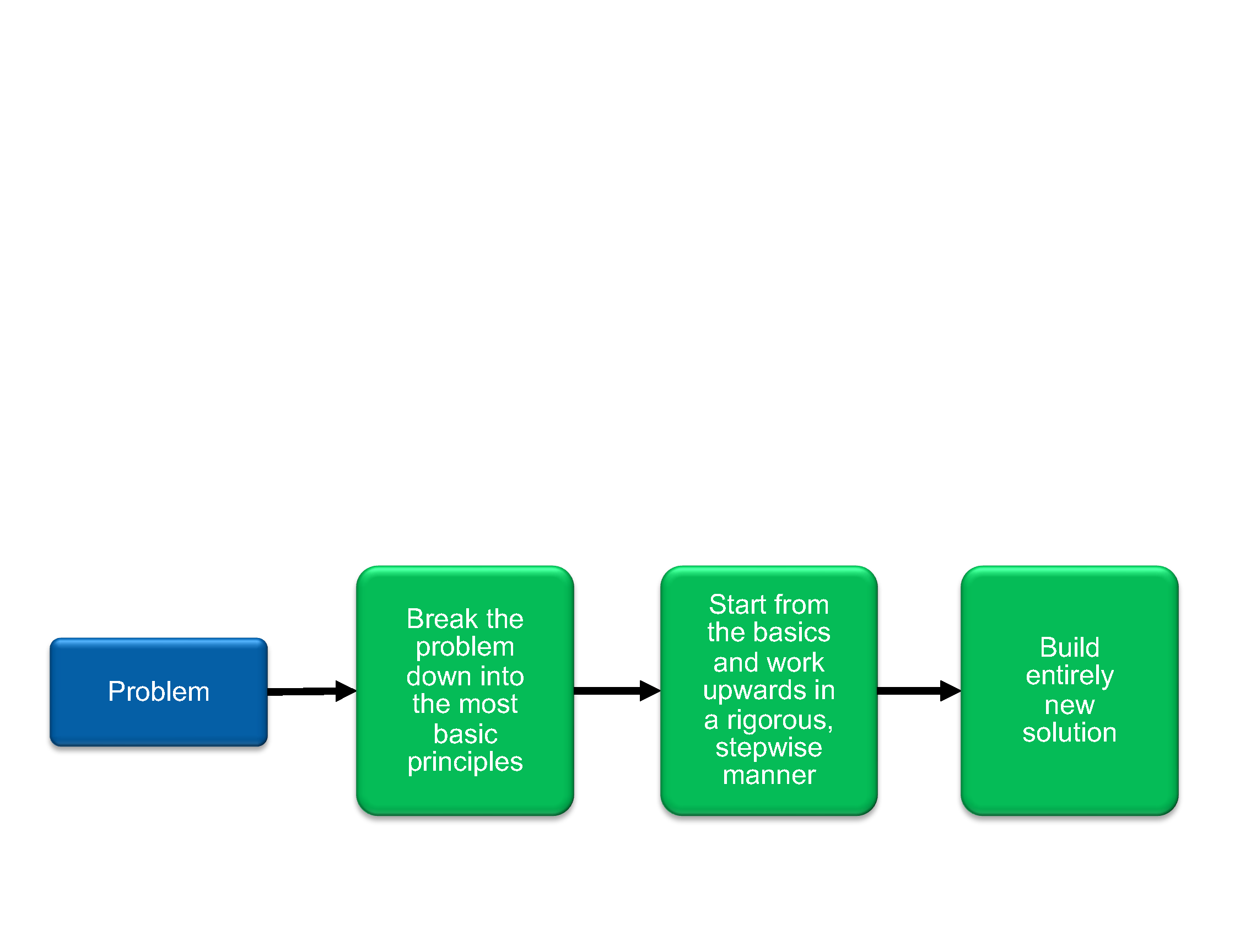
First Principles Thinking
Deep Dive: Explanations
According to physicist David Deutsch, the father of quantum computing, the pursuit of truth is an ongoing process of creating ever better explanations of reality. He argues that explanations, not observations or predictions, are the fundamental building blocks of knowledge. An explanation is an assertion about what is really out there and how it behaves, and it almost always appeals to things we cannot see in order to account for the things we can. A theory that only predicted but never explained why, would leave you with no understanding at all, and no way to know whether to trust it in a situation you had never tried before.
What separates a good explanation from a bad one? Deutsch’s answer is that a good explanation is hard to vary while still accounting for what it is meant to account for. Every detail in it is doing real work. Take the seasons. The ancient Greek myth explained winter as the grief of the goddess Demeter while her daughter Persephone was away in the underworld. That story is easy to vary: swap in a different god, a different family quarrel or a different emotion and it “explains” winter exactly as well, which is to say not at all. The modern explanation, that the Earth’s axis is tilted relative to its orbit so that each hemisphere receives more direct sunlight for part of the year, is hard to vary. Change the tilt, the geometry or the timing and it stops accounting for the seasons we observe.
Good explanations also tend to have reach: they solve problems far beyond the ones they were invented for. Newton’s laws were worked out to account for falling apples and the orbits of the planets, and they turned out to describe the tides, the path of a cannonball and the flight of a spacecraft. Reach is not something we design into an explanation; it is a bonus we discover afterwards, and it is why knowledge compounds. This is the basis of Deutsch’s larger claim that there is no limit to the explanatory power of human knowledge. All our explanations remain conjectural and fallible, so we are always potentially wrong, but that is not a reason for despair: what matters is the rigorous, iterative process of conjecturing boldly and then criticizing, testing, refining and updating our explanations, rather than somehow reading theories off the raw data.
Go deeper: David Deutsch’s TED talk, “A New Way to Explain Explanation,” is a good short introduction (Link in References).
Deep Dive: Bayesian Inference
Bayesian Inference is one of the most fundamental methods for building a robust model of reality, and one of the leading theories of how our brains work (the “Bayesian Brain Hypothesis”) is based on it. The idea: you start with a prior belief about how likely something is, then each new piece of evidence (the “likelihood”) is weighed against that prior using Bayes’ Rule to produce an updated belief (the “posterior”). For example, you wake up expecting a sunny summer day (prior), then see wet roads (evidence), which lowers your estimate; then you remember the street-cleaning crews come through before a VIP visit, which raises it again. When an infant repeatedly drops a toy to your exasperation, it is running exactly this process to come to grips with gravity. A great deal of our learning is just the repeated application of this cycle, each pass making our model of reality a little more accurate.
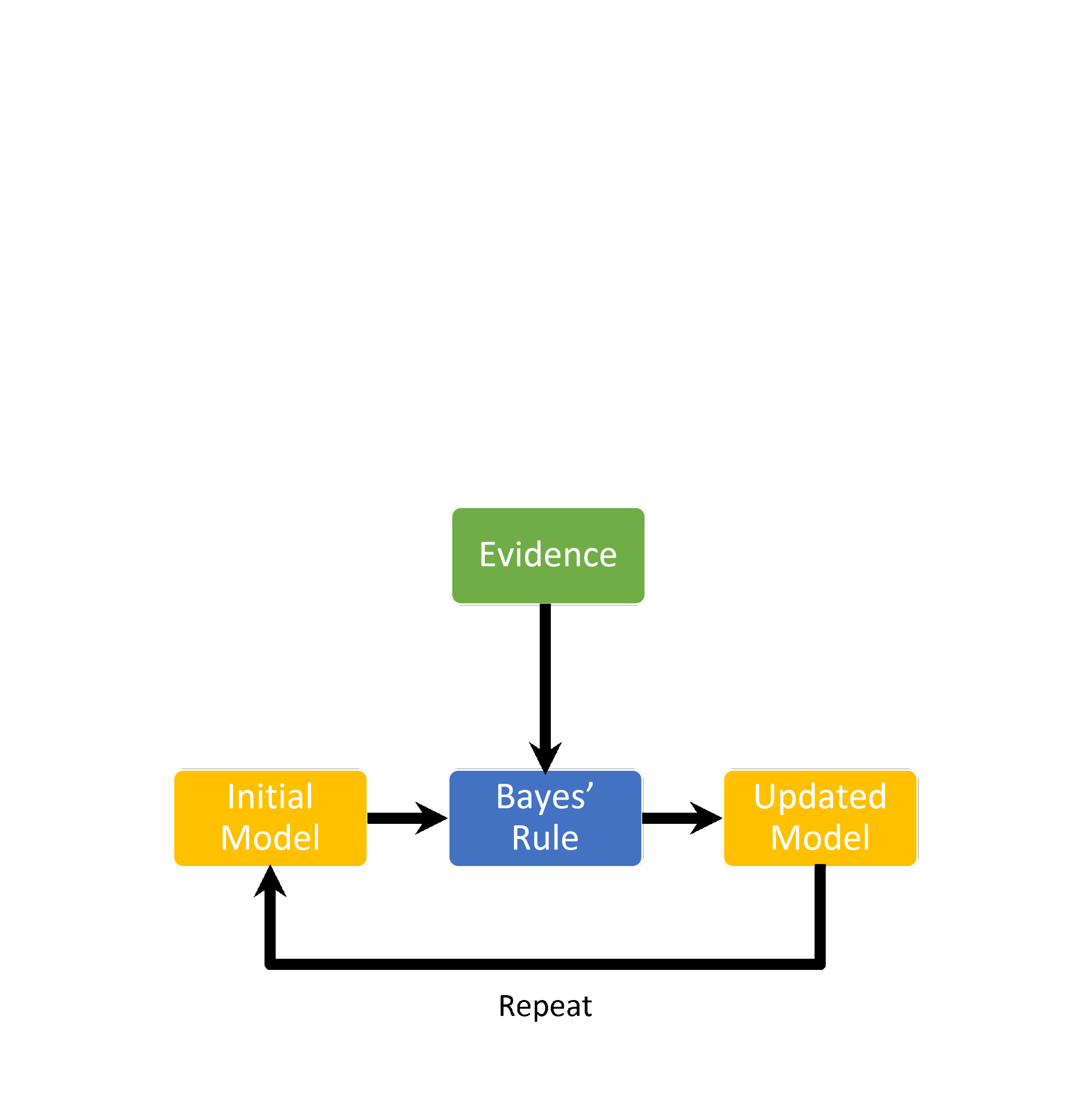
The Bayesian Inferencing Process
Deep Dive: The Scientific Method
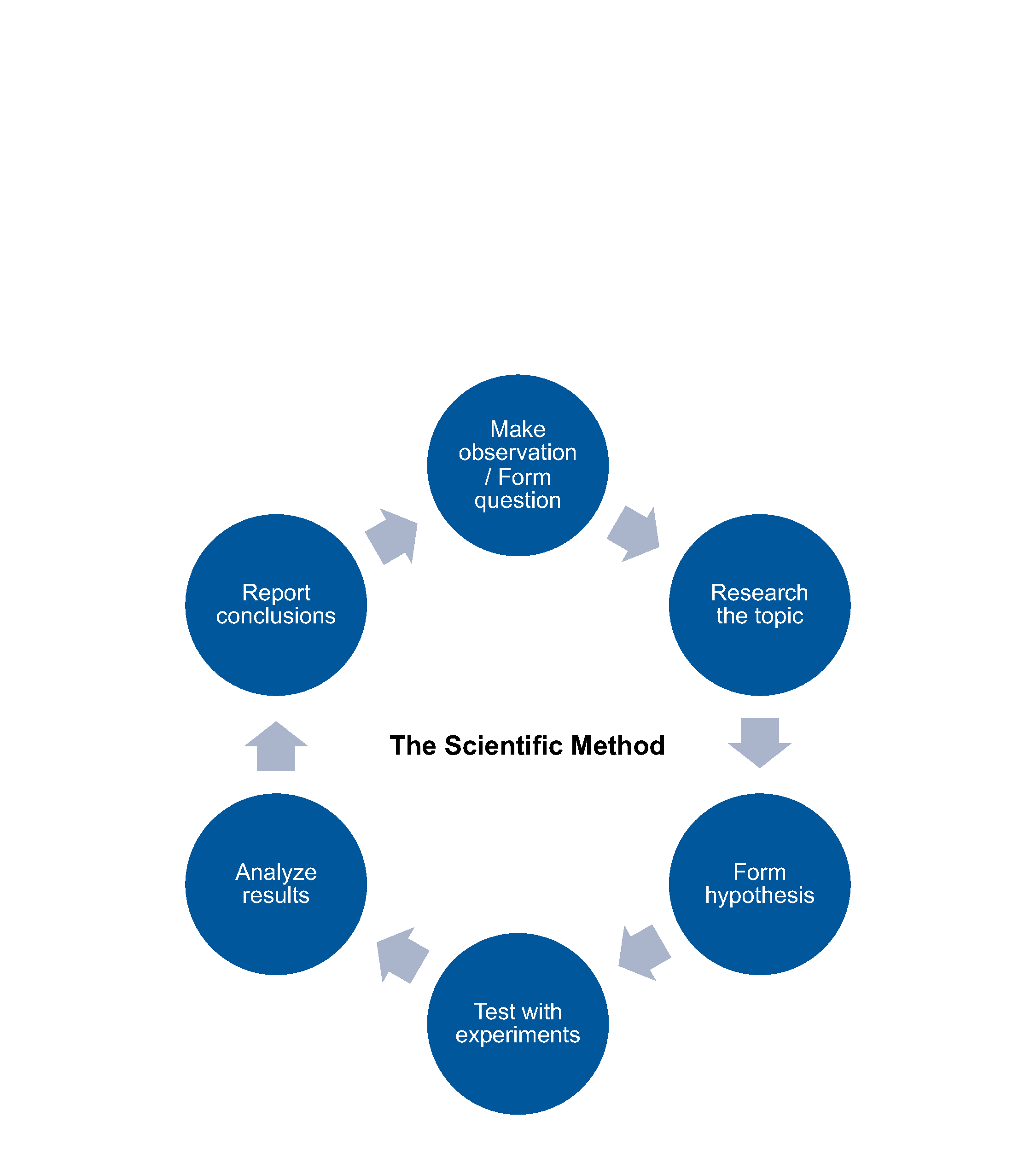
The scientific method consists of making observations, forming a hypothesis based on them, and conducting experiments to see whether the hypothesis holds. If it does, the hypothesis becomes a scientific fact or model; if not, the results feed back into new questions and the cycle repeats. In reality, progress is often messier than this, full of accidents and sudden insights, but the scientific method remains the best way to explain the process after the fact or to replicate results. A confirmed hypothesis is essentially an abstract model that encapsulates the evidence that went into it, and all of science is a constantly evolving set of such models. This means science is never really “done,” which makes some people uncomfortable, but it also gives science a unique kind of authority: it is impossible to defy where it is settled, it tells us the limits of its own reach, and its underlying method remains trustworthy even as the body of knowledge evolves.
Deep Dive: Introspection
Many subjective experiences are self-evident to ourselves, but the inner world of our minds is opaque to everyone else, so there is no way to prove anything about them objectively. This has meant that science has made limited progress analyzing our internal experience, leaving a major gap in our understanding of things like consciousness, meaning and purpose, which are only felt internally. Lately, though, many scientists have come to accept that such subjective phenomena can be analyzed scientifically if the experience is widely corroborated. For the MSE Framework, we take evidence from introspection seriously if it is widely corroborated and has no other explanation. The existence of consciousness, for example, is nearly universally corroborated and has found no other explanation, so we include it in our models (while remaining ready to adjust if an objective explanation is found).
Deep Dive: Pattern and Nebulosity
David Chapman, a computer scientist and Buddhist scholar, has written two phenomenal books, “In the Cells of the Eggplant” and “Meaningness,” which explore the fact that reality seems to contain both pattern (aspects that are clear, definite, and structured, which we can often capture in formulas and equations) and nebulosity (aspects that are inherently indeterminate, fluid, and ambiguous). Physics itself shows both: it gives us precise laws, but at bottom we find inherently nebulous quantum fields and the hard limits of the Heisenberg Uncertainty Principle. Chapman’s example of a cloud captures nebulosity perfectly, as no set of physical or chemical properties can exactly describe it. He argues that pure Rationalism overemphasizes the patterned aspects of reality while ignoring the nebulous ones, so while we shouldn’t abandon rationality, we need to look beyond it. This idea is central to this book, and it has close parallels in other traditions: Shiva and Shakti in Hindu/Vedic philosophy, Emptiness and Form in Zen, and the Apollonian and Dionysian in Western philosophy.
Go deeper: “In the Cells of the Eggplant” and “Meaningness” by David Chapman (both listed in the References).
Deep Dive: The Present-Bounded Rationality Cheatsheet
A quick reference for the methodology developed in the Methodology chapter.
What methods are we allowed to use to build the MSE Framework?
- Build everything from First Principles, starting with the smallest possible number of self-evident phenomena that have no other known explanation. There is a scientific term for these: Axioms (which themselves can be challenged and replaced if something deeper is found).
- From these axioms, follow Bayesian Inference and the Scientific Method to build the model. Typically this yields a crisp formula or model, falling into some branch of Science.
- But sometimes a phenomenon is too nebulous or complex to capture that way. Rationality has limits when applied by our finite minds to something as complex as reality. So we add Satisficing, Heuristics, Approximations, Optimizations, Grounding in the present moment, Open-Mindedness, and Humility into the mix. This modified rationality is Present-Bounded Rationality.
- This methodology, along with the practices that emerge from it (including those using tacit or embodied knowledge that is still systematic and evidence-backed), is the essence of Mindful Engineering.
- As science and engineering progress, they will keep improving our conceptualizations, including our definitions of meaning, purpose and hope. None of it is frozen in time.
What do we do when we can’t know or model something?
- Be comfortable with not knowing, and resist the temptation to take leaps of faith or rely on unjustified opinions. This is the most important aspect of any rational methodology.
- Treat the unknown phenomenon as a black box and study it. Create hypotheses or pedagogical devices to understand it, but never confuse these constructs with the truth.
- Check whether our lack of knowledge is due to a mental block or cultural baggage, and challenge such preconceived notions.
- Keep hacking at the phenomenon using the methodology above to incrementally understand it over time.
Deep Dive: Conscious Realism
Donald Hoffman, a cognitive psychologist at UC Irvine, proposes a theory called Conscious Realism, which holds that evolution did not engineer us to perceive reality as it truly is. Because reality is far too complex, and knowing it fully would cost too much energy, evolution took shortcuts, letting us perceive only the features that offered a survival advantage. What we perceive, then, is not ultimate reality but a representation of it, highly correlated with survival-relevant features. The analogy is a computer’s user interface, which shows us simplified icons that let us use the machine without revealing what actually happens in the circuits, or a map, which represents a territory without being it (and from which the territory cannot be exactly reconstructed). The upshot: it is impossible for us to truly understand ultimate reality, since our only access to it is through our survival-tuned perceptions.
Go deeper: “The Case Against Reality” by Donald Hoffman (listed in the References).
Deep Dive: The Simulation Hypothesis
The Simulation Hypothesis is a hypothetical model of what ultimate reality may be like. (Note that it is at best a pedagogical device, not necessarily the truth; claiming it as truth requires a leap of faith, since we have no evidence for it.) The idea: imagine a universe beyond ours containing something like a computer running a game, a Massively Multiplayer Online Role-Playing Game (MMORPG), with one or more players represented by characters inside it. The game is so engrossing that the players forget they are playing and identify completely with their characters, and the only way to “wake up” is for the character to die. You and I may be such players, fully identified with our characters in a game that looks like our universe; the consciousness we experience may be the consciousness of the player, which could explain why it remains such an enigma. Many science fiction works explore this theme, the Matrix trilogy being the most popular.
Deep Dive: The Computational Universe Hypothesis
Max Tegmark, a physicist at MIT, proposes that the physical universe is not merely described by mathematics but actually is a mathematical/computational structure. The idea is to imagine that reality, at its essence, is the space of all mathematical formulas and algorithms, which somehow expand or execute to generate all of physical reality, including us. This is loosely related to the Simulation Hypothesis but not the same: there is no reality or players outside the “game”; the mathematics is all there is. A major advantage is that it can answer the hardest question of all, why anything exists at all, since mathematics can be seen to exist all by itself in some platonic space without anyone having to “create” it. A big problem is that the theory appears unfalsifiable and untestable, though it still serves as a great pedagogical device for understanding aspects of reality like space, time, and quantum fields.
Go deeper: “Our Mathematical Universe” by Max Tegmark.
Deep Dive: The Wolfram Physics Hypothesis
Stephen Wolfram, a computer scientist and founder of Wolfram Research, has a proposal similar in spirit to Tegmark’s. He proposes that the universe is a hypergraph of on the order of 10^500 vertices, evolving according to rules (cellular automata) that specify how to expand the graph. Starting from a single seed vertex, the rules are applied over and over until the graph becomes our current universe, and all events are the result of the rule being applied to parts of the graph. (The actual rule remains to be discovered.) In this picture, Space at any instant corresponds to a state of the graph, and Time corresponds to its evolution through a sequence of states. Sometimes a formula lets you “jump ahead” to the result of many steps without simulating each one (Computational Reducibility), yielding a concise law of physics; at other times there is no shortcut and the answer can only be found by actually running the steps (Computational Irreducibility). According to Wolfram, most of the hypergraph is irreducible, but it contains reducible “veins,” and physics has progressed by following those veins, which is also why we must contend with nebulosity where reducibility runs out. It’s a rich theory, but still only a theory.
Deep Dive: The Vedic Universe Hypothesis
Vedic Philosophy holds that there is just one universal unified consciousness, Brahman, which is the true ultimate reality; our physical reality is only an illusion, known as Maya. There is no duality between the self and Brahman, and the ultimate purpose of life is to realize this unity (Moksha, or enlightenment), a process, not a destination, that one can progress along forever, endowing life with long-term purpose. A major benefit of this philosophy is that universal compassion follows logically from believing we are all part of the same unified reality. The Simulation Hypothesis can serve as a pedagogical device for understanding Brahman: the external universe containing the game computer and the player together stand for Brahman, our physical reality is the environment inside the game, we are the characters, and the consciousness we feel is really the player’s. It is interesting that over such vast spans of time and from such different backgrounds, people have arrived at such similar ideas, which lends some credence to there being a kernel of truth in at least some aspects of it.
Deep Dive: Poetic Naturalism (Sean Carroll)
Sean Carroll, a physicist, philosopher and podcaster, describes his model of reality as Poetic Naturalism in his book “The Big Picture.” Physical reality is mostly explained by the Standard Model of Physics, except at the low and high extremes (black holes, deep space, the Big Bang). Beyond physics, different domains have their own valid explanations: biology with evolution and genetics, then psychology, then sociology, each with its own laws. How we transition between the layers of this hierarchy (phase transitions, or emergence) is not well understood, which is why a unifying “theory of everything” remains elusive. Carroll’s proposal is that there are many valid ways of talking about the natural world, each valuable in its domain: the fact that the underlying laws are deterministic and impersonal does not prevent us from meaningfully talking, at the human level, about reasons, goals, purposes and free will. It is still fundamentally Naturalism, but with a poetic element in how we describe the higher levels, hence “Poetic Naturalism.”
Go deeper: “The Big Picture” by Sean Carroll (listed in the References).
Deep Dive: A Missing Law of Nature
Many scientists have noticed that the universe exhibits natural tendencies that appear to run counter to the simple degradation implied by the law of Entropy, building order and complexity even as overall entropy increases. A recent effort to formalize this is the paper “On the roles of function and selection in evolving systems” by Michael L. Wong et al., in the Proceedings of the National Academy of Sciences (Vol. 120, Issue 43, Oct 2023). Its abstract reads, in part:
“The universe is replete with complex evolving systems, but the existing macroscopic physical laws do not seem to adequately describe these systems… We suggest that all evolving systems—including but not limited to life—are composed of diverse components that can combine into configurational states that are then selected for or against based on function. We then identify the fundamental sources of selection—static persistence, dynamic persistence, and novelty generation—and propose a time-asymmetric law that states that the functional information of a system will increase over time when subjected to selection for function(s).”
Go deeper: The full paper is linked in the References.
Deep Dive: The “Easy” Problem of Consciousness
The “Easy” Problem of Consciousness refers to the question of how and why certain physical processes in the brain give rise to conscious experience, as distinct from the deeper “Hard” problem of why there is subjective experience at all. It is called “easy” only relative to the Hard problem; it remains an area of active research with several leading approaches. Higher-Order Theories propose that consciousness arises when the brain generates higher-order representations or thoughts about its own mental states. Representationalist Theories tie consciousness to the brain’s capacity to model the world, much like the internal model in the Free Energy Principle. Attentional Theories emphasize attention acting as a spotlight that selects and amplifies certain information into conscious awareness. Global Workspace Theory suggests consciousness arises when information is broadcast globally in the brain and made available to many cognitive processes. No single theory has yet provided a complete explanation.
Deep Dive: Integrated Information Theory
Integrated Information Theory (IIT), proposed by neuroscientist Giulio Tononi, attempts to characterize the Hard Problem of Consciousness. According to IIT, a conscious experience is characterized by a high degree of integrated information: the conscious system must generate a large number of highly differentiated and irreducible states that cannot be decomposed into simpler components. The theory holds that consciousness exists on a spectrum, with different levels corresponding to different degrees of integrated information: a simple system like a thermostat has very low integrated information and would be considered unconscious, while a complex system like the human brain has a high degree of it and can support rich conscious experiences. IIT is one attempt to generalize consciousness to any sufficiently organized system, irrespective of substrate, but it remains controversial, and a satisfactory theory of the Hard Problem is still an open challenge.
Deep Dive: The Observer in Quantum Mechanics
At the most fundamental level we know of, the universe consists of quantum fields, each essentially a probability distribution (a wave function) that has a value everywhere in space, corresponding to the probability of a particle existing there. Yet when we observe reality, we don’t perceive evolving probabilities; we see concrete things. To explain this, physicists developed the Copenhagen Interpretation, which proposes “wave function collapse”: the universe behaves as a quantum wave function when unobserved, but as soon as an observation is made, the wave function collapses into a definite outcome. The Schrödinger Equation successfully predicts the results of this collapse, giving us strong evidence for it. But the idea that “an observation” causes the collapse introduces the notion of an “observer,” which many have speculated is nothing but the mysterious (Hard version of) consciousness. Physicists have generally shied away from this direction, content to do the calculations and leave the observer to the speculators, though Stephen Wolfram has proposed an intriguing possibility (below).
Deep Dive: Stephen Wolfram’s Conceptualization of the Observer
Building on his own framework of physics (see the Wolfram Physics Hypothesis above), Stephen Wolfram offers an intriguing take on the “observer” in quantum theory. His argument: we ourselves are embedded in the universe, which means we too ultimately consist of quantum fields, so we can never be certain of anything being anywhere at any time. This raises the question of how an observer embedded in such a quantum universe can “make sense” of anything at all. According to Wolfram, the only way for such an embedded entity to make sense of anything is to make the field “collapse” into concrete physical particles. This is exactly what the Copenhagen Interpretation demands, and it is corroborated by the fact that whenever we make an observation we always see concrete things (while still being able to infer the underlying quantum fields). This too is still a hypothesis, actively being worked on.