4. Methodology: Engineering the Sh*t Out of My Midlife Crisis
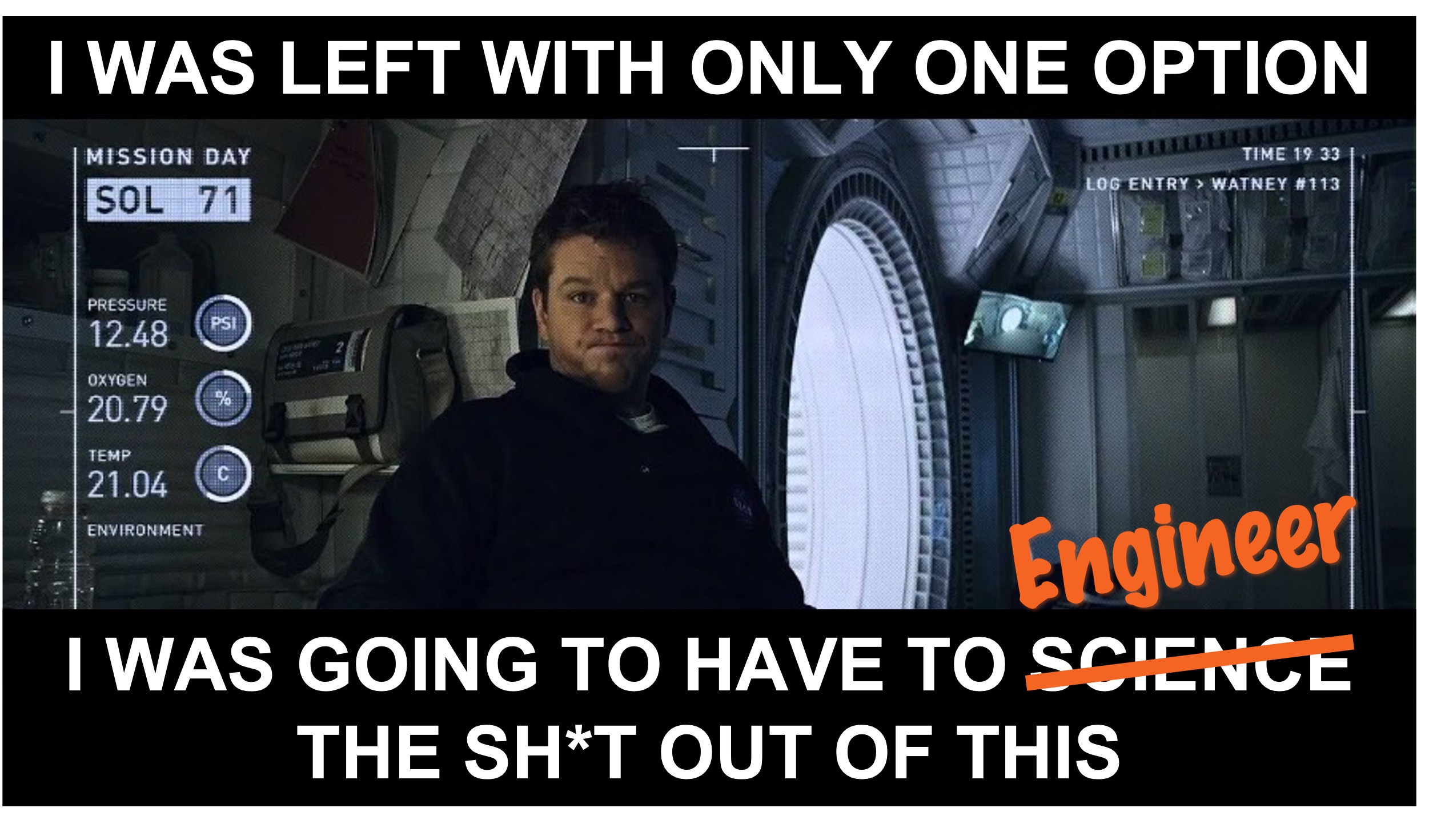
The Martian didn’t “science” sh*t, he “engineered” it!
“P(A|B) = [P(A)*P(B|A)]/P(B), all the rest is commentary.”
― Scott Alexander, Rationalist blogger and psychiatrist, in “Astral Codex Ten” (Blog)
“Nebulosity is pervasive. Other than in mathematics and fundamental physics, nothing is ever definitely this-or-that. Everything is always somewhat this and somewhat that. Put under high enough magnification, a stainless steel ball exhibits the same indefiniteness as a cloud. No ball can be perfectly round, nor made of perfectly pure steel, nor can one definitely say whether some particular atoms are part of it or part of its surrounds.”
― David Chapman, Computer scientist and Buddhist scholar, in “The Cells of the Eggplant”
“Science can amuse and fascinate us all, but it is engineering that changes the world.”
― Isaac Asimov, Science fiction writer, in “Isaac Asimov’s Book of Science and Nature Quotations”
In this chapter, we are going to define the methodology we will use to build the MSE Framework. And since we want to be hardcore about doing things from First Principles, we are going to start from the absolute beginning.
Your beginning, that is.
A Journey of Discovery Begins…
When we are born, we know very few things about our new reality that we suddenly find ourselves in.
But what we are really good at is experimenting with the world and learning from it. Our very life depends upon it!
We quickly learn that when we are hungry, we cry and then we get fed. When we feel wet, we cry, and we get cleaned.
Then we start to associate some faces with the feeling of being fed or cleaned. As a result, we associate feelings of joy and comfort with those faces.
Then, we notice that the faces often smile at us. So we start to mimic the same action. This makes the faces smile even more and do even more feeding and cleaning for us, so this behavior gets fixed in our head.
Days and weeks pass. We are starting to get the hang of this new place. Familiar faces, familiar surroundings, familiar responses to our actions.
Life starts to become a little more predictable and thus a little more comfortable - at least some of the times and at least as compared to the complete chaos at the beginning.
Then one day, we open our eyes and find one of those familiar faces smiling at us. We beam back as usual.
But then, as if by magic, the face suddenly vanishes right in front of our eyes!
We are confused. What happened to that face? Where did it go?
The smile on our own faces disappears and is replaced with concern.
But then, before our attention wanders off, the face reappears seemingly out of nowhere!
Yaay! We are so happy! Everything is again fine with the world and we respond with a chortle.
Then the face vanishes again. And we are again confused. Where did it go? Why does this keep happening to me?
This cycle is repeated a few times and it is a roller coaster of emotions for us, with alternating joy and confusion.
Until we get tired. Or hungry. Or need to be cleaned.
And this game is just one of countless other pleasing, annoying and confusing things that occur around us all the time.
We start to realize that the world is a neverending series of confusing phenomena, i.e. magic, as far as we can tell.
Of course, we don’t know the word “magic” yet, but we intuitively associate the underlying concept of magic with the world. We know that we can have some level of control over our fate, but the world is full of magic nonetheless.
Fast forward a few more months, and we start to figure out what’s really going on with some of these magical phenomena.
By then, due to our incessant activity, curiosity and exploration of our world, we have started forming concepts like “the world contains objects”, “the objects have properties like distance, movement, and occlusion”, “most of these objects appear to persist, though they occasionally move”,”sometimes, when an object moves, it can get occluded by another object” and so on.
We don’t know what any of those words mean yet, of course, but we have started forming a tacit understanding of real-world physics. Not the definitions, formulas and equations yet, but the related attributes, behaviors and intuitions behind them.
Suddenly one day, while we are once again playing our favorite game of peek-a-boo, a light turns on inside our heads. “That face that appears and disappears, it isn’t completely vanishing from reality. It is simply hiding behind an opaque object for a second and then reappearing!”
Unfortunately, once we start to understand this, some of these games start to lose their magic for us. When someone tries to play those games again with us, our attention starts to wander, looking for other magical things in the world.
And the same phenomenon repeats over and over.
Eventually, we figure out that most things that we initially thought were magical, turned out to be not so. They were predictable physical phenomena that we thought were unexpected or magical only because we didn’t understand the physics behind them. But once we do, they don’t remain magical to us anymore.
I believe that this joyful experience of magic (and its eventual loss) stays with us. Sometimes our whole lives. To the extent that whenever we come across something new that confounds us, our first intuitive reaction is to think that it must somehow be magical.
We cling to that joyful magical feeling so much that sometimes we prefer to suspend our disbelief or our natural curiosity just so that we can preserve the feeling!
Luckily, for many of us, the world contains a never-ending supply of magical objects and phenomena, and the fun continues. The cycle of temporarily experiencing magic, followed by exploration and understanding, which results in the loss of that sense of magic, continues in many directions and probably never ends.
What’s interesting and truly magical here is the fact that we are naturally wired to be curious, to perform experiments with the world, to analyze their results, discover insights and find reliable methods for coming up with trustworthy explanations.
Over time, we have created formalisms around this natural tendency that we were all born with. You guessed it, we are talking about the concepts of evidence and reason, and the processes of the mathematical, scientific and engineering methods. They form the ultimate basis for the methodology we will use in this book.
Let us take a deeper (and more formal) dive into them.
Evidence and Reason
Let us rewind back to the wonderful time when you had just opened your eyes for the first time. Your brain was suddenly receiving a lot of input from the various senses that you were born with: sight, sound, smell, touch, taste, and proprioception.
You didn’t know it at that time, but what your brain was doing was collecting evidence about the world (and yourself), detecting patterns in it, categorizing those patterns into objects and concepts, making logical inferences based on them, and slowly piecing together a model of the world and yourself in it.
With each new piece of evidence your brain gathered, it updated this model, bringing it more in line with how the world really is. The strength and direction of these updates depended upon how strong the new evidence was, how strong your prior understanding of the phenomena was, whether it was corroborated by multiple senses and so on. It did this most of the time without your conscious awareness.
You didn’t know it at that time, but what you were essentially doing was Bayesian Inference. In fact, one of the leading theories of how our brain works is called the Bayesian Brain Hypothesis. It is fundamental to how we understand our reality.
(Note that any such descriptions of how our brain functions tend to be somewhat simplistic approximations of what really happens in there. In reality, the brain is a lot more complex and messy, but we can still usefully describe its function at a high level in this manner. Keep the messiness in mind though, it is highly relevant to our endeavor and we will get to it soon enough.)
Over time, the model of reality that your brain built got larger and more complex, and most importantly, more capable of coming up with better explanations as well as making better predictions about phenomena in the real world. And, the better your model got, the better your ability to deal with your new reality, going from total confusion to mere survival to some level of comfort to some measure of predictability and even control. Not perfect, but getting better all the time.
Also note that you did this not just by observing what was occurring around you, but also by performing various actions and observing their results. Not only that, but you acted on your curiosity and your imagination, and inspired by them, sought out new phenomena or built new things in the world, which further improved your understanding of it.
You didn’t know this at that time either, but what you were doing is known as Active Inference. This concept is so important to all living beings that we will devote a major part of the “Life” chapter to it, later on in the book.
In short, we can say that evidence and reason were the basis upon which you built your model of reality. As you grew up, you also started acquiring knowledge in other ways, such as relying on what the adults told you or what the books said. Over time, you also learned some things via introspection (which again could be described in terms of evidence and reason, turned inwards).
The astute reader may have realized that what we are really talking about here is the area of philosophy known as Epistemology. So let’s get into that next.
Beliefs, Knowledge and Gray Areas
Philosophy textbooks define Epistemology as the branch of philosophy that deals with knowledge: what it is, how we acquire it and related details.
Since we are trying to build a fundamental framework for meaning, purpose and hope from First Principles, based on knowledge rather than myths or dogma, we have to start there: What constitutes knowledge and which methods can be used to acquire it. (I have included a deep dive into First Principles Thinking in the appendix if you are unfamiliar with it).
The most widely accepted definition of Knowledge is “justified true belief”.
It is an honest admission of the fact that none of us really knows the ultimate truth of reality and all we really have in the end are beliefs with various degrees of justification for their truthfulness. (For now, just hold that thought in mind. We will get deeper into this in the next chapter.)
So, in order for a belief to be classified as Knowledge, we need strong justification for its truthfulness.
It goes without saying that beliefs that don’t have justifications should not be considered as knowledge. These are things like myths or dogma for which we don’t have any basis. Note that we aren’t saying that they aren’t valuable in other ways. Myths and dogma play a huge role in human affairs. All we are saying is that they can’t be considered to be knowledge, and since our endeavor here is to create a framework based on knowledge, we can’t include them in it.
This still leaves a gap.
Not everything falls neatly into “justified” vs “not justified”. For many real-world phenomena, in particular, when dealing with subjects like meaning and purpose, things aren’t always so black and white. What do we do about those?
This is one of the reasons why people throw up their hands and say that these things are beyond the scope of rational analysis. But, as we have seen, this allows things like myths and dogma with even weaker bases to get in and fill the gap. We want to stop that from happening.
What we have to do in such cases is to honestly acknowledge when we don’t have an incontrovertible explanation of some phenomena, but we may have a strongly justified one, and this justification is significantly better than any other. In such cases, we can provisionally allow such phenomena into our model, with the understanding that they can be replaced if better justifications become available down the road. Also, we always remember that this inclusion is provisional and do not rely on it too much in our model.
Being able to deal with such gray or nebulous areas is an important aspect of our methodology. How we do this will become clearer as we proceed through this chapter.
To start the discussion, let us identify the types of knowledge and then sources of knowledge. This may look a little too academic, but its importance should not be underestimated. In fact, I would argue that many attempts at defining meaning and purpose go wrong right here.
Types of Knowledge
The first type of knowledge is Knowing Facts or Know-What. Here we include things that are typically associated with science. These come in the form of evidence, propositions, formulas, algorithms, equations, models, etc. that we use to explain natural phenomena.
The second type is Knowing How or Know-How. Here we include things like the skills associated with various processes, techniques and practices. This type of knowledge is hard to put into words, and can only be learned through observation and practice or apprenticeship. Other terms that are generally associated with this type of knowledge are Tacit knowledge or Embodied knowledge. Things like learning to play a musical instrument or riding a bike fall into this category.
There is a third type of knowledge, Knowledge by Acquaintance. This includes things like knowing a person or knowing the taste of some food. This type of knowledge can’t be described in terms of facts or be taught via apprenticeship. It has to be learned via direct, personal relationships or encounters with the subject of knowledge.
Just to give you a taste of another way of defining types of knowledge, I have included a deep dive into John Vervaeke’s Model of Cognition in the appendix, which has a significant overlap with the above, but adds further nuances.
Next, let us look at the sources of knowledge.
Sources of Knowledge
The Stanford Encyclopedia of Philosophy states that there are 5 sources of knowledge:
- Perception,
- Reason,
- Memory,
- Testimony, and
- Introspection.
While all of these sources are valuable, since we want to build our framework from First Principles, we need to be careful about how or under what constraints we use them.
It is easy to see that Perception and Reason are highly amenable to First Principles Thinking, because we can do those things ourselves.
For the third source, Memory, we should realize that while we do have first-hand access to our own memories, our memories do tend to fade or get overwritten over time. One way to mitigate this problem is to calibrate our trust in a memory based on how fresh it is or how likely it is that it might have been clouded due to our emotions or judgments.
Since it is practically impossible for us to experience or measure everything, we have to include knowledge acquired through the fourth source, Testimony, into our model. But, in order to do so, we need to have sufficient justification that we could acquire the knowledge ourselves if we wanted to.
For example, we can rely on a result published in a scientific journal (which would fall into the category of Testimony) provided we could, in principle, replicate the result ourselves if we wanted to. Scientific results are expected to fall into this category because being able to replicate them is a standard requirement for something to be considered scientific. (We have all heard of the “replication crisis”, particularly in social sciences. Such a crisis is a lot rarer in the “hard sciences”, so we will focus mainly on them.)
What about Introspection?
Finally, we need to say something important about the fifth source of knowledge, Introspection. There is some debate in the scientific community about how to deal with Introspection in an objective manner given that it is a subjective phenomenon.
In order to avoid stepping into controversial areas that border on pseudoscience or woo, we will only take any evidence derived from Introspection seriously if it meets all of the following criteria:
- It must be simple to describe or define. The definition should be parsimonious and in its purest possible form, i.e. it should contain only the things that are absolutely necessary. Avoid tacking on any additional baggage.
- It must be very widely corroborated. This entails that it should be easy to experience by anyone (including yourself) and the vast majority of people should agree on it.
- It goes without saying that it should not be explainable in any other way. This includes all of the other acceptable sources of knowledge we discussed above, because, in that case, we would prefer those explanations anyway.
For example, this definition allows us to include the concept of consciousness, purely as subjective or phenomenal experience, into our methodology, without any of the additional religious or spiritual baggage that often gets associated with it. It fits our criteria because it is simple to define in its purest, most parsimonious form, we can readily experience it ourselves, it is very widely corroborated, and we have no other explanation for it at present. (Of course, if a better explanation becomes available down the road, we will update our framework accordingly. We will talk about this in more detail in the chapter on Consciousness.)
We will also allow for something like The Great Unknown, the idea that there may be things that are beyond our comprehension, at present and maybe forever. This includes answers to some of the deepest questions about existence such as “Why does anything exist at all” or “What is its ultimate substrate” or “What does ‘existing’ even mean” etc. And again, the idea of The Great Unknown in its purest form is easy to define, is parsimonious in its definition, is easy to understand, is widely corroborated, and no other explanation for it exists.
At the same time, we cannot include introspective reports of many other religious concepts such as the existence of supernatural beings with specific features or actions or commandments supposedly coming from them. This is because they aren’t widely corroborated in the sense that people don’t agree on any of their specific features or actions or commandments, often even getting into conflicts due to such disagreements. Moreover, we have been finding other explanations for many of their supposed features or actions. As a result, we will not be able to include such reports of introspection in our model.
One could say that all such religious ideas ultimately have a common, parsimonious core, which, as it turns out, is essentially the same as the idea of the Great Unknown described earlier. So while we do include that in our model, we don’t include any of the other attributes associated with any religion.
What About Intuition and Emotions?
Yes, it is true that we have also developed other ways of experiencing and dealing with reality besides evidence and reason, such as emotions and intuition. Many people believe that these are fundamentally different from reason and may even be superior.
But more and more work in neuroscience, evolutionary psychology, cognitive science, and even machine learning is peeling off layers after layers of these phenomena, finding logical explanations for them. And there is no reason yet to expect this process to stop anytime soon. Moreover, throughout this process, we have found no other, magical or otherwise, source that could potentially be giving rise to these phenomen either.
On the other hand, we often find our intuitions and emotions failing us. This is because their validity is heavily dependent upon the context you are in. For example, our intuition might tell us that we should always go for high-calorie foods. This intuition evolved in a time period when nutrition wasn’t as readily available as it is today. So while the intuition may have been valid at that time, it is not valid today. The same can be said about emotions. It is a common experience for all of us that there are times when an emotion is appropriate and times when it is not.
So reason is still the arbiter that decides whether the context we are in is appropriate for relying on our intuition or emotion. And since we are trying to develop a general framework for understanding reality and finding meaning, purpose and hope in it, it makes sense for us to rely on reason.
And even reason has a boss: The ultimate basis of everything is always evidence. Reason is just a process we use to explain the evidence, compress and represent it in our mind, and make predictions about any future evidence we expect to encounter.
Bottomline
All of this discussion on epistemology may have just been a long-winded way of me saying that we are going to base the framework only on the principles of Evidence and Reason, without relying on any faith or dogma or magic or opinion. (Yes, I am aware that there are some strong objections to using this approach for explaining reality, and in particular things like meaning, purpose and hope, and we will address them immediately after this section.)
It is true that taking this approach does mean we lose some of the sense of magic in our lives that we may have enjoyed in the past, but luckily we keep discovering new instances of unexplained or magical phenomena to entertain ourselves!
Also, an extremely important point to note is that any of the concepts that we do include in our framework can be challenged and even replaced if something better comes along. Nothing that is included here should be seen as final. In fact, being flexible and constantly improving, or being “alive”, is an essential aspect of the framework.
Knowledge and epistemology in general are of course very deep topics in philosophy and volumes have been written on them. I am not really doing full justice to them here in one section. But I felt it is important to start there since we want to be absolutely sure that we aren’t going to depend upon anything that does not have a strong justification for it.
This type of analysis is exactly what our insistence on rationality and Thinking from First Principles demands. (Now you may understand why I am unhappy with the other ways of finding meaning in our lives. They do not rise anywhere close to this standard.)
Still, an honest application of rationality itself requires that we recognize its limits, and come up with rational ways of dealing with them. In other words, we want to follow rational thinking as much as we can, but avoid becoming zealous followers of rationalism.
Limits of Rationality
The dictionary defines rationalism as “a belief or theory that opinions and actions should be based on reason and knowledge rather than on religious belief or emotional response”.
That sounds a lot like what we are trying to do here, doesn’t it?
But it is also known that taking this approach too far causes serious problems. In fact, one of the strongest criticisms of rationalism is exactly that its adherents suffer from naiveté on the one hand or hubris on the other.
At a higher level, one can say that every good idea eventually gets driven off the cliff by its most ardent followers! The concept of rationality or rationalism is no exception to this rule. History is full of self-described rationalists driving themselves and their faithful followers off cliffs.
This occurs because many rationalists have a tendency to make it sound like reality is far simpler than it really is or that our rational thinking abilities are far stronger than they really are. Rationalists usually fall in love with some abstract idea or model or “theory of everything” and really believe that it describes everything in reality. The idea or model is usually pure and clean and very appealing to our minds. Then they try to impose those pure and clean ideas on the real world. But the real world is not as pure and clean. It contains a lot of complexity and nebulosity. So their predictions fail or their recommendations lead to disasters.
What they don’t realize is that they are actually falling for the same trap that the non-rationalists fall for: taking leaps of faith! Their faith in their model is so strong that they ignore all the complexity and nebulosity of reality.
Ironically, other rationalists have analyzed this phenomenon, and come up with names for a set of psychological biases that many ardent rationalists suffer from:
- Legibility bias: The tendency to favor information that is clear, well-organized, and easily comprehensible over more complex or ambiguous content.
- Formality or Elegance bias: The inclination to prioritize solutions or ideas that are aesthetically pleasing or sophisticated in presentation, sometimes at the expense of practicality or functionality.
- Systematicity bias: The preference for structured and systematic approaches, often leading to a tendency to overlook or undervalue more flexible or chaotic methods.
We need to be careful to avoid these pitfalls of over-reliance on rational thinking. We know that reality is not always legible, formal, elegant or systematic.
We also need to distinguish between using rational methods in a bottom-up (or First Principles-based) manner vs using them in a top-down manner to prove some idea that the rationalist holds as sacred. The latter is basically the same as what is commonly known as “rationalization” and is not a scientific method. It is more of a method of advocacy, which is not what we are attempting to do here. We only want to create a framework that anyone can validate for themselves without anyone needing to advocate for it.
Pattern and Nebulosity
Finally, we need to acknowledge something fundamental about reality itself: it seems to contain some regularities or patterns, but also a lot of nebulosity as well as many unknowns. This idea is critically important to the book, so let us spend a moment on it. (I came across it through the books of David Chapman, the computer scientist and Buddhist scholar quoted at the top of this chapter. There is a Deep Dive on his work in the appendix.)
Science has shown us that reality does contain many patterns, i.e. aspects that are clear, definite and structured. In many cases, we have managed to capture these patterns in terms of formulas and equations with very high levels of predictability and accuracy. But at the same time, we have ample evidence that many aspects of reality are not so easy to capture. They are too nebulous: inherently indeterminate, fluid and ambiguous. Chapman gives the great example of a cloud. No matter which physical or chemical properties you consider, trying to exactly describe a cloud is impossible. It is inherently nebulous. Even a shiny stainless steel ball exhibits the same indefiniteness as a cloud when seen under a microscope. Physics itself tells us that at the bottom of it all we have quantum fields that are inherently nebulous, and the Heisenberg Uncertainty Principle puts hard limits on how accurately we can even measure things.
(Interestingly, this idea has close parallels in other bodies of thinking: Shiva and Shakti in Hindu / Vedic philosophy, Emptiness and Form in Zen philosophy, and the Apollonian and Dionysian forces in Western philosophy.)
The upshot is this: rationality can help us come to grips with the patterned aspects of reality, but it fails when dealing with nebulosity or unknowns. Pure rationalism tends to overemphasize the patterned aspects of reality while ignoring the nebulous ones. So, while we should not abandon rationality, we definitely need to find a principled way for going beyond it.
At an even more fundamental level, opponents of rationalism point to Gödel’s Incompleteness Theorem as the ultimate proof of the futility of using rationality to understand reality. (I have included a Deep Dive into Gödel’s Incompleteness Theorem at the end of the chapter, in case you are unfamiliar with it, along with how our framework answers this objection.)
When people encounter these objections to rational thinking, their knee-jerk reaction is to totally give up on it and go back to far more irrational concepts to justify their beliefs (such as faith or emotions) or stop thinking altogether.
This is throwing the baby out with the bathwater. We don’t want to do that.
Dealing with the Limits: Present-Bounded Rationality
In order to address all these limitations of using rationality to explain or deal with reality, we need to put some constraints on how we will apply it and also qualify the results we come up with.
Doing so gives us a modified version of rationality, which I have named Present-Bounded Rationality. It combines elements of the well-known concept of Bounded Rationality with the idea of starting from and focusing on the present moment and location. Both of these are well-established ideas, though, as far as I know, this particular combination appears to be new.
Present-Bounded Rationality rests on four pillars. Let us go over each of them.
A) Insistence on Evidence and Reason, with Evidence as the Supreme Arbiter
Fundamentally, we are still talking about a rational method of knowledge acquisition. So it is still primarily about using evidence and reason. This means using the well-known techniques of Thinking from First Principles, Bayesian Inference and the Scientific Method. (These should be quite familiar to many people, but Deep Dives on each of them are included in the appendix for completeness.)
But one of the largest pitfalls of rationalist thinking throughout history has been that people have sometimes become so confident in their process of reasoning that they have neglected clear and present evidence that was contradictory to the results of their reasoning. The well-known failures of the cultural and architectural movement of Modernism, as well as those of Rational Choice theory in economics and its eventual replacement by Behavioral Economics, have been blamed on exactly this.
We want to avoid this trap. It seems silly to have to say this, but it is important to say it anyway: We must always treat evidence as the ultimate arbiter, no matter how confident we are of our reasoning process.
Here is a famous quote that captures this sentiment perfectly:
“It doesn’t matter how beautiful your theory is, it doesn’t matter how smart you are. If it doesn’t agree with experiment, it’s wrong.”
― Richard Feynman, American Physicist
Evidence is where the rubber meets the road. If the evidence does not agree with the results of our reasoning, then we must go back and deeply investigate our entire reasoning process, look for any piece of evidence that we may have missed along the way and update our process accordingly.
B) Bounded Rationality and Satisficing
Reality is full of complexity, nebulosity and unknowns. In spite of the great strides we have made, our ability to model reality accurately or influence it predictably is limited.
This can be easily demonstrated with a simple activity that many of us do regularly, such as making dinner. There is a recipe you need to follow, but you can rarely follow it exactly as specified. The water might be too cold. The spice may have lost some of its flavor. The butter may be too hard. The phone might ring in the middle of cooking. One has to both follow the recipe and keep adjusting it depending upon all such unforeseen factors. Add to that the large variety of kitchen configurations, recipes, ingredients and utensils, and it should be no wonder that, in spite of a huge and lucrative potential market, we have not yet managed to create a general-purpose cooking robot.
These problems have been widely recognized and studied by many rationalists who had the misfortune of taking their beautiful formulas and diagrams and building something real in the real world. Such as a house. Or a sewage pipeline. Or, indeed, a whole city. This is the domain of engineering, rather than science.
One of the most prominent voices among such people was that of Herbert Simon, an American political scientist who has the rare distinction of winning both the Nobel and Turing awards. He formulated an approach known as Bounded Rationality to deal with these constraints. This approach recognizes the limits to our knowledge of reality, the cognitive constraints of our intellectual ability, and the complexity of the problem. It involves the incorporation of heuristics, tacit or embodied knowledge and evidence-based practices that can’t always be formulated precisely in terms of scientific formulas. But note that we are still bound by the constraints of evidence and reason, not leaps of faith and wishful thinking.
A closely related idea is Satisficing, a combination of “satisfying” and “sufficing”. The idea here is that, due to the limitations described above, coming up with perfectly optimal solutions to some problems may not be feasible. In such cases, we may need to settle for solutions that are “good enough” and keep improving them over time.
This is basically what we do pretty much all the time in our real lives. We are constantly making decisions in a complex and dynamic environment based on very limited knowledge. In fact, it has been shown that the total amount of knowledge, as we expand further out from our immediate context, is so incredibly large that there is simply no way we could analyze it rationally. We are almost always forced to satisfice.
There is ample evidence that everything in nature itself follows this approach. No system in nature can afford to look for the perfect solution, settling instead for something that is good enough and incrementally getting improved via the process of evolution. Some of the most well-known examples of satisficing are the human reproductive system, the way pollen gets spread by bees, and indeed the process of rapid iterative development with constant feedback that is recommended for startup companies.
C) Grounding in the Present Moment
Many models of reality rely on starting points that are abstractions or “somewhere out there” e.g. some abstract principles or values (including “human values”) or ultimate goals (including “human flourishing”). I am not saying that these starting points are necessarily wrong, but they are often taken for granted without any supporting evidence for why those starting points and not some others. If we did that here, this whole project would become meaningless. We need a starting point that is a lot more defensible and real.
As a result, I have chosen to go with something much more concrete and trustworthy as a starting point: the present moment.
If there is one thing I can be most sure of, it is that I exist right here, right now. I am alive, awake and experiencing this present moment. And the same applies to you. So it makes sense to start from there instead of from some abstract concepts for which we may have no evidence.
We have a far better understanding of our present situation and the forces at play in the current moment than any other situation or moment. It is well acknowledged that our ability to predict things too far into the future (or remember things from the past, for that matter) goes down rapidly as the timespan increases. Same for physical distance or difference in contexts in general.
This is because reality is extremely complex, involving too many entities and forces acting on them along too many dimensions. Trying to apply our relatively limited knowledge of reality to this complex soup quickly leads to combinatorial explosions. Real-world systems are also extremely sensitive to initial conditions, which we may not be able to measure accurately. As a result, the longer the time or distance horizon or along any other dimension, the less we should trust our ability to make any statements about it.
It is not just that none of us can say exactly what will happen tomorrow or whether our account of some distant event in the past is accurate in all its aspects. Even well-known scientific theories, such as the origin of the universe or its presumed end, aren’t as clear-cut as we think they are. There are serious challenges to either the whole or parts of these theories.
The way we deal with this limitation is to put most of our trust in the present moment, our present location in space, and our current context along all other dimensions of reality that we can think of. We want to base as much of our thinking as possible on phenomena we can observe “right here, right now”.
Note that this does not mean we can’t look at long-term or distant phenomena at all. We can and certainly do make long-term plans and strategies when going through our lives. But all our actions are always in the present. And given that everything is constantly changing, we may have to adjust our planned course of action. This adjustment, again, occurs in the present moment. It is important to realize that there is really no getting away from the present moment! Everything else is an abstraction, i.e., a simplified and often inaccurate or even completely untrue, model of reality.
This is clearly in contrast with most other ways of thinking about meaning, purpose and hope. Their insistence on abstract or far-off phenomena (such as the beginning or the end of the world, or heaven and hell, or some supernatural power etc.) necessarily involves taking leaps of faith. Often the distance from our present situation to those phenomena is so large that, if we are honest, we are simply unable to apply any sort of rational analysis to them. (Interestingly, this allows their proponents to claim that rational analysis is useless for such purposes. This is circular reasoning!)
Starting from and focusing on the here and now makes our methodology far more robust and amenable to rational analysis as compared to the alternatives.
D) Humility and Open-Mindedness
One of the most important failures of rationalists in the past has been overconfidence and hubris. This is what made them go out and rearrange the world based on their ideas and ignore clear evidence that things weren’t quite working as they had imagined. And then they kept pushing ahead even after their ideas had completely failed.
One of my favorite sayings is “All good ideas die at the hands of their most ardent supporters.” We obviously want to avoid this fate. So remaining humble and open-minded, and being willing to change our minds based on evidence, is a load-bearing pillar of Present-Bounded Rationality, not an afterthought.
That completes the definition. To summarize: Present-Bounded Rationality is a principled way of forming, updating, and pruning our model of reality despite significant real cognitive and informational limitations. It insists on evidence and reason, acknowledges the complexity and nebulosity of reality and the limits of our cognition, satisfices rather than chasing perfection, grounds itself in the present moment, and stays humble and open-minded throughout.
Before we proceed, I want to emphasize two interesting points.
Mindfulness and Stoicism
I am not the first one to suggest ideas like non-judgmental focus on the present moment (though, as far as I know, I am using it in this way for the first time.)
In fact, what I am talking about looks a lot like the practice of Mindfulness. This connection between the Present-Bounded Rationality methodology and Mindfulness isn’t accidental either. There is a strong scientific basis for this connection, and we will explore this in much depth in the chapter on Life.
Also, note that the ideas of grounding in reality and non-judgmental observation are central to the Western tradition of Stoicism.
I believe that the fact that our Present-Bounded Rationality methodology has so much in common with well-established practices in two totally unrelated traditions lends further credibility to the methodology. We will rely on this fact much later in the book when we talk about developing practices based on our model.
The second point I want to address is a common misconception about the relationship between science and engineering.
Science vs Engineering
You may have noticed that I keep mentioning engineering in the same breath whenever I talk about science.
This is very much intentional. There are some interesting and critical differences between science and engineering.
The most obvious may be that the methodology of Present-Bounded Rationality is actually closer to engineering than to science. One can say Present-Bounded Rationality has the same relationship to engineering that pure rationality has to science.
But this idea goes a lot deeper than that.
We usually think of Engineering as the application of science and math to some real-world problem. For example, Wikipedia defines Engineering as follows:
“Engineering is the practice of using natural science, mathematics, and the engineering design process to solve technical problems, increase efficiency and productivity, and improve systems.
― Wikipedia
This way of defining engineering makes us believe that science and math were developed first and then engineering was developed as their application. But this is not true.
What do you call the activity that honeybees or spiders or birds perform when they build or fix up a hive or a web or a nest? What do you call the activities that human beings were engaging in when they started using the first tools or practicing agriculture or building shelters long before there was any notion of science? What do you call the activities that go on in your own body when it is repairing a broken bone or patching broken skin?
Going even deeper, when you take a close look at the activities that go on inside a living cell, such as various proteins building tracks for transporting molecules from one part of the cell to another or making copies of DNA, a lot of them look exactly like what we would typically call engineering. Every biological cell, as well as the organ or organism it is a part of, is a nano-factory.
Don’t these activities involve building or fixing complex structures in a methodical and repeatable way, based on an understanding of requirements, physical principles and local conditions? In other words, doesn’t it all look like engineering?
What’s interesting here is that neither honeybees nor spiders nor birds nor even the living cells in our bodies have any explicit or formal understanding of science or math. One could say that they have embodied or tacit knowledge, acquired through the trial and error method of evolution, but none of it is in any form we would recognize as a scientific formula or model. And yet, in spite of this seeming lack of understanding of science or math, all of these entities are able to deal with complex, nebulous and even unknown aspects of reality, which science and math struggle with!
And their methodology for doing that looks a lot like Present-Bounded Rationality!
I think that engineering, seen in this light, is a much broader and older discipline than what we have typically believed it to be. One could even say that engineering, and its basis, Present-Bounded Rationality, are the primary activities all living creatures engage in. Only for intelligent creatures like ourselves do science and math emerge as secondary activities that aid and formalize (and eventually improve) parts of various engineering methods and practices, instead of the other way around.
An engineer’s ultimate responsibility isn’t to discover scientific explanations or mathematical bases for phenomena but to solve a real problem in the world in a systematic way. Such explanations can always come later and may help improve the engineering method in turn, but they are not essential to the activity itself. One can say that engineering isn’t just an application of science and math to real-world problems, but science and math can be thought of as formalizations of engineering!
There is a general belief that math and science are inadequate for the task of dealing with many aspects of reality, including things like meaning, purpose and hope. The reason why I keep bringing up engineering is exactly because I think this inadequacy can be effectively addressed by adding engineering (and the related methodology of Present-Bounded Rationality) into the mix.
Now, I know what you’re thinking. “But engineering or technology has created its own problems!”
Yes, that’s true. Some of the major evils that plague us today have been blamed on technology: Everything from nuclear weapons to factory farming to overfishing to social media to the potential for the dreaded “AI apocalypse”.
This is where, once again, some of the important aspects of Present-Bounded Rationality come into the picture. If you constrain your engineering efforts by grounding them in the present and being humble and open-minded, you can overcome the aforementioned evils.
In fact, I am going to go ahead and coin another term, “Mindful Engineering”, to capture this. Mindful Engineering is the practice of Present-Bounded Rationality i.e. systematically building things or fixing problems in the real world, while honoring the four pillars: the supremacy of evidence, bounded rationality, grounding in the present moment, and humility and open-mindedness.
This reminds me of something.
Well, But What About the Martian?
At the beginning of the chapter, I included a meme about The Martian. Let me explain why.
In the movie by that name, Matt Damon’s character finds himself stranded on Mars, alone and without any hope of being rescued anytime soon. He only has a few days’ worth of rations, and more importantly, oxygen, left.
So, what does he do? In his words that have achieved meme status,
“In the face of overwhelming odds, I am left with only one option: I’m going to have to science the sh*t out of this!”
― Matt Damon, American actor, in “The Martian”
He then proceeds to calculate how to make his rations last longer, how to grow his own food, and even make his own oxygen! Eventually, he figures out how to take off using a broken rocket.
What is not obvious to a lot of people is that he isn’t really “science-ing” much. He is mostly “engineering” it!
While there is certainly a good amount of science involved in what he does, most of his activities actually fall into the domain of engineering: Quickly and constantly assessing his overall situation, determining his constraints and requirements, figuring out and scheduling the critical path to survival, conducting field experiments, many of which fail and have to be redesigned. Not aiming for the luxury of perfection but for the reality of “satisficing”. Not discovering new concepts or models, but applying existing concepts and making them work in the messy and unpredictable world. This is pretty much the textbook definition of engineering.
I included this here to further emphasize the distinct identity and supremacy of engineering as compared to science.
(Ahem. “Identity” and “Supremacy” and Matt Damon? Sorry, couldn’t help it.)
I suppose my emphasis on engineering rather than science may look a little unusual to many people, so it makes sense for me to address one of the main objections I can think of.
Don’t We Need Perfect Knowledge?
In some ways, our methodology of Present-Bounded Rationality feels like a compromise.
We have been led to believe that we need a complete and perfect understanding of reality before we can talk about things like meaning and purpose. This belief has led people to create the illusion of complete and perfect knowledge by invoking some supernatural power with various attributes and behaviors to fill the gaps in our knowledge.
But do we really need that? I don’t think so.
Cells in your body contain amazingly complex structures and execute equally complex processes that allow them to feed themselves, fix problems as they occur, and replicate when appropriate. They do this even though they are immersed in a complex, nebulous and largely unknown reality. They have no notion of any kind of supernatural power and that doesn’t stop them.
Zooming up to the human level, we have developed medicines that manipulate the functioning of our own cells at the molecular level, tools that etch nano-scale circuits on semiconductors, and spacecraft that can land on distant asteroids moving at astronomical speeds, in spite of the fact that we do not have complete and perfect knowledge of their structure and functioning.
All these examples are proof that being able to evolve extremely complex structures and processes or solve extremely complex problems does not require complete and perfect knowledge. Moreover, if you look at how all of these phenomena came into existence, you will see something very much like Present-Bounded Rationality at work. In fact, the methodology is simply a formalization of what we can see at work everywhere in nature.
So this methodology is not a compromise at all. In fact, it looks like it’s the only methodology that works in the real world.
Isn’t that so much better than taking leaps of faith or taking someone’s overconfident but baseless proclamations as the truth? Or throwing up your hands that you aren’t able to create a complete and perfect model of reality that explains everything?
Still, I am not against people who want to continue on the path of faith. This book is not about the raging debates on religion vs science or faith vs fact. I actually prefer a world where many competing approaches to the ultimate truth flourish and learn from each other. All I am saying is that, if someone does want to stick to the path of evidence and reason, it is possible to go a lot further with it than what we have been led to believe. More importantly, you aren’t going to miss out on anything that the other paths give you.
Here is an interesting quote from Laplace, a well-known French scholar from the 18th century, that is highly instructive in this regard:
When Napoleon asked Laplace why he had not mentioned the Creator in his book on the system of the universe, Laplace said
“Sire, I had no need of that hypothesis.”
― Quoted by Augustus De Morgan in “Budget of Paradoxes”.
Similarly, I am also claiming that we do not need to hypothesize a magical source of complete and perfect knowledge in order to reach our goal of finding meaning, purpose and hope in our lives.
To conclude, Present-Bounded Rationality, as described here, will be the methodology we will use to build the MSE Framework.
As one would expect, any framework designed to help one find meaning, purpose and hope in one’s life needs to not only define a model of reality, but also guidelines about how to live in it. Over the next few chapters, we will accomplish both of these goals. And since we will be using the Present-Bounded Rationality methodology to build both, we will be able to see how everything is built and, as a result, have a lot more confidence in it as compared to other approaches that rely on taking leaps of faith or appeals to authority.
As you would expect for any framework based on First Principles Thinking, we need to start by first defining our model of Ultimate Reality. We will do that in the next chapter and then go on stepwise from there.
But before we do that, here is one deep dive that I feel is important enough to keep right here in the chapter, because it addresses the strongest formal objection to this whole endeavor. (The rest of the deep dives for this chapter are in the appendix.)
Deep Dive: Gödel’s Incompleteness Theorem
Gödel’s Incompleteness Theorem proves that no mathematical system can be complete as well as self-consistent.
Many people have used this as proof that trying to use reason or rationality to understand reality is doomed right at the core. Essentially the claim is that rationality is a mathematical system and as such, it cannot provide an explanation of reality that is both consistent and complete.
The MSE Framework addresses this problem as follows:
- The framework relies not on pure rationality, but on Present-Bounded Rationality, which takes the inherent limitations of rationality into account and accommodates them via heuristics, satisficing, and grounding in the present and in reality rather than abstractions.
- We are not claiming to build a complete model of reality. We admit that reality contains many unknowns as well as complexity and nebulosity that we are unable to capture in terms of mathematical concepts. We also rely on axioms, and we admit that we cannot peek behind them.
- We are not aiming to create a complete and final solution to our problem of defining meaning, purpose and hope either. Any solution we come up with will be good enough to solve the problem in the best way currently possible, while remaining open to learning and modification in the future.
Sometimes, the people who bring up Gödel’s Theorem and the limits of rationality in general want you to just give up on rationality and take leaps of faith with them or accept some dogma or poetic ideas.
But the flaw in that argument is that even if one admits all these limits of rationality, that does not give you permission to suddenly turn around and run in the opposite direction where your only choice is to take leaps of faith or rely on even less firmly established concepts. Just because you only have a good enough but less-than-perfect solution does not mean you should suddenly jump to something with no substantiated basis at all!