2. Premise: Two Roads Diverged in a Yellow Wood…

Well, not quite a yellow wood, but we’ll make do with this for now
“All the interests of my reason, speculative as well as practical, combine in the three following questions: 1. What can I know? 2. What ought I to do? 3. What may I hope?”
― Immanuel Kant, German philosopher, in “Critique of Pure Reason”
“If you are in a shipwreck and all the boats are gone, a piano top buoyant enough to keep you afloat that comes along makes a fortuitous life preserver. But this is not to say that the best way to design a life preserver is in the form of a piano top. I think that we are clinging to a great many piano tops in accepting yesterday’s fortuitous contrivings as constituting the only means for solving a given problem.”
― Buckminster Fuller, American architect and systems theorist, in “Operating Manual for Spaceship Earth”
Man’s (Incomplete) Search for Meaning
As I mentioned in the previous chapter, I really wanted to find honest, defensible answers to the questions of meaning, purpose and hope, based on rigorous stepwise analysis, all the way from the ground up. No shortcuts, no leaps of faith, no hand waving, no dogma.
But how was I going to do that?
Luckily, this quest is not uncommon at all. In fact, it might even be one of the oldest.
Since the dawn of time, in every corner of the world, scores of human beings have gone through this exercise. Time and again, people have asked fundamental questions about existence, such as:
- What is all this that surrounds us?
- What does it all mean?
- What is its purpose?
- Who am I?
- What is my purpose?
- Where is it all going?
- What can I be hopeful about?
- How can I live a good life?
Now, if you go down the street and try to ask a random person what they think about the fundamental questions of “life, the universe and everything”, most of them will probably say that they don’t think about such stuff. (That is if they don’t look at you like you were crazy and cross the street first!)
Many people probably go through their entire lives without ever thinking about these questions. Some might point to some book or some person. Some would say it’s a luxury they can’t afford. Some would even say it’s a waste of time.
But the reason why most people are able to get through their lives without having to think about these questions on a regular basis is exactly because various people in the past have already done this thinking for them. Sometimes explicitly, as in some holy man/woman or philosopher or even scientist coming up with a brilliant idea that suddenly clears things up. At other times, the process was a lot more subtle, consisting of just regular people rolling up their sleeves and solving a problem they were facing, and then their solutions continuing to evolve through trial and error.
Over time, the answers and solutions that worked have turned into social structures, practices, laws, rituals, technologies and techniques, which hide all the underlying complexity of thinking and experimentation from the person in the street.
That’s the reason most people are able to ignore such questions most of the time. (Isn’t that the real luxury?)
We could even say that most of the progress humanity has made over the millennia has been, in large part, due to many such thinkers and tinkerers relentlessly asking such questions, simplifying the answers, creating structures and processes based on them, and bringing them to people.
The nerdy way of saying the same thing is that these questions and answers form the operating system of society, on top of which many apps have been built. Most people can simply use the apps to get through life. Only a few ever get their hands dirty by going deep into the operating system.
But that’s what an engineer does, isn’t it? An engineer whose hands aren’t dirty is not really an engineer, right?
Engineers don’t want to just use the apps. We want to understand the plumbing beneath them. We want to know how the apps work, where they came from, why these apps and not some other ones, how to develop new ones, and so on.
For an engineer, what can be more interesting than learning about the operating system of life, the universe and everything?
Note that here, by “engineer”, I don’t necessarily mean just those who went to engineering school or those who have it as their job title. I mean anyone who thinks like an engineer, anyone who wants to systematically understand how things work and how they could be improved.
So my definition of engineers includes scientists, doctors, entrepreneurs, architects, lawyers, artisans and everyone in between. Anyone who doesn’t want to just use the apps, but wants to understand the operating system underneath them, and build new apps or even a whole new operating system, if necessary.
But I am getting ahead of myself. We will get back to the special role of engineers when it comes to things like meaning in life soon enough. After all, the book is titled “An Engineer’s Search for Meaning”!
For now, let us get back to the person in the street we started with, the one who said they rarely think about this type of stuff.
Whether they think about it or not, most people do face such questions, either explicitly or implicitly, when they have profound life experiences, such as births or deaths in the family or when diagnosed with a serious disease or when they break up with someone or lose their job or get betrayed or seriously disappointed in some way. Or when they face major life decisions, such as choosing a career path or a life partner or a new place to live. Or whom to vote for.
And of course, as we have already seen, when going through midlife crises!
To summarize, while these questions look rather obscure, they have been extremely important and influential throughout history, and continue to be so, both at the societal level as well as the individual level. Plenty of literature is devoted to them.
As a result, all I should have needed to do to find satisfactory answers to the questions of meaning, purpose and hope in life was to simply go to the library (or Google and Wikipedia or ChatGPT) and spend a few months reading.
Well, as it turned out, it wasn’t that easy.
My insistence on answering these questions rigorously and from First Principles ended up becoming a major hurdle in my way. I didn’t just want some answers that sounded good or were popular. I wanted to know how those answers were arrived at and be convinced that they stood on firm ground.
Unfortunately, that’s not what I found in the library. Or any of the newspapers. Or the internet in general.
There were plenty of answers, to be sure. But none of them quite met my criteria. They all looked made up, at least to some extent.
I had to make a choice. As Robert Frost’s famous poem goes, “Two roads diverged in a wood…” One was well-traveled, while the other one wasn’t.
(I am aware that there is supposed to be some controversy about how to interpret the poem. But we are going with the popular (mis?)interpretation here.)
Let us first look at the well-traveled road(s) and why they didn’t work for me.
Well-Traveled Roads: Religions / Philosophies / Causes / Institutions
The largest bodies of thinking that address existential questions, and have the widest and deepest range of answers, can be found in the world’s popular religions and philosophies or ideologies.
Also popular, particularly among people who have decided to move away from religions and philosophies, is dedicating oneself to various causes. These may include things like freedom, environment, justice, health, poverty, the arts and so on. Alternatively, some people dedicate themselves to various institutions, including their employers or the industries they are in.
On a more fundamental level, we also have the popular triumvirate of money, power and fame that most people, knowingly or unknowingly, dedicate themselves to.
All of these approaches can be quite appealing, both emotionally and sometimes even intellectually. They can lead to happy and successful lives. What’s more, these paths contain many readily available options that you can simply follow, without having to find your own way. There are existing communities and activities that one can participate in, and they can provide a strong sense of meaning, purpose and hope to participants.
What I am trying to say is that I’m not disparaging these approaches at all. Along these paths lie some very powerful ideas that have impacted the world very deeply, and many of them I find very appealing myself.
Just a sampling: the Delphic maxims of “Know Thyself” and “Nothing to Excess” inscribed on the Temple of Apollo. The ancient Eastern practice of Mindfulness, which enhances one’s non-judgmental awareness on the present moment. The ancient Western tradition of Stoicism, which teaches that a well-lived life requires practicing virtues in everyday life and not getting bothered by things beyond our control. And so on. (Interestingly, there is a lot of overlap between these two independently derived philosophies. That fact by itself is noteworthy, because it suggests there may be some deeper truth behind them. Hold on to that thought. We will revisit both of these ideas in depth later on.)
The list goes on: the idea of Enlightenment, in both its religious sense (complete awareness of our ultimate reality, also known as Moksha or Nirvana) and its historical sense (the Western intellectual movement emphasizing reason and individualism over tradition). The Vedic concepts of Brahman and Maya, the unseen underlying unity of all existence and the world of illusion we think of as reality. Spinoza’s idea that the universe itself is God, with no need for any divine presence outside of it. Plato’s Cave, a wake-up call to seek the truth rather than settle for what we are shown. Aristotle, whose contributions include the idea of Thinking from First Principles that forms the foundation of this book. The Golden Rule. The Buddhist and Hindu idea of Impermanence, which says that everything in the universe is constantly changing, and that it is better to think of everything as ongoing processes rather than fixed objects. And the Yin-Yang and Shiva-Shakti concepts from ancient Chinese and Indian philosophies, which suggest that the universe is full of opposite but interconnected, mutually perpetuating forces.
I wouldn’t have been able to do what I am doing here without these ideas and the work people have done in structuring society on their basis. I am certainly in their debt.
But even when I found myself agreeing with the ideas mentioned above, I was not satisfied with the whole package they came in. And the list didn’t form a coherent whole by itself. Even for the items in the list, I had some questions.
My Main Problem with the Well-Traveled Paths
While many ideas from world religions or popular philosophies or causes are emotionally, and sometimes even intellectually appealing, I couldn’t always find rigorous justifications for them.
How were any of these ideas arrived at? What axioms were used and what steps were taken to get from the axioms to the final concepts? What body of evidence was collected in support of them? What alternatives were considered and discarded? What logic was used?
What’s interesting is, some of the ideas are actually amenable to such rigorous analysis.
For example, the validity of the Golden Rule has been established using Game Theory. We will see later on in the book that the central ideas behind Mindfulness and Stoicism can be shown to have a scientific basis. The idea of impermanence can be verified by getting down to the molecular level, where everything really is nebulous and changing constantly. And so on.
In fact, one of the reasons why these ideas interest me is exactly because I can at least see the outlines of scientific theories underneath them. But it looked like there wasn’t much coordinated effort put into formulating such theories.
And even if these individual ideas could be proved in this manner, the bodies of knowledge they belong to don’t always hold themselves to the same standard.
Most of these ideas are also frozen in time in some prehistoric period when people knew a lot less about the world than we do today. As a result, we now know that some of those ideas are clearly wrong or could easily be improved, but they still continue to be studied and practiced in their original form.
So, while I have already acknowledged the benefits of the road well-traveled and its attractiveness even to me, it just wasn’t going to satisfy my requirements.
The Importance of Evidence and Reason
The importance of thinking rigorously from first principles based on a cohesive body of evidence-based knowledge cannot be overstated. It can reveal previously unknown truths, expose flaws in our thinking itself, and even lead us to highly unintuitive or unpopular conclusions.
For example, the sun really does appear to go around the earth. All our senses and intuition tell us that this seems to be true. This was a commonly accepted idea for a long time, with large communities of people believing it and even finding meaning in it.
But the idea fell apart when people tried to build a comprehensive and coherent framework to explain the movement of multiple commonly known heavenly bodies.
This larger framework, known as Astronomy, which itself is a branch of Physics, tells us that it is the earth that goes around the sun. Not only that, but based on this framework, we can calculate how all the planets and other bodies in the solar system move and exert influence on everyone else’s movement.
Physics is by far the most successful framework for explaining reality that we have ever invented. Using this framework, we can not only calculate exactly where Mars is, but fly to it. Or land on asteroids flying at astronomical distances and speeds. We can even calculate the probability of one of those asteroids hitting the earth, and how much damage that is likely to cause, and what we can do about it.
Isn’t that not only a much richer and more satisfying explanation but also more useful in practice, not to mention existentially? Doesn’t it eventually lead to other interesting discoveries like steam engines and lightbulbs and MRI machines and black holes and supernovae and how our own planet may have been born and so on? Doesn’t knowing these things inspire more awe than simply accepting the first explanation?
Taking it a step further, if we built a rigorous, comprehensive and consistent framework for answering the deeper questions of life, wouldn’t that be more satisfying and further strengthen those concepts, and even lead to new discoveries about life and the universe and our place in it?
For a science and engineering nerd like me, who is used to having everything clear-cut and buttoned down, the well-traveled path mentioned above left too many gaps. I found myself repeatedly coming back to science and engineering. This was the body of knowledge that met my requirements when it came to many other questions. This was my comfort zone, the path I trusted the most to take me where I wanted to go.
The Path Less Traveled: Evidence and Reason
One could say that science and engineering, which are the result of our dogged pursuit of evidence and reason to explain reality, have spoiled people like me.
This path has provided us with a very deep, wide and rigorous framework and methodology for learning about and even controlling reality. Based on this body of knowledge, we can build rigorous explanations of phenomena from first principles, make trustworthy predictions, think of potential counterfactual scenarios and many times even make them come true.
When you understand a real-world phenomenon scientifically, you get a deep sense of satisfaction that you understand it far better than you would through other ways of knowing. You can explain the phenomenon in a rigorous stepwise manner, all the way from the bottom, based on very few simple and well-known axioms. Moreover, the entire body of scientific knowledge, constructed in the above manner, hangs together with far fewer inconsistencies than the other alternatives.
Plus, this body of knowledge is humble enough to accept that it does not know everything. It even has a well-defined way of continuously improving itself whenever inconsistencies and exceptions are discovered. This process can keep revealing new knowledge and even new capabilities that can enrich our lives.
Once you get a taste of this, it is hard to settle for anything else!
Long story short, it became clear to me that this was going to be the only way for me to get what I wanted.
Meaning Void, Meaning Contortions and Meaning Crisis
Now, I can sense the most likely objections you may have.
I am perfectly aware that there are well-known limits to science and engineering.
While reality does contain many discernible patterns that are amenable to factual and logical analysis, it also contains a lot of nebulosity, uncertainty and even unknowns.
In addition, we also have Gödel’s Theorems that show the inadequacy of mathematical models to conclusively explain all of reality. (We will go over these limits and how we deal with them when we get to the chapter on our Methodology.)
As a result of some of these issues, as well as some dogma associated with religion, scientists and engineers have generally shied away from saying much about things like meaning, purpose and hope. They have been content to leave those concepts to the well-traveled paths mentioned earlier.
This has meant that anyone who wanted to travel the path of science and engineering had to either:
- Give up on things like meaning, purpose and hope, creating a “Meaning Void” in their lives i.e. surrendering to nihilism, or
- Go through uncomfortable and ultimately unsustainable “Meaning Contortions” trying to reconcile conflicting ideas from science on one side and religion or philosophy on the other.
Confounding matters further, while developments in science and engineering have brought us many benefits, they have also created a plethora of problems, such as environmental degradation, economic disruptions and social and political upheavals.
All of this has created what has been called a “Meaning Crisis” in modern times.
This crisis has been blamed for everything from rising rates of anxiety, depression, drug abuse and loneliness to the disintegration of families and communities and political polarization.
I suppose even my own midlife crisis could be seen as another consequence of the same problem. Just a generation or two before, someone in my situation would have simply read the prevalent scriptures or spoken to some wise person, taken their word as final, no questions asked, and never had this crisis.
But it is not possible for people like me to do that anymore.
Those of us who have developed a respect for the ways of science and engineering need a robust framework for finding meaning, purpose and hope in our lives, one that has a strong, rigorous and trustworthy foundation, where anyone can understand the entire framework and its methodology all by themselves, question any of its tenets and conduct their own experiments to verify for themselves the truth of its claims.
In the absence of anything already existing that could satisfy my requirements, I had no choice but to go out and build such a framework myself. And, luckily for me, I found a way to do it.
Using this framework, I was able to come up with definitions of meaning, purpose and hope that do not require leaps of faith or dogma.
I know, this may sound like a little too much “tech-bro hubris”. But to my own surprise, I am not the first one to think along these lines.
It’s Not Just Me Saying This!
Here is a (partial) list of people who have done great work in this area. All of them have far better credentials than me and have been working in this area for much longer than me. I am very much standing on the shoulders of some of these giants, as well as many other well-known scientists and thinkers.
- John Vervaeke (“The Meaning Crisis”, Cognitive Scientist, U of Toronto)
- David Chapman (“Meaningness”, AI Researcher / Writer)
- John Campbell (“Einstein’s Enlightenment”, Researcher / Writer)
- Sean Carroll (“The Big Picture”, Physicist / Philosopher / Podcaster)
- Gary Drescher (“Good and Real”, AI Researcher / Writer)
- Stuart Kauffman (“Reinventing the Sacred”, Medical doctor / Biologist)
- Donald Hoffman (“The Case Against Reality”, Psychologist, UC Irvine)
- Venkatesh Rao (“Ribbonfarm”, Consultant / Writer)
- Erik Hoel (“The Intrinsic Perspective”, Neuroscientist / Writer)
- Bobby Azarian (“The Romance of Reality”, Journalist / Cognitive Scientist)
- Joscha Bach (Synthetic Intelligence, AI Researcher / Cognitive Scientist)
- R. Buckminster Fuller (“Operating Manual for Spaceship Earth”, Architect, Systems Theorist, Writer)
While I do not always agree with them on everything, I have found some of their ideas useful or inspirational, and my own work has certainly been enriched by theirs.
I believe that all of these people, including me, ultimately have the same premise, just different approaches to it, and this is how it should be. Reality is complex, people have different backgrounds and contexts, and it is only natural that there are multiple paths leading to very similar ends.
Also, this area is still relatively new and somewhat immature, so many perspectives are to be expected and applauded. I actually like the fact that many perspectives coexist and continue to interact and evolve as the field matures.
This is just like a diverse community of living organisms, each with their own unique characteristics, trying to fit into different niches, and yet having the same overall goals, resulting in a harmonious ecosystem, which appears to have a life of its own.
(Let us keep that image in mind, as it is another important theme in this book.)
This Calls for a Picture
Since I am an engineer and a visual thinker, I like to prepare diagrams to help guide my thinking. So here is a diagram that illustrates the premise of this book as outlined above.
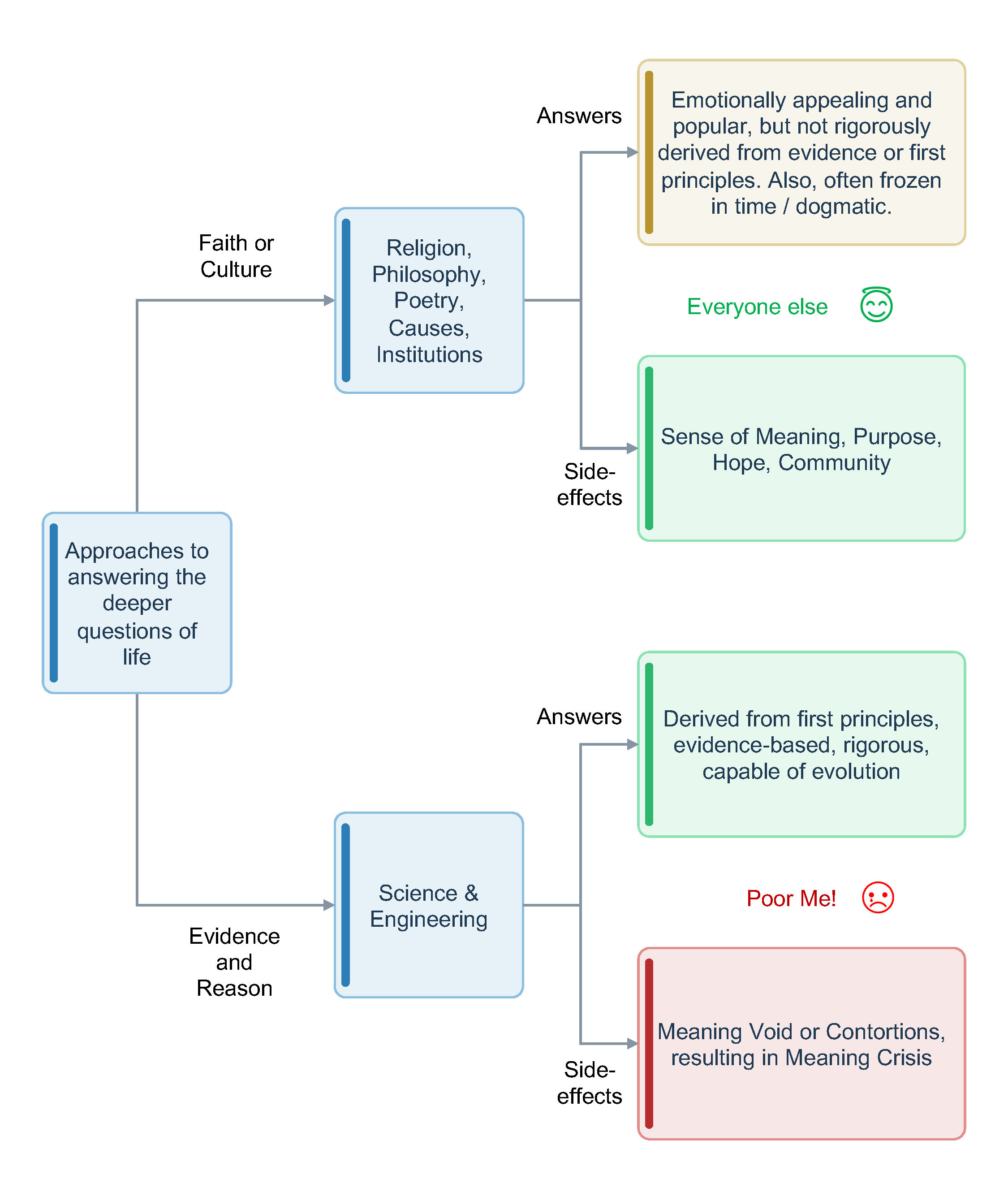
Taking the path less traveled
I include such diagrams throughout the book. They are a nice way to quickly recap the main ideas.
The diagram captures the whole chapter: the well-traveled path to questions of meaning through faiths, traditions and causes leads to answers that are appealing and easy to follow but, for an analytical person, full of gaps; the other path through evidence and reason leads to science and engineering, and to potentially far more trustworthy answers, but it has rarely been taken. That gap is what leaves people with either a Meaning Void or the contortions of trying to reconcile the two sides, and it is what has produced the Meaning Crisis. The way out is to come up with definitions of meaning, purpose and hope based on evidence and reason.
This is the premise of this book. In the next chapter, we get into the promise: how we actually go about solving this problem.
A Note about “Deep Dives”
Throughout the book, I mention some important ideas that are related to the framework we are trying to build, but aren’t central to it. Rather than interrupt the flow of the argument, I have collected short “Deep Dive” summaries of these ideas in an appendix at the end of the book, along with pointers to books, papers and videos where you can explore them further. I highly recommend that you take at least a quick look at them, and if you find them interesting, go deeper.
A good example is John Vervaeke’s “Awakening from the Meaning Crisis” lecture series on YouTube, which provides a detailed overview of how and why the present-day meaning crisis has come about and what can be done about it. (See the Deep Dive on it in the appendix.)