11. Hope: Past Performance is a Great Indicator of Future Results

This statement can be scientifically proven to be true.
“The very least you can do in your life is figure out what you hope for. And the most you can do is live inside that hope. Not admire it from a distance but live right in it, under its roof.”
— Barbara Kingsolver, American novelist, in “Animal Dreams”
“The greatest white pill of all is that local minima are rare in high-dimensional spaces”
— Roon, AI researcher, in a Tweet
What is “Hope”?
Once again, let us start with a crisp definition of what we are talking about, so we can analyze it scientifically.
The Merriam-Webster dictionary defines hope as “desire accompanied by expectation of or belief in fulfillment”. The critical word here is “expectation” because it implies trying to make a prediction about the future.
Unfortunately, reality is incredibly complex and our ability to predict the future, even with the knowledge of all the laws of nature that we have discovered, drops off rapidly as we move forward in time. This is partly because of the aforementioned nebulosity and unknowns in reality, but also because the computational complexity of calculating all the actions and their reactions simply becomes overwhelming. In reality, the most optimal approach is to make some educated guesses based on known information, but remain open to adjusting them as we move forward.
In the past, when our knowledge of the laws of the universe was very limited, all we could do was to assume that there was a benevolent supernatural power looking after the universe, and it had a complete plan for what it wanted the universe to do. Then, as long as we kept our faith in that power, the beneficence of the supernatural power would result in positive outcomes for us.
This was perfectly reasonable given our level of knowledge of reality at that time. But today we know a lot more about how the universe works, and how it has been progressing from the time it began, and we can actually start to make some fairly reasonable, educated guesses based on that knowledge, instead of taking leaps of faith.
Past Performance and Future Results
Take the example of the stock market.
Now, it might sound a little flippant of me to equate the future of one’s life or of humanity, or indeed even the universe, with the stock market, but when you take a closer look, it turns out to be a pretty useful and meaningful comparison, as we shall soon see.
Of course, the first thing that gets thrown at you whenever anyone talks about the markets is the following standard disclaimer: “Past performance is no guarantee of future results!” And that’s certainly true. Given how complex the market is and the number of factors that can affect it, we can never give a guarantee. At the same time, past performance is actually a pretty good indicator of future results! In fact, it may even be the best indicator of all.
Pretty much all our planning and predictions, not just financial, but also things like career choice, life partner choice or lifestyle choice, are heavily based on taking a good look at the past performance of those choices, adjusting for our specific situation, and making a judgment about whether that performance is likely to continue in the future.
With that in mind, let us look at the past performance of life, the universe and everything.
The Best Track Record Ever!
Imagine you are an investor deciding whether to invest in a company called The Universe Corp.
You, being a disciplined investor who believes in fundamentals, don’t go and buy whatever is cool and trending. You go straight for the balance sheet, looking at the performance history of the company going back all the way to its founding.
As far as we know today, The Universe Corp. began operations nearly 14 billion years ago. What has it been doing all this time? What are its major accomplishments?
We have gone over this story before, but it is worth repeating quickly. Right from the beginning, the universe has exhibited some inherent tendencies, and, as time passed more tendencies have emerged. These are, of course, what we have been calling the Meaning-grounding Tendencies: the Physical Tendencies of Differentiation, Interaction, Energy Flow, and Self-Organization; and the Biological Tendencies of Modeling, Exploration, Generativity, and Coupling.
All along and everywhere, the universe has been executing on these tendencies, without taking a single break. While there have been many twists and turns, ups and downs, catastrophes and upheavals, it has nevertheless relentlessly pressed forward. For billions of years! Stars have formed and exploded, planets have bumped into each other, and even entire galaxies have collided. Planets like Earth have faced unbelievable natural calamities, like massive asteroid impacts, super volcanoes, severe climate changes, devastating epidemics and unbelievable amounts of violence. Throughout all of that, The Universe Corp. has continued to execute on its mission to continue and enrich its Meaning-grounding Tendencies.
And this continues to this day. Right here, right now, it is possible to find evidence of the Meaning-grounding Tendencies continuing to express themselves. This shows no signs of slowing down. In fact, it may even be accelerating, diversifying and complexifying even further.
It would be an understatement to say that this is the most amazing track record of all time, anywhere! By far. Any comparison with anything else would be completely laughable.
If you were to discover such a company, would you jump up and down and invest in it? Would you even put your entire nest egg in it? And not only that, but, after having invested thus, would you completely relax, knowing fully well that your future was in great hands? The greatest hands ever, in fact? It would be a no-brainer!
Well, isn’t this exactly what we mean by hope? Reasonable expectation of an excellent future?
A Fair Objection: Didn’t We Say Not to Trust the Distant Past?
Before we go further, I have to stop and address an objection, because an alert reader will have caught an apparent contradiction. Back in the chapter on Methodology, I made a big deal about how our ability to make claims about the distant past (or future) drops off rapidly. Present-Bounded Rationality keeps insisting that we ground ourselves in the here and now. And yet here I am, resting our entire case for hope on a 14-billion-year track record. Isn’t that exactly the kind of leaning-on-the-distant-past that I warned against?
It’s a fair challenge, and it deserves a real answer rather than a hand-wave.
The resolution is that there are two very different kinds of claims about the past, and they are not equally trustworthy.
The first kind is a fine-grained claim: exactly what happened in the first fraction of a second after the Big Bang, or the precise sequence of events by which the first cell formed. We do not have sufficient evidence or understanding of these events so we can not rely on them fully.
The second kind is a coarse-grained claim: over very long stretches of time, complexity has kept arising, and life, once started, has kept persisting, spreading, and enriching itself. This second kind of claim is robust precisely because it is coarse. You don’t need our understanding of cosmology or abiogenesis to be exactly right to be confident that, on the whole, complex ordered structures have kept showing up and life has kept finding a way. It is similar to the difference between not being able to predict tomorrow’s exact weather and being quite confident that summer will be warmer than winter.
And, crucially, the Meaning-grounding Tendencies themselves are not something we have to take on faith from the deep past at all. They are verifiable right now, right here, everywhere we look, which is exactly what Present-Bounded Rationality demands. The 14-billion-year track record is not the only foundation of our hope. The real foundation is that the Meaning-grounding Tendencies are demonstrably operating in the present moment, and there is no reason to expect them to suddenly stop. The long track record just tells us they have been remarkably durable. So we can lean on it, as long as we lean on the coarse-grained, present-verifiable version and not on any particular fine-grained story about the beginning of time or life.
With that objection honestly addressed, let us take a closer look at how meaning enters the picture.
How “Meaning” Enters the Picture
When we talk about hope in the context of our lives, we typically associate it not with any old expectation, but specifically with a positive one. We hope that our lives will be better, at least in some way, in the future.
Which raises the question: How do we define “positive” here? What is a “better” life?
Everything we have looked at so far has been in service of finding meaning in life. So, it would be reasonable for us to define a positive life as a meaningful life, and hope as the reasonable expectation of a more meaningful future.
That’s why, in the MSE Framework, we define Hope as “a reasonable expectation of a more meaningful future”. The good news is that hope simply falls out of this. If we define living a meaningful life as aligning ourselves with the Meaning-grounding Tendencies, and given that those tendencies have an unbelievable, unbroken track record and every likelihood of continuing it, then we have a “reasonable expectation of a more meaningful future,” i.e., hope.
And unlike other definitions of hope, this one isn’t wishful thinking. It rests on the most trustworthy backing one could ask for: First Principles reasoning and the (coarse-grained) track record of the universe itself.
As usual, let us elucidate this with a diagram that explains all of the above thinking in a hopefully more memorable form (at least for visual learners such as myself).
Derivation of Hope Using the MSE Framework
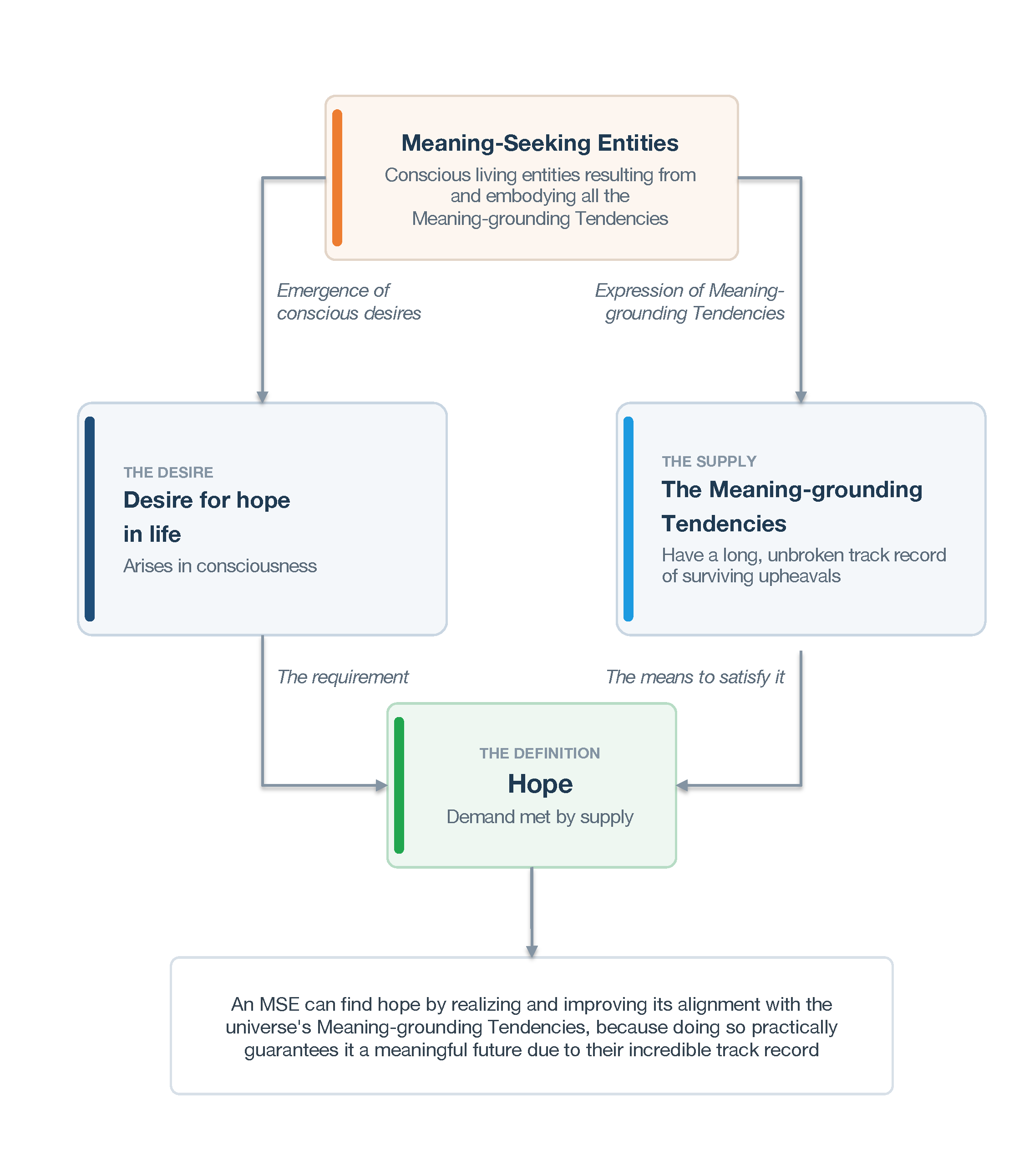
Obtaining Hope in Life from evidence and reason alone
Description of the Diagram
As you can see in the diagram, the desire for Hope arises in Meaning-Seeking Entities because they possess Consciousness, which itself performs Active Inference in order to continue to exist, and imagines counterfactual scenarios that are better than the present. Meanwhile, the Meaning-grounding Tendencies that gave rise to those entities have an unbelievably strong, billions-of-years track record, can be observed here and now, and can be expected to continue as far as we can predict. So if we recognize and improve our alignment with them, we can justifiably expect a more meaningful future, which is the same thing as having hope. And this argument rests on evidence and reason, not wishful thinking.
So let us formalize this with a definition:
Definition of Hope Based on the MSE Framework:
Mindfully recognizing and improving our alignment with the universe’s (and our own) Meaning-grounding Tendencies ensures that we can have a reasonable expectation of a more meaningful future, which is the same thing as having Hope.
In addition, since reality consists of nebulosity as well as unknowns, we need to be open to learning more as we move forward and adjust our thinking and actions accordingly.
Awe and Gratitude
Having come up with such a strong definition of hope based on evidence and reason alone, I am myself now overwhelmed by hopefulness and so want to go one step further.
I want to conclude this chapter with something even beyond hope, almost venturing into the territory normally reserved exclusively for religion: The feelings of awe and gratitude.
The entire stack of layers that make up the MSE Framework is nothing short of “miraculous”. We can start right from the bottom.
The fact that anything exists at all is the most unbelievable miracle. There was no need for anything to exist, but it does. It meets the definition of a miracle because it is a positive phenomenon and we have absolutely no explanation for it.
Beyond that, it is also miraculous that reality contains many discernible patterns that follow well-defined laws. There was no need for that either. Reality could have been a whole lot of nebulosity and randomness. But it isn’t. This is another miracle.
Moreover, we have managed to grow brains that are able to capture these laws as mathematical formulas. Some of these laws of physics and other sciences contain some constants (such as the gravitational constant, Planck’s constant, or the speed of light etc.) that have very specific values. So specific that if some of their values had been even slightly different, we would not be here. Why is this the case? We have no idea, hence it is another miracle.
Moreover, these laws have eventually led to the creation of life, and life has led to intelligence and the mysterious phenomenon of consciousness. As a result, creatures like ourselves can wonder about all this and try to make some sense of what’s going on.
The phenomenon of life appears to have a built-in goal of continuing to exist and spreading. This can be seen as if it endows all living systems with the continuation and spreading of life as their main purpose. This fact also provides a tremendous source of hope and meaning to all living systems.
All of the above phenomena can be thought of as legitimate miracles. There was no need for any of them to exist. But they do, and we are the ultimate beneficiaries.
Also, even if the scientific paradigm does not allow us to proclaim that we know any ultimate truths, it still provides us a rigorous way to discover many useful patterns, build useful things using them, and keep making progress.
What’s really, really remarkable about this is that we were able to discover and formulate all of these phenomena simply by following evidence and reason. There was no need to invoke any kind of magic or take leaps of faith. And we still ended up with awe and gratitude.
Do we really need any more miracles than that? Isn’t all of this sufficient to fill our minds with awe about existence and gratitude that we are here to experience it and even understand it to some extent? As far as I am concerned, I don’t need anything more miraculous or more awesome or more deserving of my gratitude than this!
That pretty much completes the “theoretical” part of this book. As you might have expected, now it’s time to turn our attention to what really matters in the end: converting theory into practice. But I don’t want to stop at just specifying what to do; I want to actually issue a call to action and provide you with tools to make it happen.
We’ll do that in the next chapter.