5. Ultimate Reality: Known Unknowns and Unknown Unknowns
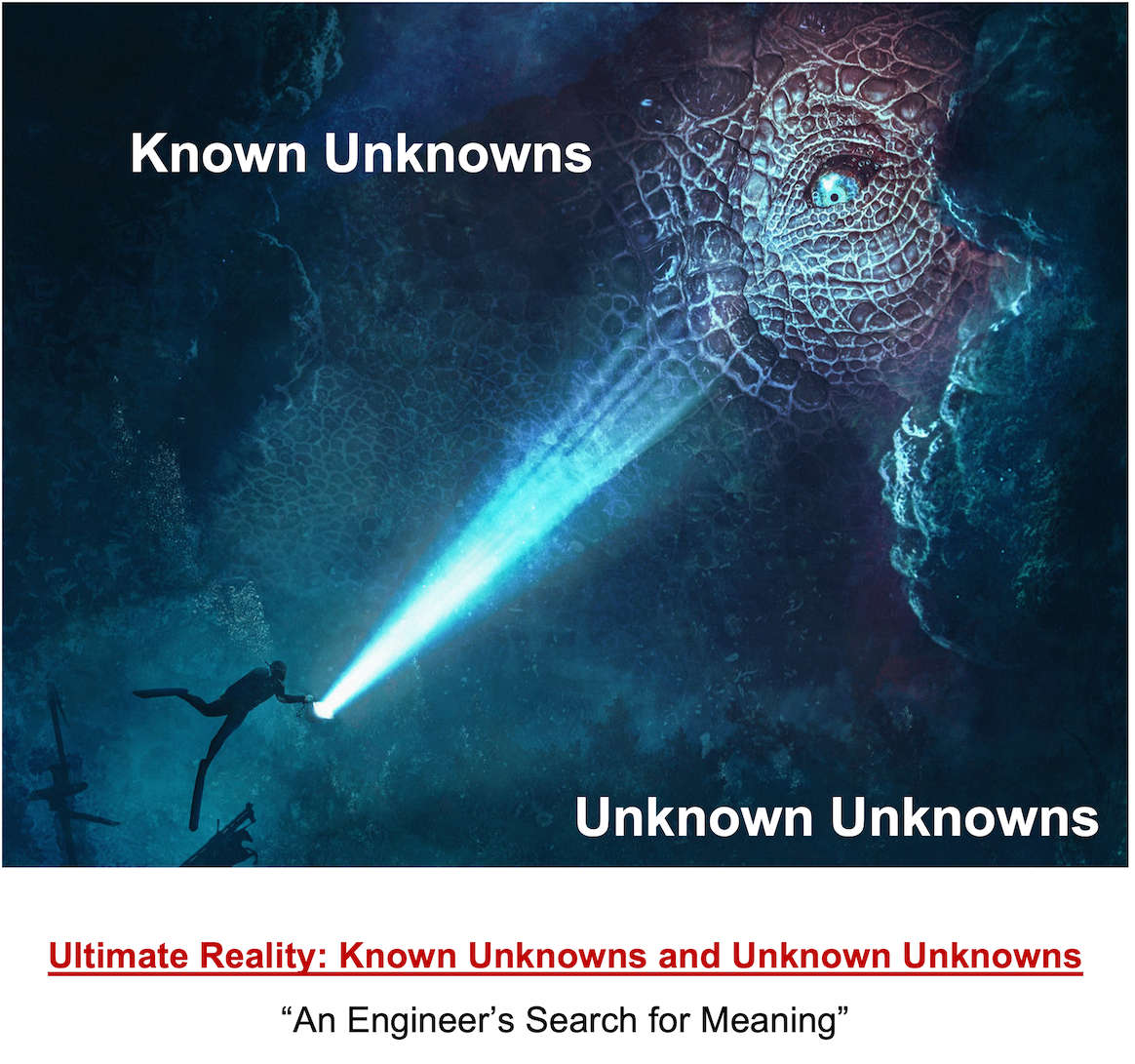
“There are known knowns; there are things we know we know. We also know there are known unknowns; that is to say we know there are some things we do not know. But there are also unknown unknowns—the ones we don’t know we don’t know.”
― Donald Rumsfeld, former U.S. Secretary of Defense
“Perception is not a window on objective reality. It is an interface that hides objective reality behind a veil of helpful icons.”
― Donald D. Hoffman, in “The Case Against Reality: Why Evolution Hid the Truth from Our Eyes”
Morpheus: “What is real? How do you define ‘real’? If you’re talking about what you can feel, what you can smell, what you can taste and see, then ‘real’ is simply electrical signals interpreted by your brain.”
― Lana Wachowski, in “The Matrix: The Shooting Script”
The Rumsfeld Matrix of Ultimate Reality!
Ultimate Reality is the name we will use in our model for the most fundamental reality that exists. It is also commonly known as “base reality”, “the fabric of reality”, or even “the ultimate truth.”
And, just like some of the quotes above suggest, this Ultimate Reality is not directly accessible to us. All we know are our perceptions of it, or the electrical signals reaching our nervous system, and any inferences we can make from them. We have no way of knowing what is generating those signals.
We could even be in a simulation, as many people believe, and have no way to tell.
In fact, as the Rumsfeld quote above says, not only do we have many known unknowns about ultimate reality, but we also have an unknown number of unknown unknowns.
Among the deepest known unknowns of reality are questions such as:
- What exists? In particular, what exists “out there” and “in here”? (And what does “out there” and “in here” even mean?)
- Why does it (or anything) exist at all? Where did it come from? (And if it did come from somewhere, where did that come from?)
- Does existence have a beginning or an end? What came before? What happens in the end?
- What does “existence” even mean?
- We call everything we can perceive using our senses, such as vision or hearing or touch, “physical”. But what does “physical” even mean?
- Is this physical reality different from our ultimate reality? In that case, how does the former emerge from the latter?
- What is “experience”? What is consciousness? How does that emerge?
We have asked these questions for eons. And while we have made tremendous progress in answering so many questions, we haven’t really answered any of the questions above convincingly.
And of course, beyond this long list of “known unknowns”, we also have the, possibly never-ending, list of “unknown unknowns”. And for them, since we don’t know what we don’t know, we can’t even ask any meaningful questions.
In spite of all these difficulties, thinking about our ultimate reality has occupied the minds of many thinkers for millennia and their thoughts have formed the basis of many religions, philosophies and cultures.
So much so, that we have come to believe that unless some body of knowledge, like a religion or philosophy, has answers to these questions, that body of knowledge can’t really say anything about things like meaning, purpose and hope.
This is because, for a long time, we have believed that there was some omnipotent and omniscient entity behind all of reality, that created it and had its own reasons and plans for it. The belief was that concepts like meaning, purpose and hope have their origins in those reasons and plans.
But, as I mentioned in the previous chapter, we have no need for that hypothesis.
What I am claiming in this book is that we do not need to find ultimate answers to the “unknowns” mentioned above in order to come up with rigorous, evidence-based definitions of meaning, purpose and hope. We can absolutely get there by relying on just the “knowns”.
Yes, once again, we are talking about our methodology of Present-Bounded Rationality.
Present-Bounded Rationality to the Rescue
As we have already mentioned in the chapter on Methodology, we do not need to start from “why does anything exist at all and where did it come from” etc., and then rely on some supernatural power to rescue us from that conundrum.
We also do not need to start from some distant past when the universe “began” or some distant future, when the universe will supposedly “end”. Both of those events are so distant that there is a lot of uncertainty about them, as well as about the path we have taken from there to here or from here to there, respectively.
Instead, we will start from what we know a lot more about: entities and processes that can be shown to exist right here, right now.
Think of existence not as a story of the universe from the beginning to the end, with both ends shrouded in mystery. Instead, think of it as a story that begins with you at the center, where things are quite crisp and clear, but they get foggier and foggier as you move away in time or space in any direction.
You have a lot more evidence supporting the idea that you exist here and now, than about how the universe may have been created or how it will end. You are conscious, you are breathing, you can see and feel things happening around you. You know where you are in relation to your surroundings. You are aware of your thoughts.
This is basically how the Present-Bounded Rationality approach to solving problems works. We don’t ask for the entire universe to be completely unveiled to us, we make do with what we know far more clearly, and see if we can get to where we want to go from there.
So, what do we know about the here and now?
We know three things for sure:
- Something seems to exist, including us. That is pretty much all we know about the ultimate reality because, as far as we know, we don’t have direct access to it. All we have are our perceptions that we can sense using our nervous system. This brings us to the next point.
- We seem to have a physical existence, in something we can call Physical Reality. We know this because we can perceive it, but we don’t really know how this physical reality emerges from the ultimate reality. But that’s not all we have.
- We also seem to have a conscious existence. We are aware of our existence and our physical reality through our consciousness. We clearly have a sense that there is some presence inside of us. We don’t know how our consciousness emerges from the ultimate reality or whether it has any relation to physical reality either. (Yes, there are some speculations about that, but none of them are proven. We will look at some of them later.)
Unfortunately, even these simple statements of fact lead to raging debates.
Philosophical Debates
Most people take our physical reality as the primary reality, and consciousness as secondary. This is generally known as Physicalism or Naturalism.
Other people object to that and say that true reality is ultimately non-physical, and consciousness is all that there is. For them, it is physical reality that is secondary or emergent or even imaginary. This idea is closely related to the philosophy known as Idealism in the West and Brahman in Vedic Philosophy or Tao in Chinese Philosophy.
Unfortunately, we have no objective and incontrovertible proof of either of these two claims. This causes endless debates and confusion about which model is “real”.
We do not need to get into that debate.
Our methodology of Present-Bounded Rationality tells us that we have no need to get into these abstract debates. Instead, we need to focus on grounding ourselves in the here and now, with our ultimate goal in mind.
We don’t need our answers to originate from some supernatural power or from some “beginning of time” or some “judgment at the end of time”. We are fine with looking for answers in the here and now. Also, as with all of science and engineering, we are fine with provisionally knowing a few things and having a process for knowing more in the future, and seeing where that leads us.
And, as we will see in this book, we can accomplish our goal with just that much.
With that lengthy introduction, let us finally get down to the business of looking at the model of Ultimate Reality as per the MSE Framework.
The MSE Framework - Model of Ultimate Reality
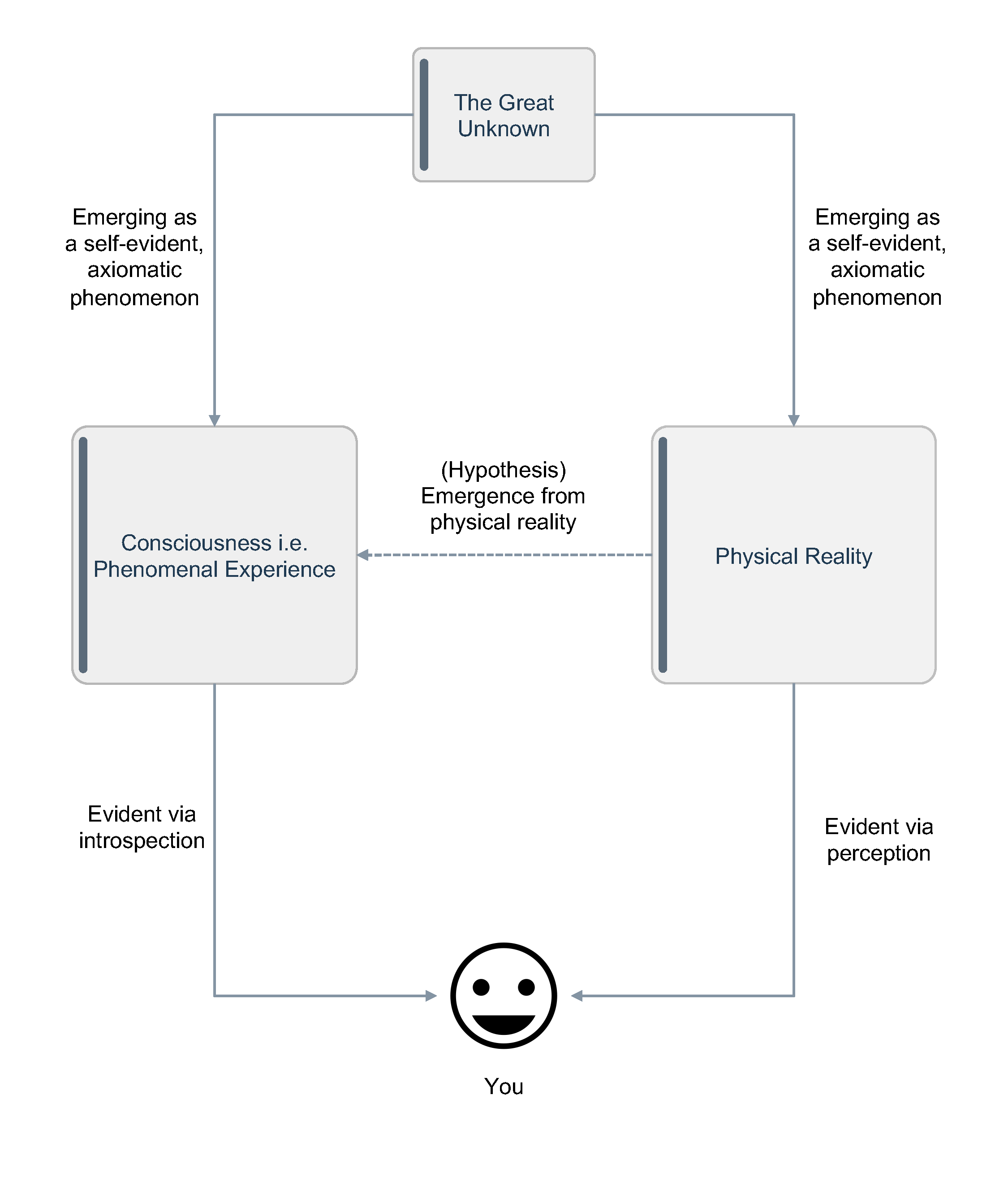
Model of Ultimate Reality in the MSE Framework
We will start at the top of the diagram with the box that has a totally black background, labeled The Great Unknown.
In most religious or philosophical models of ultimate reality, The Great Unknown would be called God or Creator. Some religions think about the Great Unknown in a different manner, such as the concept of Brahman in Hinduism or Tao in Taoism.
We also have some very interesting modern hypotheses for The Great Unknown, such as the Simulation Hypothesis, The Computational Universe Hypothesis and the Wolfram Physics Hypothesis.
I have found many of these ideas fascinating and educational. As a result, I have included Deep Dives into them in the appendix. You may find them interesting, too.
But none of these models can provide any proof for their claims. So, we will continue to use the name The Great Unknown because we really don’t know anything about it. Our methodology would not allow us to complicate our model with assumptions and opinions about the nature or features or intentions of this Great Unknown.
All we can say is that we have no choice but to start with something like The Great Unknown, which we will take to be self-evident and fundamental, but beyond that, we can’t say anything for sure.
Luckily there is a scientific term for such concepts, “Axioms”.
As a result, for the purposes of the MSE Framework, we will simply take The Great Unknown to be our most fundamental axiom.
Coming back to the diagram, we see two arrows emerging from The Great Unknown. Let us look at each one of them in turn.
Physical Reality
Physical reality, as the name suggests, is the part of ultimate reality that we can either experience physically, using our senses, or prove the existence of, using instruments we have created or the laws of physics we have discovered.
We know a lot about physical reality, and can even write formulas that can be shown to work perfectly. At the same time, we still have many unknowns about other parts of it.
We will look at what these unknowns are in the next chapter, but for now, we have indicated this partly clear and partly murky knowledge by using a gradient for the background color of the Physical Reality box.
Consciousness
Just like we can all agree that we live in something like a physical reality, we can also agree that there is something inside us that we call “me”, i.e. Consciousness.
Over the millennia, people have tried to understand what this thing inside of us is, but we are still far from reaching that goal in a scientific manner. But we can say that our lack of knowledge about consciousness isn’t as dire as that about Ultimate Reality.
So, the background color of the Consciousness box is gray instead of black or white to indicate this.
We will take a deeper look at Consciousness in a subsequent chapter.
As true scientists, we are simply going to treat both Physical Reality and Consciousness as axioms since they are both self-evident and fundamental to us. Moreover, we treat them both as equally valid and complementary to each other, not in competition with each other like in the aforementioned philosophical debates, again, because we have no evidence pointing to the primacy of either of them.
Let us also note that how Physical Reality and Consciousness emerge from or interact with The Great Unknown is also unknown. Luckily, we do not need to know that for our framework, since our methodology allows us to work with partial knowledge.
Just for completeness, let us note that at the bottom of the diagram, the Consciousness and Physical Reality boxes come together into You. This is the You, as a physical as well as conscious entity, existing here and now and experiencing both.
There is only one little item remaining in the diagram, the dotted line from Physical Reality to Consciousness.
Does Consciousness Emerge from Physical Reality?
What is interesting is that we do not know how Physical Reality and Consciousness interact with each other, but do have clear, widely corroborated evidence that they, in fact, do.
For example, when something happens in physical reality and we perceive it, we can experience it in our consciousness.
Also, our consciousness can direct us to perform actions that affect physical reality. (This is typically known as Free Will, which is another controversial topic that we will not get into since we don’t need to do that for our purposes.)
Physics is the most successful of sciences, and it gives us a great account of all the physical objects and forces that exist. Still, we have not been able to find any force of Physics that can be shown to emerge from consciousness. And likewise, we know of no force that emerges from Physics that appears to act on consciousness.
So how the bidirectional interaction between physical reality and consciousness occurs is unknown.
At present, we have more plausible theories for showing how consciousness may be arising out of physical reality than the other way around. This is indicated in the diagram using a dotted arrow from Physical Reality to Consciousness.
If one of these theories gets proven, we will be able to simply delete the arrow that goes from The Great Unknown to Consciousness and convert the dotted line connecting Physical Reality to Consciousness into a solid one.
This means that, even if that were to happen, the rest of the MSE Framework remains intact. So, we can say that the framework is future-proof to some extent.
Ok, having started with this high-level overview in this chapter, we will be digging deeper into each of these concepts in subsequent chapters, starting with Physical Reality.