9. Meaning: Sorry Fellow Hitchhikers, It’s NOT 42!
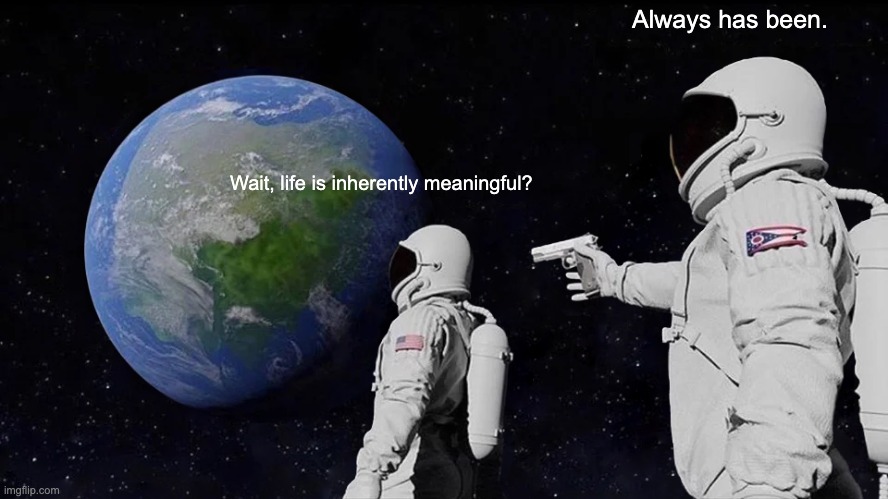
You don’t have to go to the ends of the earth to find that out! It’s all right here, right now.
“Suffering ceases to be suffering at the moment it finds a meaning.”
― Viktor E. Frankl, Austrian psychiatrist, in “Man’s Search for Meaning”
“Human being is meaning making. For the human, what evolving amounts to is the evolving of systems of meaning; the business of organisms is to organize, as Perry (1970) says.”
― Robert Kegan, American developmental psychologist, in “The Personnel and Guidance Journal”
“Ask yourself these two questions: What do I want to exist even if I don’t. And how much of a difference I make to it. If you’ve got good answers to both of those, you have meaning in life. If you have only the first but not the second, you are seeking. If you have neither, you are in trouble.”
― John Vervaeke, Canadian philosopher and cognitive scientist, in “Solving the Meaning Crisis”
Man’s Search for Meaning
Let us start with a quick introduction to Viktor Frankl and his seminal book, “Man’s Search for Meaning”. His book is credited with raising awareness of the idea that finding meaning in our lives is critical for human beings.
Frankl was an Austrian psychiatrist and a Holocaust survivor during the Second World War. He spent about 3 years in various concentration camps, where he witnessed as well as personally endured horrendous suffering and saw how various people dealt with it. It was his experiences during that time, observed through the lens of a fellow prisoner as well as a psychiatrist, that led him to write the book.
In the book, Frankl discusses the concept of “existential vacuum,” where people experience a sense of emptiness and purposelessness when they lack a clear sense of meaning in their lives. We have used the term “meaning void” to describe essentially the same idea in this book.
Frankl argues that filling this vacuum with meaning is the primary human motivation. According to him, people can endure suffering with dignity and inner strength, even in the most extreme circumstances, if they can find some meaning in their trials. The following quote by him conveys this idea well:
“Life is never made unbearable by circumstances, but only by lack of meaning and purpose.”
― Viktor Frankl, Austrian psychiatrist, in “Man’s Search for Meaning”.
I have been greatly influenced by these ideas. So much so that I felt using a slight variation of the title of Frankl’s book would not only be perfect for my book, but also pay homage to his ideas.
As stated earlier, my goal here is to take a rigorous, First Principles-based approach to the concept of meaning, so one does not have to take leaps of faith or rely on someone’s opinion to get there. In order to do so, we have to first define what exactly we mean by “meaning”.
The Meaning of “Meaning”
Right off the bat, we should note that most people, including many scientists themselves, believe that the concept of meaning, used in this context, is beyond the reach of science or reason. In my opinion, people who say this are, knowingly or unknowingly, admitting that meaning can only originate either from a supernatural power, or somewhere deep inside our subconscious which, in their opinion, is beyond the reach of reason.
Many others think the concept of the meaning of life itself is meaningless or totally made up. Still, others think that you can make it whatever you want it to be.
I wonder if Douglas Adams, the author of the Hitchhiker’s Guide series of books and the one who popularized the phrase “Life, the Universe and Everything”, had similar thoughts in mind when he came up with “42” as the answer to the question of the meaning of life. Here is the relevant excerpt from his book:
“Alright,” said Deep Thought. “The Answer to the Great Question…”
“Yes…!”
“Of Life, the Universe and Everything…” said Deep Thought.
“Yes…!”
“Is…” said Deep Thought, and paused.
“Yes…!”
“Is…”
“Yes…!!!…?”
“Forty-two,” said Deep Thought, with infinite majesty and calm.
― Douglas Adams, English author and humorist, in “The Hitchhiker’s Guide to the Galaxy”
None of these answers are satisfactory for our purposes. We should try to do better, and, as we will soon see, we can. A lot better.
Apart from long-held religious and philosophical ideas, I believe a major part of the reason for all this confusion about “meaning” is that the word itself is not defined very clearly. Concepts need to be well-defined before we can apply any significant amount of rigor to them. And, as it turns out, we can actually define “meaning” quite crisply and when we do so, it becomes quite amenable to rigor.
To start with, let us note that a lot of academic literature uses the phrase “meaning in life” to distinguish it from the colloquial phrase “meaning of life”. This is probably because the phrase “meaning of life” is very closely associated with religion. Defining a different phrase, “meaning in life”, allows us to distinguish ourselves from these old religious and philosophical notions and the confusion associated with them.
With that introduction, let us dive in and take a deeper look at what the scientific literature says we mean by the phrase “meaning in life”.
“Meaning in Life” Based on Psychological Analysis
Luckily for us, this topic has already been studied quite extensively by psychologists. And based on various studies and surveys, they have converged on 3 primary components that comprise the notion of “meaning in life”:
Having coherence or comprehensibility in one’s life,
Having a sense of purpose in one’s life, and
Having a sense that one’s life matters or has existential significance.
(This is from a recent comprehensive review of the field, “The Science of Meaning in Life” by Laura A. King and Joshua A. Hicks, published in Annual Review of Psychology (Vol. 72:561-584), January 2021.)
Let us take a look at each of these categories in a little more detail.
A) Meaning as Having Coherence or Comprehensibility in Life
If you see structure and inter-relatedness between your life’s experiences and recognize understandable patterns in them, then you have Meaning as “having coherence or comprehensibility” in your life. In simple words, it refers to our commonly held expectation that “my life makes sense” or that “I can tell a coherent story about my life”.
Human beings have always been storytellers. Stories are the way we make sense of everything, from a kindergartener coming home from school excitedly shouting “Guess what happened today”, to people sitting in lecture halls listening to some scientist telling them “the story of life, the universe and everything”. It is natural for us to be able to do the same for our own lives in order for it to feel meaningful.
One of the popular bumper stickers from the 80s was “One who dies with the most toys wins”. It was used to justify a lifestyle of materialistic excess. But now that we are older and wiser, maybe we can replace it with “One who dies with the most meaningful life story wins”. I like that phrase a lot personally. You may recall that this was exactly how I got started on this journey: My desire to make sense of my life and tell a coherent and meaningful story, starting from First Principles.
B) Meaning as Having a Sense of Purpose in Life
Meaning as “having a sense of purpose in life” refers to the expectation that you are aware of your aims or core goals and direction in life and you adhere to them to the best of your ability. In other words, if you are convinced that your life has a purpose, then you feel that your life is meaningful.
When asked about their purpose, people typically come up with answers such as “I need to support my family”, or “I have a mortgage”, or “I like to accomplish things”, or “I feel a need to fulfill my natural calling”, or “I want to become rich” and so on. Here is a famous quote along these lines:
“We’re here to put a dent in the universe. Otherwise, why else even be here?”
― Steve Jobs
In my case, researching and writing this book has provided me with a strong sense of purpose day in and day out while I have been at it. Due to this, by the time I publish it and before anyone has read it, it would already have provided immense value to me! (As an aside, I would highly recommend writing a book about a subject you really care about. It is incredibly rewarding even if no one ever reads it.)
C) Meaning as Existential Mattering or Significance
A common refrain you might hear when talking to people about meaning in life is that they feel they need to contribute to something “much larger than themselves” or “make a difference” in the world somehow. What they are referring to here is “existential mattering” or “significance”. People who feel that their lives matter or are significant in some way feel that their lives are meaningful.
This need probably arises from the fact that we are consciously or subconsciously aware of our mortality as well as our relatively minuscule sphere of influence when compared to the unimaginable longevity and immensity of the universe. We want our lives to have an impact well beyond our limited lifespan and our local niche.
The reasonable way to achieve that is to look for something that is likely to survive far longer than ourselves and has a far larger scope than ourselves, and make a contribution to it. This is why people usually like to associate themselves with something large and long-lasting, such as a well-known religion or philosophy or a long-lived institution or cause that has survived for a long time and is likely to continue and grow for a long time. As long as their contribution helps that entity survive and maintain or increase its scope, they can feel that their life is meaningful.
The “intense conscious experiences” that we talked about in the chapter on Consciousness, such as listening to sublime music or reading a particularly moving story or even appreciating the mathematical beauty of some formula also fall into this category. The heightened states of consciousness experienced at such moments give us the feeling that we belong to some sort of divine, all-pervasive and immortal reality.
As you might have noticed, there is some overlap among all three components of meaning mentioned above, but there is also something unique in each. Also, most peoples’ definitions of meaning in life will probably contain some amount of each of these components.
Looking at Meaning from First Principles
Normally, the definitions of meaning provided above would be adequate for our purposes, but one may still have some discomfort over the fact that they are derived from surveys rather than from the ground up. You may ask: Is there a way to derive these definitions of meaning starting from First Principles?
And there is! The Free Energy Principle and Active Inference come to our rescue here again.
As we saw in the chapter on Life, Active Inference is the process that all living organisms perform in order to continue to survive in a dynamic environment. Active Inference involves the living organisms building a generative model of their environment, which generates counterfactual scenarios and then seeks evidence for them, thus improving the predictive power of their models. Moreover, conscious living organisms such as ourselves need to build a constantly improving internal model of not just our environment, but also ourselves in relation to it. This allows us to make better predictions and avoid a larger number of surprises.
As our internal model gets better, things within as well as outside of ourselves start to make more and more sense to us. This implies that our sense of coherence or comprehensibility improves, which improves our sense of meaning in our lives.
As conscious beings, we are able to reflect upon this process and analyze it. As a result, we can detect patterns in our environment as well as ourselves. We start to realize that these patterns have a direction to them - they are heading towards something. This gives it the flavor of having a purpose. When we realize this and align ourselves better with this sense of purpose, our sense of having meaning in our lives also improves.
And, ultimately, as we saw in our discussion of mindfulness and Active Inference, as we get better and better at this process, our sense perception improves, our internal model becomes more aligned with our environment, and our actions in the world get more effective. As a result, we become better participants in the activities of the universe overall. This could be interpreted as us contributing to something much larger than ourselves. Moreover, being conscious beings, we can understand this ourselves, which provides us with a sense of “existential mattering” or significance.
This whole process can also be seen from the point of view of the communities we are a part of. If one thinks of these communities as living organisms themselves, then our participation in Active Inference at the individual level contributes to the Active Inference process at the community level also.
Essentially what I am getting at is that “meaning” may be how our consciousness interprets the process of Active Inference that we must perform in order to continue to exist, both as individuals and as parts of whatever communities or institutions we consider ourselves to belong to.
Thus, the emergence of the 3 components of meaning that we identified earlier can all be explained from First Principles, via Active Inference. This gives the concept of meaning a very solid foundation.
But it gets even better!
Deeper Dive into Meaning-Seeking
Let us take a look at the hypotheses we have put together about consciousness in the last chapter:
- Consciousness may be a virtual life form that we give birth to and nurture all our lives
- Consciousness itself may be performing Active Inference in order to continue to exist
- Our desire for meaning arises in our consciousness
Could we hypothesize that “meaning in life” is really just the internal generative model created by our consciousness as a result of it performing Active Inference? In other words, our search for meaning is how the conscious living entity that lives inside us interprets its own motivation to continue to exist and, which, in turn, motivates us to do the same for our physical bodies.
What I like about this way of thinking is that it is somehow more palatable and frankly, even more meaningful, as compared to the idea that consciousness is a myth or something we make up. Sure, we may be making it up, in the sense that it is an abstract living entity that we give birth to. But that does not make it meaningless. In fact, it is what gives rise to the concept of, and the desire for, meaning, and is thus critical for conscious living organisms such as ourselves.
Agreed, this idea is mostly speculation on my part, but I think it is a rich vein of thought, and I hope many more meaningful ideas will come out of it.
Getting back to our main thread after that bit of diversion, let us revisit the list of Universal Tendencies that we have been putting together over the last few chapters, and see what interesting insights may emerge out of that.
List of the Universal Tendencies
As we already saw in the previous chapters, the universe appears to exhibit some discernible patterns, laws and processes. We observed that these features, laws and processes, taken together and observed over time, give the appearance that the universe has some inherent tendencies, a set of directions it appears to “want” to go in.
These tendencies are strong, ubiquitous and ever-present. All of them can even be seen to exist right here, right now. They fall naturally into two groups: tendencies that arise from the fundamental physics of the universe itself, and tendencies that emerge in living systems.
Physical Tendencies
1) Differentiation: The universe creates distinct, definite things out of uncertain or undifferentiated states. Quantum fields give rise to elementary particles; clouds of gas coalesce into stars and planets; subconscious impressions crystallize into concrete thoughts.
2) Interaction: Distinct things interact and combine, weaving themselves into interconnected webs of escalating complexity. Elementary particles form atoms, atoms form molecules, molecules form cells, cells form organisms, organisms form societies.
3) Energy Flow (Dissipation): The universe drives change through the constant flow from low-entropy to high-entropy states. This directional flow, i.e. dissipation, gives the universe its arrow of time and sets everything in motion. Without it, nothing would change at all.
4) Self-Organization: The universe appears to channel this Energy Flow through webs of Interaction into far-from-equilibrium, yet stable, self-sustaining structures of escalating complexity. This tendency manifests as the persistence of such entities, the emergence of new properties at each new level of complexity, and the evolution of systems toward more robust and varied forms through natural selection.
Biological Tendencies
5) Modeling: All living systems build and continuously refine internal representations, i.e. generative models, of their world. These models allow them to predict, plan, and navigate their environment in order to continue to exist.
6) Exploration: Living systems actively seek out new patterns and experiences, driven by their generative models to encounter richer information about the world. What we typically call curiosity is this tendency expressed in conscious beings.
7) Generativity: Living systems act on their internal representations to alter the world, not merely adapting to it, but actively creating new structures, artifacts, and possibilities. What we typically call creativity is this tendency at work.
8) Coupling: Living systems bind together into larger living wholes, from cells into organisms to individuals into communities; and in conscious beings, this becomes the felt, reciprocal bond of love and belonging.
That completes the list of Universal Tendencies we have collected.
As with any such list, some of these tendencies may overlap slightly. Still, each captures something unique, and having them spelled out this way makes it easier to identify them in the phenomena we see around us and to see how they could be helpful in our own lives, as we will soon see.
From “the Tendencies Exist” to “the Universe is Driven Toward Life”
Before we go further, I want to pause on a step that is so important, and so easy to slip past, that it deserves its own section.
We have established that these eight tendencies exist, are ubiquitous, and are present right here, right now. That much is solid. But there is a further claim lurking in the background that I need to make explicit and defend, namely, that these tendencies, taken together, add up to a universe that appears to be driven toward the creation, expansion, and enrichment of life and consciousness specifically.
A skeptic will immediately, and rightly, push back. “Hold on. The same tendencies that produce you also produce black holes, hurricanes, viruses, and cancer cells. Energy Flow and Self-Organization don’t care about life. So how can you say the universe is aimed at life rather than at, say, entropy or black holes?”
This is a fair challenge, and here is my answer.
I am not claiming that life is the only thing the tendencies produce, nor that the universe is trying to make life in some conscious, goal-directed way. What I am claiming is narrower and more defensible: when you follow these eight tendencies through, in the specific kind of environment we find ourselves in (a planet with a complex chemical soup and a steady energy source), they compound. Differentiation gives you distinct things. Interaction connects them. Energy Flow drives energy through them. Self-Organization channels that flow into stable, complex structures. And once structures cross a certain threshold of complexity, the Biological Tendencies switch on: those structures start modeling their world, exploring it, altering it, and coupling with one another. Each tendency sets up the conditions for the next. Life and consciousness are not a side effect that the tendencies happen to allow; they are the direction the whole sequence points to when it runs to completion.
Crucially, this is not a claim about the distant past or the far future. It is something we can verify in the present. Look around: complexity has, in fact, kept arising. Life has, in fact, kept expanding, diversifying, and enriching itself, over billions of years and right up to this moment. The tendency is not a speculation about cosmic destiny; it is a description of a process we can watch happening, at every scale, all the time.
What about the black holes, viruses, and cancer cells? They are real, and they are also products of these tendencies. But notice that they lack the full set. A black hole differentiates and interacts and dissipates, but it does not model, explore, generate, or couple. A cancer cell does self-organize, but in doing so it destroys the larger coupled system it depends on, which is why it ultimately destroys itself along with its host. The tendencies are most fully expressed, all eight at once, in living, conscious, coupled beings, and least expressed in the things we intuitively recognize as sterile or destructive. The tendencies don’t just permit life; they find their fullest expression in it. So the claim isn’t that life and consciousness are the only things that the universe appears to be driving towards, but that they are where all the tendencies best express themselves. (We will return to this “smallpox objection” in the Rude Q&A, because it is exactly the kind of question a careful reader should ask.)
With that in place, let us close the list and give it its formal name.
The Meaning-grounding Tendencies
We are about to declare the list closed and sanctify it with a formal definition. From here on, we will call these eight Universal Tendencies the “Meaning-grounding Tendencies,” because, as we will show shortly, they provide the foundation — the ground — for meaning in life. They are the universe’s own way of doing what we seek to do: create coherence, direction, and mattering.
Meaning-grounding Tendencies:
Based on an overwhelming amount of evidence and the rigorous application of logic, human beings have discovered certain patterns in the universe, in the form of certain features, laws and processes.
Based on the fact that some of these patterns are ubiquitous and ever-present, and we can find deeper explanations for them in physical laws, we can say that the universe appears to exhibit certain inherent “tendencies”.
We have strong evidence that they have existed for a very long time, and, as far as we can predict, will continue to exist for a very long time in the future. But far more importantly for us, they can be seen to exist right here, right now, all the time and everywhere.
The Meaning-Seeking Entities (MSE) Framework identifies 8 such tendencies, grouped into two categories:
Physical Tendencies (arising from the physics of the universe itself): Differentiation, Interaction, Energy Flow, and Self-Organization.
Biological Tendencies (emerging in living systems): Modeling, Exploration, Generativity, and Coupling.
We call them collectively the “Meaning-grounding Tendencies” because they provide the foundation for meaning in life.
Doesn’t that feel great?
We aren’t quite done yet, though. We need to define one more concept before we can finally put everything together into something even more meaningful.
“Meaning-Seeking” Entities
Finally, we get to talk about the concept that gives meaning to the “Meaning-Seeking” part of the MSE Framework. Let us start by defining the concept.
Meaning-Seeking Entities are complex Living Entities that are:
- A result of all the Meaning-grounding Tendencies mentioned earlier,
- Exhibit those tendencies themselves,
- Have the desire for Meaning, Purpose, Hope in their life, and
- Can experience them, too
Before we unpack this, let me just start by saying that every conscious Living Entity can be said to be a Meaning-Seeking Entity. In other words, we ourselves are Meaning-Seeking Entities. Everything that follows in the book takes these terms as their basis to get to our final goal of finding meaning, purpose and hope.
The following diagram gives a visual representation of what we mean by the Meaning-grounding Tendencies and how they give rise to Meaning-Seeking Entities.
Meaning-Seeking Entities (MSE) - Overview
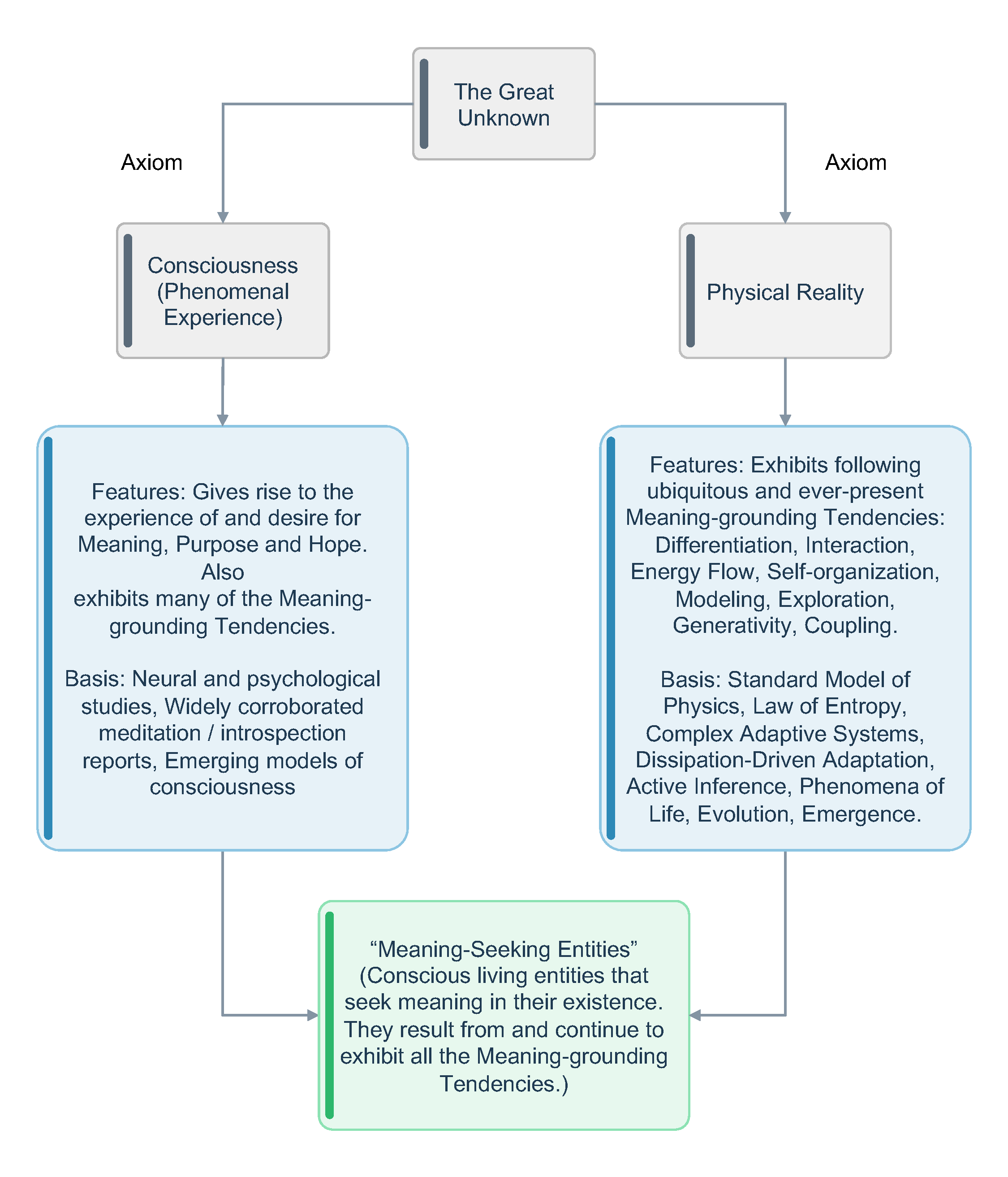
We are all Meaning-Seeking Entities
This diagram depicts how Meaning-Seeking Entities evolve out of the foundation we have built so far.
The upper part should be familiar from the chapter on Ultimate Reality: the three axioms, The Great Unknown, Physical Reality and Consciousness. On the Physical Reality side, the evidence for the Meaning-grounding Tendencies shows up in its regular patterns and in the phenomena of quantum wave function collapse, self-organization, Dissipation-Driven Adaptation, Active Inference, evolution and emergence. On the Consciousness side, we see the features relevant to our framework, including the emergence of our desires for meaning, purpose and hope, which (based on widely corroborated introspection reports, and the hypothesis that desires arise from Active Inference) originate here. Consciousness, too, exhibits all the tendencies.
Further down, the Physical Reality and Consciousness arms combine to form conscious Living Entities, which is what I am calling Meaning-Seeking Entities.
Ok, so now we have a rigorous definition of meaning and a list of inherent tendencies of the universe that give rise to Meaning-Seeking Entities that also embody those tendencies. Now, if we can show how these inherent tendencies of the universe can satisfy all the requirements for meaning as defined earlier, then we would have a rigorous way for Meaning-Seeking Entities to find meaning in their lives! So let us do that.
How the Meaning-grounding Tendencies Ground Each Component of Meaning
What I want to demonstrate is that the Meaning-grounding Tendencies can satisfy all the components of Meaning we have come up with. Let us look at each of the components of meaning and see this connection.
The following table summarizes which tendencies ground each meaning component. We will then look at each in more detail.
| Meaning Component | Grounding Tendencies |
|---|---|
| Coherence — life makes sense, is comprehensible | Differentiation, Interaction, Self-Organization (Physical); Modeling, Exploration (Biological) |
| Purpose — sense of direction and future-orientation | Energy Flow (Physical); Exploration, Generativity (Biological) |
| Significance — sense of mattering and existential weight | Differentiation, Interaction (Physical); Coupling (Biological) |
A) Meaning as Having Coherence or Comprehensibility in Life:
The mere fact that the universe is full of discernible or comprehensible patterns, distinct things (Differentiation) connected into webs (Interaction) that self-organize into stable structures (Self-Organization), is strong evidence of the universe’s tendency toward coherence. Modeling and Exploration are the biological expressions of this: living systems build internal representations (Modeling) and actively seek out new patterns to enrich them (Exploration).
As we have seen, we ourselves, as Meaning-Seeking Entities, are a culmination of all the Meaning-grounding Tendencies we have mentioned, and continue to exhibit those tendencies ourselves. Our innate need for coherence in our lives is just a manifestation of this fact.
Of course, when most people talk about their desire for coherence in their lives, what they typically mean is that they want to find the coherent “thread” that goes through all of their lives. If they tried to narrate their “life story”, they would be able to say who they were, who the other main characters were, what were their interesting attributes and motivations, how they acted as a result, what events transpired, what led to what, what were the main lessons learned, and so on.
Still, smart, rigorous, skeptical people in general typically have a desire to go a little deeper. They don’t just want to know the story of their lives; they want to know the story behind the story. They want to go deeper and try to understand things from First Principles. Their desire for coherence in life goes a lot deeper and wider. For such people, becoming aware of the Meaning-grounding Tendencies and how they affect everything around them as well as within themselves, helps them achieve this deeper level of coherence, and through that, a deeper meaning in their lives.
B) Meaning as Having a Purpose in Life:
The fact that the universe relentlessly exhibits all these natural tendencies at all times and everywhere gives us ample evidence that it appears to be working towards something. In other words, it appears to have an inherent purpose.
Purpose is specifically grounded in Energy Flow since it is the directional flow that gives the universe its arrow of time. It is also expressed through Exploration (living systems actively seeking out what is next) and Generativity (actively bringing new things into being). Together, these tendencies describe a universe that is not static but relentlessly forward-moving and apparently goal-directed.
Some people may object to this and say that I am anthropomorphizing the universe, associating human qualities like purpose with it. This objection is understandable, but how else would you interpret these universal tendencies? And isn’t this a lot preferable to postulating a supernatural power (with anthropic features, I might add) who may have created everything for some unknown purpose? And even if that were true, how would this supernatural power manifest this purpose besides embedding it in the inherent tendencies of its creation?
The Meaning-grounding Tendencies provide a far firmer ground, backed by abundant evidence. It is these tendencies that have created everything around us and brought us to where we are and will carry us forward as far as we can predict. Moreover, if we simply realize the existence of these tendencies and align ourselves with them, then we can say that we have the same purpose as the universe. There is no “greater purpose” than that!
C) Meaning as Existential Mattering or Significance:
What can be more existentially mattering or significant than aligning oneself with the ubiquitous and ever-present natural tendencies that appear to be embedded in the structure and laws of the universe?
Significance is grounded most directly in Differentiation (in order for something to matter, it has to exist as something distinct first), Interaction (the fact that those things form webs of relationship that depend on each other), and Coupling (the specifically biological tendency for conscious beings to recognize each other as mattering and to choose to bind).
We all have a need to belong to something greater than ourselves, that has a high probability of existing far beyond our comparatively minuscule lifetimes. Well, looks like we have found it: It is the universe itself, along with all these tendencies it has and has already imbued us with.
In conclusion, the Meaning-grounding Tendencies are inherently capable of satisfying all 3 components of meaning, and thus of providing meaning to the lives of all Meaning-Seeking Entities, including ourselves.
Meaning Orientations
Knowing the tendencies in the abstract is one thing. But how do we actually live them? The tendencies are cosmic-scale abstractions. It is genuinely awkward to ask, first thing in the morning, “does my to-do list align with the Energy Flow tendency of the universe?” So we need something more down-to-earth and human-scale, a set of stances we can actually adopt in daily life that let the tendencies express themselves through us.
We call these stances Meaning Orientations. They are characteristic stances, or ways of engaging with the world, through which we can most naturally embody the Meaning-grounding Tendencies. Think of the Tendencies as the cosmic justification and the Orientations as the everyday stances: when you cultivate an Orientation, you are aligning your life with a Tendency, but in a form you can actually recognize and act on from moment to moment.
We have eight Meaning Orientations, as shown in the table below. Before the table, a word about how the two lists line up, because it is exactly the kind of thing a careful reader will wonder about. Each Orientation is derived from one or more Tendencies, and the correspondence is close to one-to-one, though not exactly. Six of the Orientations track a single Tendency each. Connection gathers up two of them, Interaction and Coupling, because those are the same impulse seen at two levels: things binding to things, and beings binding to beings. And Humility is the reflexive one. It comes from Modeling and Exploration turned back on themselves, from knowing that a model is only ever a model and that there is always more territory left to explore, and it is reinforced by our methodology itself, by Present-Bounded Rationality’s frank acknowledgment of nebulosity and the unknown and of the need to keep iterating.
| Orientation | What it looks like | Grounded in |
|---|---|---|
| Authenticity | Becoming and expressing your distinct self | Differentiation |
| Sense-making | Making sense of your world, and of yourself | Modeling |
| Curiosity | An open, interested stance toward experience | Exploration |
| Equanimity | Nonjudgmental engagement with flow and change | Energy Flow |
| Stewardship | Tending the systems that keep you going | Self-Organization |
| Connection | Consciously bonding with others | Interaction + Coupling |
| Creativity | Bringing something new into being | Generativity |
| Humility | Accepting the limits of our knowledge and agency | Modeling + Exploration, and our methodology itself |
Let us walk through each one, since a single table row hardly does them justice.
Authenticity is becoming and expressing your distinct self. The universe has been breaking symmetry since its first moments: no two particles’ histories, and no two lives, are interchangeable. You are one of its unrepeatable configurations. Authenticity is aligning how you live with what you distinctly are, acting from your own shape rather than from a borrowed template. The gap between who you are and how you live is misalignment at its most personal, and its friction is felt as a life that doesn’t quite fit.
Sense-making is making sense of your world, and of yourself. Every living system persists by modeling its world, and minds flourish under the same principle. Sense-making is doing this deliberately: paying attention to reality as well as to your own thoughts, feelings and reactions, and working toward consistency between what you believe, what you value, and how you act. Its payoff is the first ingredient of meaning, a life that makes sense to the one living it.
Curiosity is an open, interested stance toward experience. Exploration is built into the architecture of life; living systems actively probe the world to improve their models. Curiosity is the psychological face of that drive. It is what keeps our mental models from ossifying and our lives from narrowing.
Equanimity is nonjudgmental engagement with flow and change. Everything passes, and energy and form move through us and on. Equanimity is perceiving and acting fully while holding outcomes loosely: engaged but not grasping, steady while everything changes. It is grounded in Energy Flow, which, as we saw, we experience at the human scale precisely as impermanence.
Stewardship is tending the systems that keep you going. Order in the universe is never free-standing; it must be actively maintained against the pull of entropy. Living systems go further, extending and evolving their order over time. Stewardship is your participation in that work: sustaining, defending and growing the systems your life depends on, your body, your habits, your relationships, your work, and the larger living systems you belong to. It is tending in the gardener’s full sense: watering, weeding, and pruning toward something better.
Connection is consciously bonding with others. Bonding runs through everything: atoms forming molecules, cells joining organisms, people building relationships and communities. Connection is where you take up that tendency deliberately, recognizing the web you are already part of and choosing to strengthen your strands of it. It is the deepest source of belonging and love in human life, and of all the Orientations, it is the one people most often name when they describe what makes their lives meaningful.
Creativity is bringing something new into being. Another name for the universe is Creation. It is generative at every scale, and self-aware creativity, whether art, craft, engineering, or any other new thing made on purpose, is how we participate in that grand process rather than merely watch it.
Humility is accepting the limits of our knowledge and agency. The universe is more complex, more nebulous and more vast than any model of it, including this one. Humility is the orientation that lets us be honest about our models’ limits while still using them as tools for navigating life. It is the antidote to arrogance, cynicism and dogmatism, and it is the reason this whole framework ends in iterate rather than conclude.
One more note before we move on, because it connects this list back to something we developed in the chapter on Life. You may have wondered where mindfulness went. It is not a ninth orientation. It is the practice that three of these rest on at once, which is precisely why it turns out to be so central.
Its attentional half feeds Sense-making, since you cannot make sense of anything you have not actually noticed. That same sustained attention, turned inward on your own reactions, is how Authenticity gets discovered, because your distinct nature is not something you can reason your way to from the outside; you have to watch it operate, repeatedly, over time. And the nonjudgmental half of mindfulness, observing what arises without grasping at it or pushing it away, simply is Equanimity in practice. Attention, self-knowledge and non-grasping are three faces of the same discipline, which is why we will give mindfulness a practice of its own in the final chapter.
We will return to these Orientations in the chapter on Call to Action, where we will build our daily practices directly around them.
We will now formalize this discussion with a diagram showing our definition of Meaning in Life.
Defining “Meaning in Life” Using the MSE Framework
The following picture depicts what we have described so far.
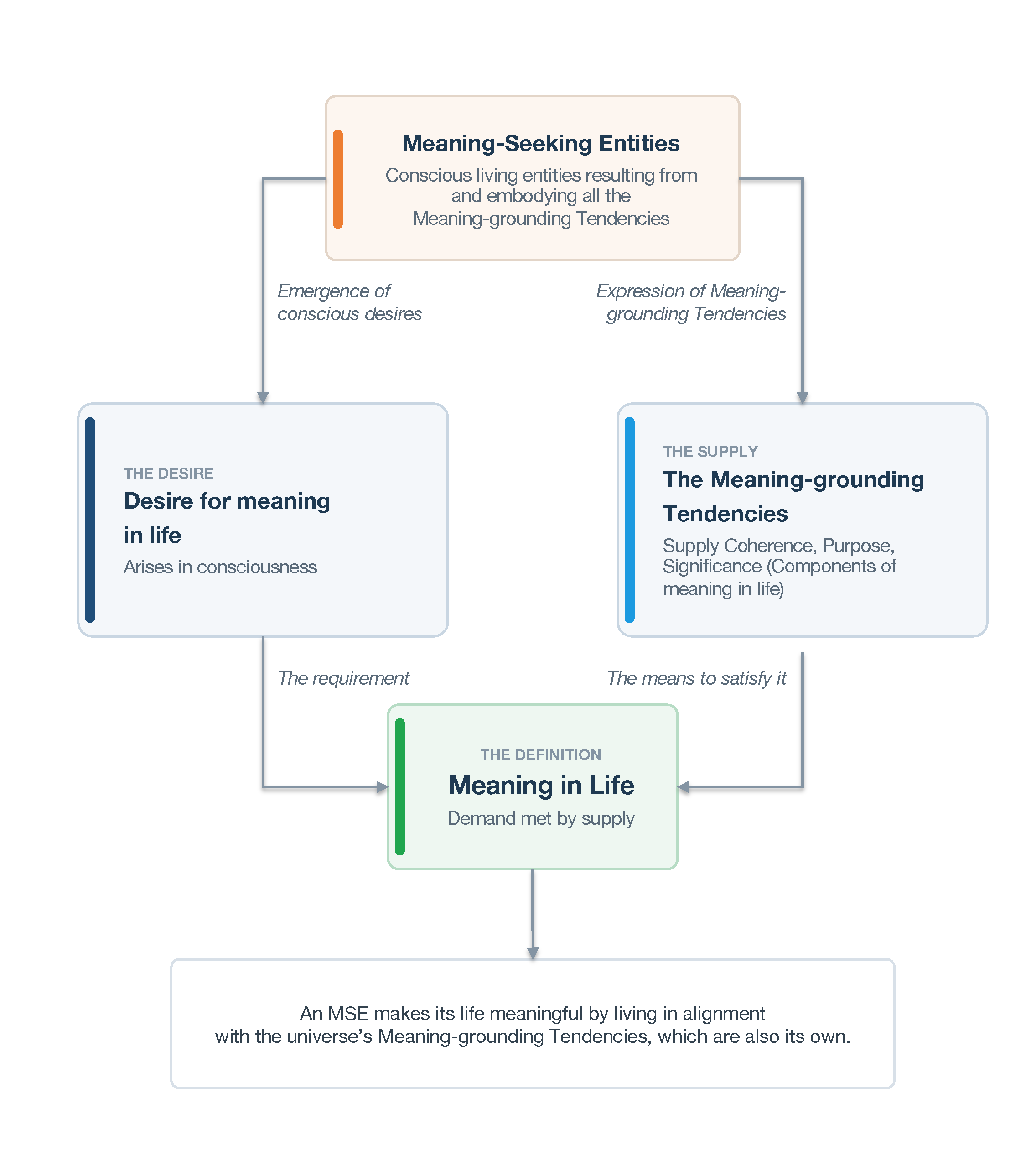
Obtaining Meaning in Life from evidence and reason alone
In the above diagram, we start with Meaning-Seeking Entities at the top. The left arrow represents their desire for meaning; the right arrow shows them exhibiting the Meaning-grounding Tendencies that give rise to them. So we now have both sides of the equation: a desire, and a way to satisfy it. All that remains is to connect them by defining “Meaning in Life” accordingly. We have the complete picture, at least in theory.
Unfortunately, theories often have problems when they have to survive in the real world. We can’t just leave things at the theoretical level. We have to see if any problems arise when we try to convert theory into practice. So let us do that.
Practical Considerations and Solutions
A) Misaligned Desires
We saw earlier in our discussion of Active Inference, that our internal generative model is generating all kinds of counterfactuals for us to seek evidence of. But note that not all of these may always be aligned with our Meaning-grounding Tendencies. In fact, very often they will not be. Some may be downright contradictory to the tendencies.
In other words, Meaning-Seeking Entities may be getting pulled in various directions by various desires emerging out of their Consciousness. (The proverbial “angel and devil sitting on our shoulders”.) So how do we ensure our continued alignment with the Meaning-grounding Tendencies?
As we had already seen in the chapter on Life, the way for a complex Living Entity to become better at executing the fundamental process of life, Active Inference, is for the Living Entity to become 1) more mindful, and 2) to select a set of values to evaluate and prioritize counterfactual scenarios i.e. desires.
Now, mindfulness is already well-understood. Mindfulness not only increases our sensitivity and attention to our perceptions, it also improves our ability to generate counterfactuals (i.e. desires) deliberately and realistically, and act on them as effectively as we can.
But what set of values would work for us to evaluate these counterfactual scenarios generated by our internal generative model?
The astute reader has probably already guessed where I am going. Yes, of course, the Meaning-grounding Tendencies of the universe, which we have established firmly, can absolutely serve as such a set of values! And the Meaning Orientations we identified earlier provide a practical, human-scale expression of those values. In other words, the way for a Meaning-Seeking Entity to become better at living a meaningful life is to mindfully align itself with the Meaning-grounding Tendencies — and cultivate the Meaning Orientations as the lived expression of that alignment.
B) Nebulosity and Unknowns
Another complication that arises is due to ever-present nebulosity and unknowns which, as we have noted earlier, are also inherent features of the universe. The existence of these factors implies that we can never be too confident or rigid about our theories, even when they are derived rigorously from First Principles. We need to remain somewhat flexible and allow for a process of constant learning and refinement.
The good thing is, as a result of us being followers of the Present-Bounded Rationality methodology, constant learning and refinement is our middle name! Our methodology requires us to always behave accordingly. The Humility orientation makes this explicit.
So, with the addition of those considerations, we finally have a resolution of all the issues and can proceed with a rigorous definition of Meaning that we have been aiming for right from the beginning of the book.
Definition of “Meaning in Life” based on the MSE Framework:
Meaning-Seeking Entities, as defined in the MSE Framework, can make their lives meaningful by mindfully living in alignment with the universe’s Meaning-grounding Tendencies: the Physical Tendencies of Differentiation, Interaction, Energy Flow, and Self-Organization, and the Biological Tendencies of Modeling, Exploration, Generativity, and Coupling.
Given that it was these tendencies themselves that ultimately gave rise to the Meaning-Seeking Entities, they already inherently embody those tendencies. Thus, all they have to do is to become aware of these tendencies they already have and allow them to be expressed through them, most naturally through the eight Meaning Orientations: Authenticity, Sense-making, Curiosity, Equanimity, Stewardship, Connection, Creativity, and Humility.
Adherence to these principles provides all the ingredients to find meaning in their lives, namely, having coherence or comprehensibility, a sense of purpose, and a sense of existential mattering or significance in their lives.
Notice that this may sound somewhat similar to the advice we typically hear from various religious doctrines or philosophies. But what is different, and significant here is that now we have a rigorous definition that we have derived from First Principles, without requiring any leaps of faith or appeals to authority or opinion. In addition, we have practical advice on how to bring this definition into practice.
In other words, we have not just the “what” but the “why” and the “how” of finding meaning in our lives. As a result, we can defend our answer using only evidence and reason, think analytically about it, raise objections, and keep improving it. Best of all, we have a way to implement these ideas and monitor how we are doing. These aren’t sweet-sounding ideas that you forget the moment you hear them because you have no reason to trust them and no way to act on them. This is the whole point of this book.
Finally, while we are on a roll talking about religious ideas, let us take a quick look at another one.
Meaning is Built into the Universe
Note that now we can make another seemingly religious statement, but based on rigorous analysis: The universe appears to have inherent natural tendencies for creating meaning.
Moreover, since we are a result of the same tendencies, we have automatically been enrolled into this effort, whether we recognize it or not. All we have to do is realize this and mindfully align our thinking and our lives to that to make our own lives meaningful.
The meaning of my life, your life, everyone’s life, and the phenomenon of life itself are all exactly the same. It all boils down to aligning our thoughts and actions with the natural tendencies of the universe. These tendencies all point towards the struggle for the continued existence of Living Entities, to higher and higher levels of differentiation, interaction, self-organization, exploration, generativity, modeling and coupling.
This isn’t a commandment from an authority either. Neither is it just someone’s opinion nor a poetic idea with no way of realizing it. It is not a popular meme that intrigues you for a second before being forgotten. It is based on a rigorous analysis of phenomena that are ubiquitous and ever-present. There is no need to project them into the far future or work backward to some event in the distant past either. They are present right here, right now. We are simply stating known facts and using logic to reach a purely scientific / engineering conclusion.
Looking at the Stars
Allow me to finally conclude the chapter with an interesting but slightly weird quote.
“We are all in the gutter, but some of us are looking at the stars.”
- Oscar Wilde, an Irish poet and playwright, in “Lady Windermere’s Fan”
Based on everything we have seen, maybe we could modify this quote (with apologies to Oscar Wilde) as follows:
“We were never in the gutter. We were always living among the stars!”
We just had to wake up to this realization.
We have done the hard part of the work now. Things get easier from here. In the next chapter, we will look at Purpose.