Summary: The Whole Book in One Place (You’ve Earned It)
Meaning is Everywhere, if You Know How to Look
“Concern for man and his fate must always form the chief interest of all technical endeavors. Never forget this in the midst of your diagrams and equations.”
― Albert Einstein, Quoted in “Machine, Platform, Crowd: Harnessing our Digital Future” by Andrew McAfee and Erik Brynjolfsson
“The real voyage of discovery consists not in seeking new landscapes, but in having new eyes.”
― Marcel Proust, French writer
“Science is not only compatible with spirituality; it is a profound source of spirituality.”
― Carl Sagan
Now that we have walked the whole path together, let us put the entire book in one place: first as a picture, then as a short message, and finally as a detailed summary you can use for reference. So let us start with a diagram that captures how we have gone about deriving meaning, purpose and hope based on evidence and reason alone, starting from First Principles.
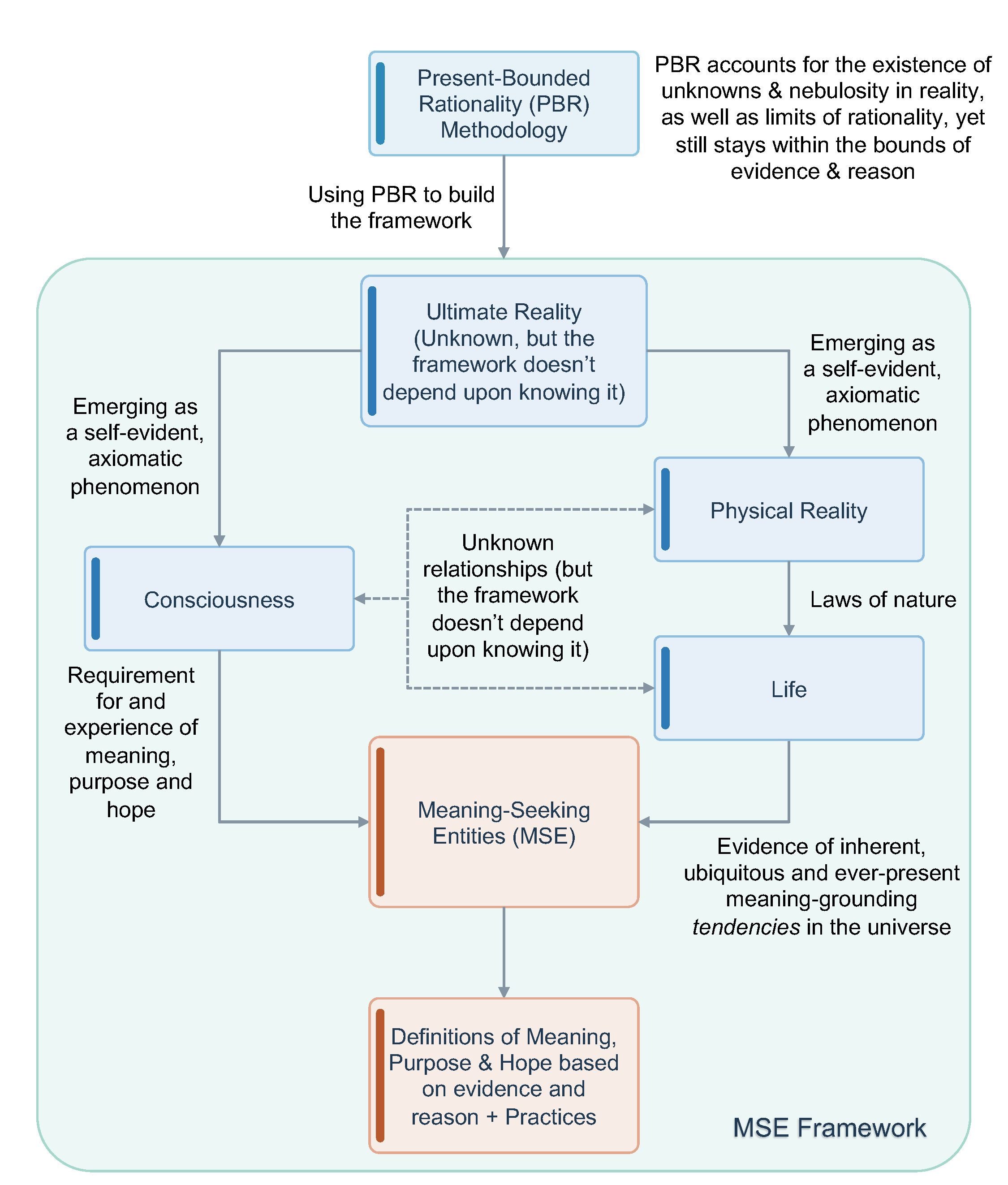
The whole book in one diagram
Let us walk through the diagram from the top.
First, we defined our methodology, which we call Present-Bounded Rationality (PBR). It is based entirely on evidence and reason, avoiding taking any leaps of faith or accepting any sort of dogma, no matter how respectable their source may be. And yes, the PBR methodology acknowledges that we don’t know everything and there is still a lot of nebulosity even in the things we do know. The methodology also acknowledges and accounts for the fact that there are well-known limits to rationality. The beauty of the framework is that we can still come up with solid definitions of meaning, purpose and hope based on this methodology. We call the framework the Meaning-Seeking Entities (MSE) Framework.
The framework starts with a discussion of our Ultimate Reality (or the Great Unknown, since it really is unknown and the framework doesn’t pretend to know it or depend upon knowing it). Emerging from it are Physical Reality on one side, and Consciousness on the other. These are the two major foundations of the framework, treated as equals since they are both self-evident and we don’t honestly know whether or how one emerges from the other. We further showed the phenomenon of Life emerging out of Physical Reality.
Based on all of the above, we showed that we have incontrovertible evidence that the universe appears to exhibit certain ubiquitous and ever-present “tendencies”, which we call the Meaning-grounding Tendencies (the Physical Tendencies of Differentiation, Interaction, Energy Flow and Self-Organization, and the Biological Tendencies of Modeling, Exploration, Generativity and Coupling). We defined these tendencies and also defined what we mean by Meaning-Seeking Entities (MSE) that naturally emerge from these tendencies.
We then stated the scientific definition of meaning in life and suggested where our desire for it may be emerging from. We also introduced the eight Meaning Orientations (Authenticity, Sense-making, Curiosity, Equanimity, Stewardship, Connection, Creativity and Humility), each derived from one or more tendencies or the framework itself. They are the practical, human-scale face of the tendencies, the stances through which we can live them day to day.
Finally, all of this structure allowed us to come up with rigorous definitions for how we can achieve meaning, purpose and hope in our lives, based on evidence and reason alone. And, once again, being an engineer myself, I did not leave you with just some abstract definitions. I defined four practices that anyone can follow on a regular basis to benefit from these ideas in their own lives.
The diagram above captures the highl level structure of the framework. The one below contains more details: the major concepts we developed and how they relate to each other, organized into the five layers we traveled through, along with the chapters where each layer is developed.
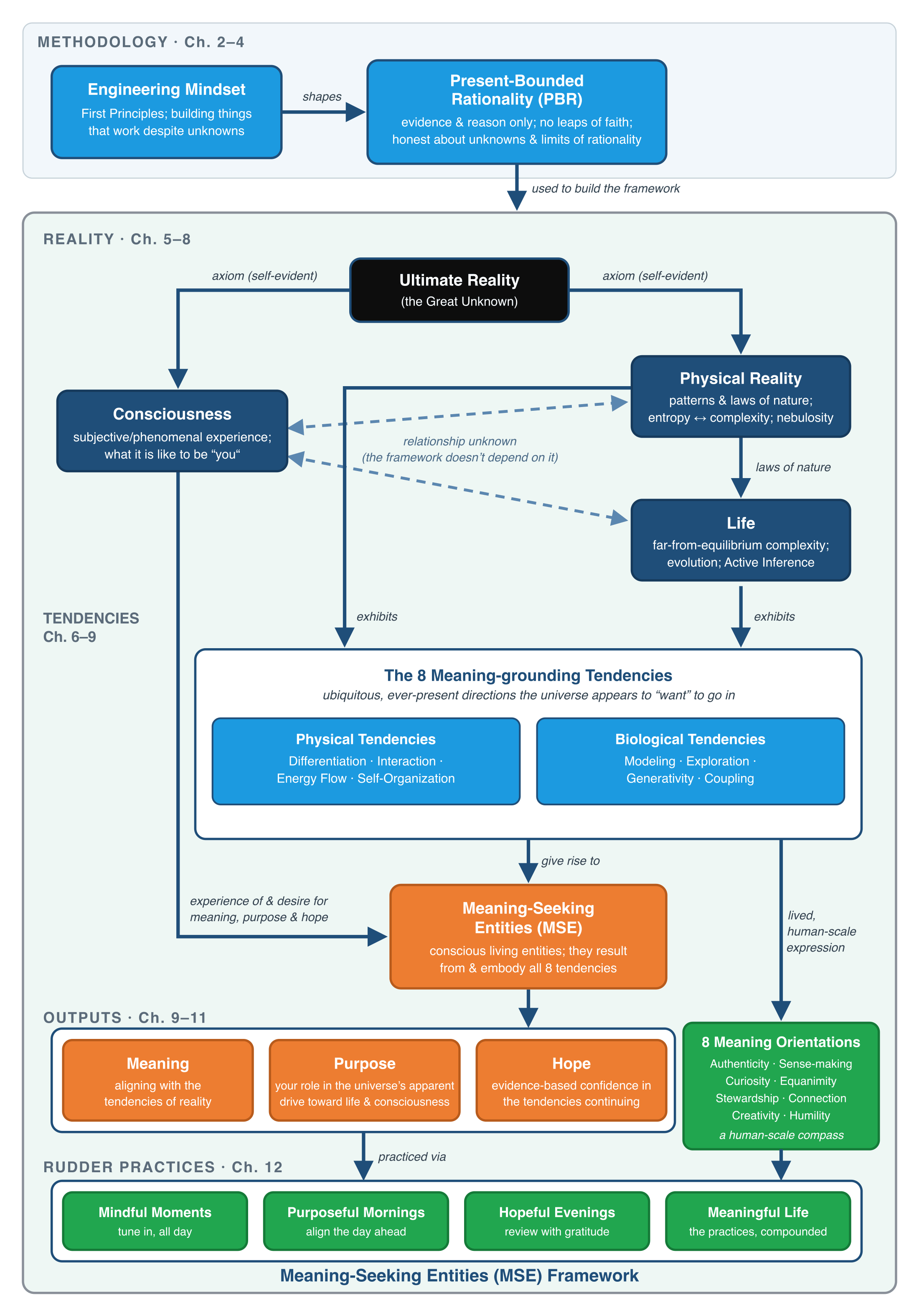
All the major concepts of the book and how they relate to each other
The book’s core message can be stated as follows:
Quick Summary of “An Engineer’s Search for Meaning”:
It can be shown, through rigorous analysis of an abundance of evidence, that it is possible to make our lives meaningful, purposeful and hopeful by following these steps:
- The universe as a whole (including ourselves) exhibits certain innate and ubiquitous tendencies, known as the Meaning-grounding Tendencies (Physical: Differentiation, Interaction, Energy Flow, Self-Organization; Biological: Modeling, Exploration, Generativity, Coupling)
- Followed to completion in an environment like ours, these tendencies compound into the creation, expansion and enrichment of life and consciousness. So we can interpret this as the universe, including ourselves, being innately directed towards that outcome
- Human beings can and do fall out of step with these tendencies, so we need to periodically check and realign ourselves to them
- The four Rudder practices outlined in the book are a good way to tune into these tendencies and to discover what affordances they are making available for us to move forward towards the aforementioned goals
- Backing up to a higher level, we can thus confidently state that evidence and reason, applied honestly and diligently, can be our most reliable guides in life. Yet, this analysis also tells us that it is important to always remain humble and willing to learn because all approaches to understanding reality have limitations
Here is the same method as a simple four-step recipe:
Discover the universe’s inherent tendencies, by thoroughly examining an abundance of evidence and applying reasoning to it.
Realize that you have those tendencies too, but that you have drifted from them, and that this misalignment is the main source of friction, dissonance, and loss of meaning in your life.
Realign yourself with them, using the Meaning Orientations and the four Rudder Practices.
Iterate, with humility. As we learn more, our understanding of the tendencies, orientations, and practices will continue to improve.
Bonus: The reduction in friction may leave you with a surplus of time, energy, and slack. You can spend a little of it on the misaligned desires you will still have (and you will still have them). Always in moderation, though.
In the pages behind us, we developed every one of these claims in a stepwise and rigorous manner. What follows is that same argument laid out in full, for those who like to have it all in one place.
Detailed Summary of the Book
The book develops a framework for finding meaning, purpose and hope in life based only on science and engineering principles, or evidence and reason. No leaps of faith or acceptance of some dogma are necessary.
This framework is called the Meaning-Seeking Entities (MSE) Framework.
Meaning-Seeking Entities can be loosely defined as conscious living entities, such as ourselves, that have an innate desire to seek meaning, purpose and hope in their lives. (A more formal definition is included further down.)
The MSE Framework is a First-Principles-based framework built upon the foundation of evidence and reason alone. It relies on rigorous explanations of reality that scientists and engineers have put together over the millennia, using methods such as Bayesian Inference and the Scientific Method.
Unfortunately, this sort of rational analysis has limits, due to the existence of complexity, nebulosity and unknowns in reality, as well as our relatively limited cognitive abilities. This has long been used as an excuse to declare meaning, purpose and hope beyond the reach of science or rationality, and to fill the gap with ideas based on faith or magic or dogma instead.
A far better way is to address these limits head-on, and so the framework uses a modified version of rationality as its methodology, which it calls Present-Bounded Rationality (PBR). This methodology is characterized by concepts from Bounded Rationality as well as the practice of grounding oneself in the present moment and location, also known as Mindfulness. Present-Bounded Rationality includes ideas such as Satisficing, Heuristics, Present-moment focus, Grounding in reality (rather than abstractions) and Non-judgmental observation, in addition to Thinking from First Principles, Bayesian Inferencing and Scientific Method mentioned earlier. Another important pillar of this methodology is always remaining humble and open to learning, thus avoiding the pitfalls caused by hubris and overreach that are typically associated with many other such frameworks. Doing so ensures that we don’t get carried away by the zealous pursuit of abstractions and purity, and trying to fit reality to them instead of the other way round.
When we practice Present-Bounded Rationality to solve real-world problems or build things in the real world, we call it Mindful Engineering.
To build the framework, we start with the axiom that we live in something like an Ultimate Reality whose essence is unknown to us because we do not have direct contact with it. We can only experience it through our senses, as Physical Reality, or via introspection, as Consciousness. Since both of them are fundamental and self-evident to us, we take them as axioms too. We do not privilege either Physical Reality or Consciousness as more fundamental because we do not have any evidence to prove that. (If, at some point, we are able to prove how one emerges from the other, we can easily modify this part of our framework accordingly and the rest of the framework can remain unchanged.)
Using the scientific method and various engineering practices, humanity has managed to discover and explain foundational natural phenomena such as:
- Quantum Fields and Wave Function Collapse,
- The Standard Model of Physics,
- Self-organization and Complex Adaptive Systems,
- Dissipation-Driven Adaptation,
- The Free Energy Principle and Active Inference,
- Evolution and
- Emergence.
Analysis of these phenomena leads us to conclude that the universe exhibits the following 8 inherent, ubiquitous and omnipresent tendencies, organized in two groups:
Physical Meaning-grounding Tendencies:
- Differentiation,
- Interaction,
- Energy Flow (Dissipation), and
- Self-Organization.
Biological Meaning-grounding Tendencies:
- Modeling,
- Exploration,
- Generativity, and
- Coupling.
We call these the Meaning-grounding Tendencies, the universe’s apparent innate drives that, taken together, can become a sound foundation for all meaning, purpose, and hope.
Note that these tendencies do not work against the law of Entropy; rather, Energy Flow is the flow of entropy, and Self-Organization channels that very flow into pockets of order and complexity. Far from being its enemy, the tendencies harness entropy to build everything interesting in the universe. In fact, we are beginning to see scientists propose a formal “law of nature” that would formalize how order keeps arising even as overall entropy increases.
With that background, we can formally define Meaning-Seeking Entities as complex living entities that are
- A result of all the Meaning-grounding Tendencies mentioned earlier,
- Exhibit the tendencies themselves,
- Have the desire for Meaning, Purpose, and hope in their lives, and
- Can experience them, too.
All MSE’s possess some level of consciousness appropriate to their level of complexity. Based on widely corroborated reports of introspection, the MSE Framework shows that the desire for meaning, purpose and hope ultimately arises in this consciousness.
We can postulate that this may be a result of consciousness itself trying to perform Active Inference, creating counterfactuals and then motivating us to go seek evidence for them. (Note that Active Inference is substrate-independent.) We can further postulate that this is because consciousness is really a new “virtual” life form that arises in complex living organisms.
The current thinking among psychologists is that the concept of Meaning in Life has 3 components. These include having a sense of:
- Coherence or Comprehensibility,
- Purpose, and
- Existential Mattering or Significance.
Using the MSE Framework, we can show that MSE’s can attain all of these by aligning themselves with their inherent Meaning-grounding Tendencies at all times and places. Thus, the MSE Framework defines that Meaning in life can be achieved by mindfully living in alignment with the Meaning-grounding Tendencies.
Because the tendencies operate at a cosmic scale that is awkward to apply directly in daily life, we also derive eight Meaning Orientations from them as their practical, human-scale expression: Authenticity (from Differentiation), Sense-making (from Modeling), Curiosity (from Exploration), Equanimity (from Energy Flow), Stewardship (from Self-Organization), Connection (from Interaction and Coupling), Creativity (from Generativity), and Humility (from Modeling and Exploration turned back on themselves, reinforced by our methodology’s honesty about nebulosity). These are the everyday stances through which we actually live out the tendencies, and they serve as our daily compass.
Given that these inherent tendencies of the universe continuously give rise to coherence and complexity in the universe, some of which self-organizes itself into self-sustaining and (sometimes) conscious, creative and curious organisms that evolve and diversify, we can conclude that that is at least one of the purposes of the universe. And since we are Meaning-Seeking Entities ourselves that are a result of the same tendencies and continue to exhibit them ourselves, our greater purpose is the same.
Thus, our greater purpose is to continue our own existence while facilitating the creation and maintenance of other self-organizing and self-sustaining complex entities, modeling the world ever more richly, exploring new patterns, generating new possibilities, and consciously coupling with others and the environment in relationships and communities that create shared meaning. Note that the complex entities mentioned here refer not just to individual living organisms but also other entities that exhibit similar tendencies, such as organized groups or institutions of living organisms, coherent and dynamic bodies of thought, and even artificial organisms.
Doing so also provides Hope because the Meaning-grounding Tendencies have an incredible track record of surviving and even thriving in spite of a very long series of extreme upheavals that have occurred in the history of the universe, right from its birth. This unbroken track record gives us tremendous confidence that these tendencies will continue to exist and be in effect far into the future. Thus, if we define hope as a reasonable expectation of a more meaningful future, then it is easy to see that this can be accomplished by mindfully aligning ourselves with the Meaning-grounding Tendencies.
Since we are Meaning-Seeking Entities ourselves, we can’t help but exhibit the Meaning-grounding Tendencies ourselves. Unfortunately, our consciousness, as a result of it performing Active Inference on its own, generates many counterfactual scenarios i.e. desires that aren’t aligned with these tendencies. Due to this misalignment, our efforts to try to satisfy these desires lead to frustration. This is where the realization and mindful alignment with the Meaning-grounding Tendencies becomes critical.
To summarize, the MSE Framework shows that all MSE’s, such as ourselves (as well as any organized groups we belong to) can find meaning, purpose and hope by mindfully realizing, acting on and enhancing their Meaning-grounding Tendencies.
The PBR methodology also requires that we always keep in mind that reality contains a lot of complexity, nebulosity and many unknowns. As a result, these guidelines themselves are subject to moderation and should always remain amenable to revision as we learn more.
Many of the ideas mentioned here can be seen in various religions and philosophies also. So, one can say that the MSE Framework is not particularly against religious or philosophical ideas. But there are some critical differences:
- We have a far crisper definition of these ideas,
- A far stronger basis for explaining them from First Principles,
- A far better chance of developing strategies for accomplishing them,
- Far better prospects of improving upon these ideas as we learn more,
- Anyone can understand and verify these ideas themselves without taking anyone else’s word for it, and
- Given that they are based on the universal language of evidence and reason, there is a higher probability that they can be adopted by people with completely different backgrounds.
In order to define some practices based on the framework, we rely on ancient practices of Mindfulness and Stoicism.
In fact, it can be shown that the practice of Mindfulness is a logical outcome of MSE’s trying to improve their Active Inference process. Improving the process entails improving perception, the internal model and effectiveness of actions in the world, which is exactly what Mindfulness also involves. Mindfulness can actually be shown to align perfectly with three of the Meaning Orientations we identified: its attentional half feeds Sense-making, that same attention turned inward is how Authenticity is discovered, and its nonjudgmental half is Equanimity in practice.
We can also rely on the Stoic practice of morning and evening journaling, but modify it to incorporate alignment with the Meaning Orientations as the main criterion.
Using these ideas leads us to define four simple practices based on the MSE Framework, which we collectively call the Rudder Practices (small, regular course corrections that keep us aligned with the tendencies):
- Mindful Moments,
- Purposeful Mornings,
- Hopeful Evenings, and
- Meaningful Life
Moreover, specifically for engineers, the book recommends taking pride in their vocation since it appears to be the essence of life. But to do so, one has to practice Mindful Engineering, ensure that it is aligned with the expansion and enrichment of life and consciousness, and refrain from hubris.
And with that, we have finally achieved what we have been aiming for since the beginning of this book: A way to find meaning, purpose and hope in life, based only on evidence and reason, or scientific and engineering principles.
Whew!
This has been quite a journey, starting from scratch to reaching our goal. Taking the “path less traveled” has certainly meant challenging some long-held notions, opening my mind to new ideas and painstakingly working through various scientific results.
As a result, I wouldn’t be surprised if what I have presented here has raised many questions and doubts in your mind. Allow me to address them next.